



As the first fighter jet to enter operational service with the Royal Air Force (RAF), the Gloster Meteor played a pivotal role in helping British engineers develop more advanced and capable fighters. The aircraft was the only jet-powered fighter to enter service with the Allies during the Second World War but saw relatively limited combat due to its many initial limitations.
The jet boasted simplicity in its aerodynamics, making it effective as a combat fighter after years of innovation and the introduction of more advanced turbojet engines. It set a number of different aviation records and, despite barely seeing combat during World War II, was extensively used throughout the Korean War and other Cold War-era proxy wars.
The aircraft pioneered jet technology, forever changing the Royal Air Force by demonstrating that the future of air-to-air combat would undeniably involve advanced jet-powered fighters. In this article, we will examine the development and operational history of the Gloster Meteor, the first fighter jet produced by the United Kingdom.
Origins
The story of the Gloster Meteor begins with a collaboration between the Gloster Aircraft Company and engine manufacturer Power Jets Ltd. The latter firm was founded by Frank Whittle, an esteemed British aerospace engineer with a radical vision to transform propulsion technology.
Whittle had long attempted to secure funding for the development of a radical new jet fighter but had never found anyone willing to gamble on his vision. By 1937, however, Whittle had gained the support of the Air Ministry as well as Sir Henry Tizard. By 1939, engineers at the Gloster Aircraft Company were beginning to see the potential of his ideas. Eventually, George Carter, the chief design engineer at Gloster, proposed a collaboration between the two companies.
While the two firms initially faced internal challenges in garnering interest in the project, the Air Ministry eventually signed a contract with Gloster in late 1939 to build a jet aircraft prototype, which resulted in the creation of the Gloster E28/39 prototype. When the plane made its first test flight in May 1941, a jet-powered fighter aircraft moved from an unproven concept to a plausible reality that could help the Royal Air Force gain an edge in the Second World War, according to The National Interest.
Shortly after, with RAF backing, Gloster began to develop a production fighter that would initially feature twin engines because of the limited thrust offered by early jets. After receiving a new RAF directive issued in 1941, the company focused all of its attention on the development of the Meteor, forgoing dozens of other projects.
Development
During the earlier phases of development, the Meteor was initially known as the Thunderbolt, and the project was completed under maximum secrecy with the codename Rampage. Later, the plane’s name would be changed to the Meteor, likely to avoid confusion with the Republic P-47 Thunderbolt, a popular American single-engine fighter.
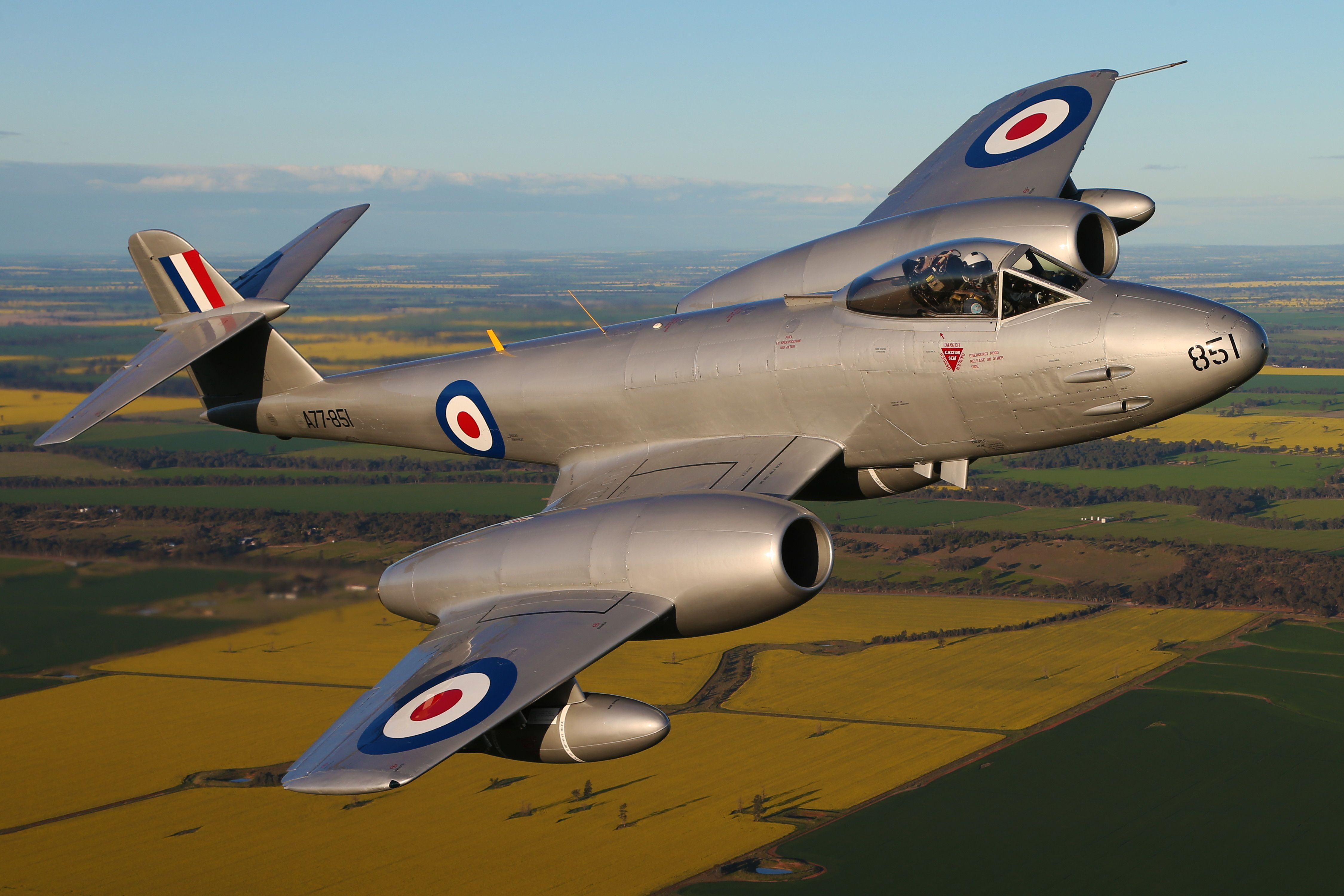
Photo: Royal Australian Air Force
Initially, development slugged forward because of repeated production delays with the plane’s engines caused by issues at several subcontractors. Eventually, the plane was fitted with de Havilland-built jet engines and first took to the skies on 5 March 1943.
By January 1944, the Royal Air Force had grown impressed with the Meteor’s development process and placed an extensive order for 100 jets. Soon, the production-variant prototype, the Meteor F.1, took to the skies later that month and entered service by July of that year. According to BAE Systems, the most produced variant of the fighter, the Meteor F.8, offered the following performance specifications:
| Category: | Meteor F.8 Specification: |
|---|---|
| Powerplant: | 2 Rolls-Royce Derwent 8 turbojet engines rated at 3,500 pounds of thrust each |
| Wingspan: | 37 feet 2 inches |
| Maximum Takeoff Weight (MTOW): | 15,700 pounds |
| Maximum speed: | 598 miles per hour |
| Maximum range: | 600 miles |
Operational history
The Gloster Meteor served briefly during World War II, but not in the air superiority capacity that one would have expected from an earlier jet fighter. The German Luftwaffe put multiple fighters into service, including the Me-262, Me-163, and then later the He-162, all of which were more powerful and heavily armed than the British Meteor.
While Germany’s early fighter jets saw one-on-one aerial combat against Allied bombers and fighters, the Gloster Meteor primarily served an alternative purpose during its brief period of World War II service. The aircraft proved valuable, however, in shooting down German V-1 flying bombs, among the earliest cruise missiles to enter the skies.
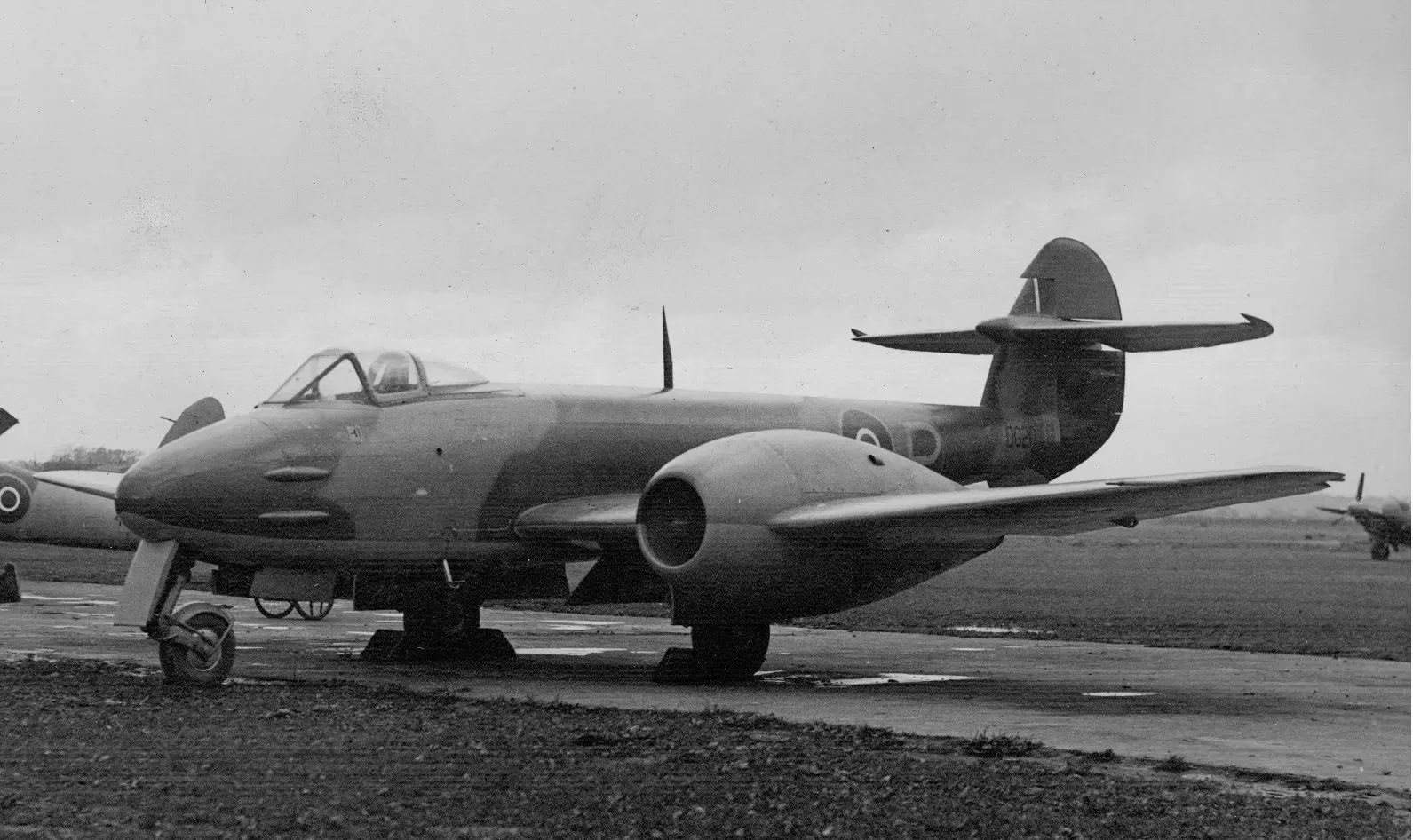
Photo: BAE Systems
With its jet engines, the Meteor could identify and take down these weapons before they reached their destined targets, but as a result, the jet spent very little time in dogfights. Later variants of the Meteor, which entered service, had alternative roles, including serving as night fighters or aerial reconnaissance. Following the war, the aircraft saw action in a number of conflicts and was operated by all the following Air Forces:
- Argentine Air Force
- Royal Australian Air Force
- Belgian Air Force
- Biafran Air Force
- Brazilian Air Force
- Royal Canadian Air Force
- Royal Danish Air Force
- Ecuadorian Air Force
- Royal Egyptian Air Force
- French Air Force
- Israeli Air Force
- Royal Netherlands Air Force
- Royal New Zealand Air Force
- South African Air Force
- Syrian Air Force
Nearly 4,000 Meteor jets rolled off of Gloster’s assembly lines during a twelve-year production run from 1943 to 1955. While most Meteors were retired by the late 1970s, two remain operational today as testbeds for ejector seat prototypes, according to Key.Aero.