



The topic of our article is about one of the variants of the armored vehicle most manufactured by the Germans in WWII. Let’s talk about the powerful 10,5 cm Sturmhaubitze 42 (StuH 42) Ausf. G – Sd.Kfz 142/2, the “heaviest” version of the Surmgeschütz III.
History
The Sturmgeschütz (StuG) III was a formidable weapon, practically revolutionizing tactical concepts on the battlefield. Its main function was to provide self-propelled fire support to infantry, but as its anti-tank capabilities were increasingly exploited, its primary role of fire support to infantry began to be relegated to the background, opening up a dangerous gap. in the doctrine of Blitzkrieg.
 |
|
Sturmgeschutz (StuG) III Ausf. G early
Sturmgeschutz-Abteilung Großdeutschland
Kurk – Russia, July 1943.
box art Das Werke 1/16 kit (#DW 16001)
|
And this became even more evident after the middle of 1942, with the installation of the 75mm long-barreled cannons, prioritizing the vehicle’s anti-tank function. The infantry was left practically without the support of self-propelled artillery.
 |
|
Infantry taking a ride on a StuG III Ausf. G
armed with powerful 7.5 cm StuK 40 L/48 gun
Russian Front – Summer, 1943
|
To address this gap, the Ordnance Department signed a contract with the Altmärkische Kettenwerk GmbH (Alkett) for the development of a support self-propelled gun armed with a 10,5 cm howitzer. In March 1942, Alkett installed a 10.5 cm le.FH 18 (leichte Feldhaubitze) howitzer on a Sturmgeschutz Ausf. F chassis, on an experimental basis. Twelve le.FH.18 for assembly at Sturmgeschutz were scheduled to be completed from December 1941 to February 1942, of which five guns were produced by May 1942.
 |
| Surmgeschutz III Ausf. F with 10.5 cm le.FH 18 howitzer. The 10,5 cm Sturmhaubitze prototype – front left view March – 1942 |
 |
| Surmgeschutz III Ausf. F with 10.5 cm le.FH 18 howitzer. The 10,5 cm Sturmhaubitze prototype – front right view March – 1942 |
On 2 October 1942, at an ordnance demonstration with Reich Minister Albert Speer at the Neue Reichskanzlei (New Reich Chancellery) , Hitler saw a Sturmgeschutz Ausf. F equipped with a le.FH. 18 10.5 cm howitzer. The Führer was very impressed with the prototype’s unusually low profile (in height), for a self-propelled howitzer.
 |
| Hitler talking with Reich Minister Albert Speer, at a weapons demonstration. December 14, 1942. |
Hitler was informed that six vehicles were already completed, that three more should be completed by 10 October and that the last three in about four more weeks. On 13 October, Hitler declared that Sturmgeschütz equipped with the 10.5 cm le.FH would be ideal for the Russian Front and ordered that the 12 pre-production Sturmgeschütz be made immediately available for operational use.
As a result, the first nine Sturmgeschutz with 10,5 cm howitzer completed in October 1942, were sent to the East front under 3.Batterie/Sturmgeschutz-Abteilung 185 and saw action at south of Leningrad in the end of November 1942.
 |
| Prototype StuH 42 Ausf F with Winterketten tracks serving at Sturmgeschütz-Abteilung 185, in the Battle of Velikiye Luki Russian Front – December 1942. |
The other three vehicles of pre-production were not reported to have been completed until January 1943. This series of 12 pre-production vehicles were built on rebuilt Sturmgeschutz Ausf F and F/8 chassis and not on newly produced chassis.
In early December 1942, Hitler ordered that the production rate of the Sturmhaubitze 10,5 cm be increased to 24 per month. All Sturmhaubitze were completed at Alkett in Berlin. There was no specific StuH 42 production line, but these vehicles were built on the same assembly line as the Sturmgeschütz III Ausf.G, which was the model chosen as the production line.
.%20Series%20production%20of%20Sturmgesch%C3%BCtz%20III%20and%20Sturmhaubitze%2042;%20approx.%20Aug.-Sept.%201943.jpg) |
| Altmärkische Kettenwerk GmbH (Alkett) plant, in Berlin Series production of Sturmgeschütz III Ausf. G (early) and Sturmhaubitze 42 Notice that StuG and StuH are mixed on the same sssembly line approx. Aug./Sept. 1943 |
The first 10 Sturmhaubitze 42 Ausf. G series production were completed in March 1943, with a total of 204 units completed by the end of the year.
For the construction of the StuH 42 version, the 10.5 cm 42 L/28 le.FH leichte Feldhaubitze was mounted in a carriage on a robust frame in the hull of the Sturmgeschütz chassis, like in the versions armed with the 7.5 cm gun.
 |
| Soldiers operating a 10.5 cm le.FH 18 light howitzer Russian Front – 1942 |
 |
| StuG III Ausf F mit le.FH 18 haubitze prototype . Notice the robust installation of the howitzer on the vehicle chassis. |
Minimal changes were made to the chassis and superstructure of the StuG III Ausf. F for adapting the 10.5 cm howitzer. One of them was the elevation of the ceiling fan turret, to increase the efficiency of smoke extraction.
 |
| Differences between the StuG and StuH version, in the prototype. |
The large opening at the front of the vehicle’s superstructure was protected by a mantlet on to which the armoured cover for the recoil and recuperator cylinders was welded. This carriage allowed the howitzer to have a horizontal drift of 10° to each side and a vertical elevation of -6° to +20°, limiting the effective range of the howitzer to 5,400 meters.
 |
| Two StuH 42 and a SuG III Ausf.G advancing on an icy Russian plain. The second StuH has its 10.5 cm howitzer at maximum elevation, as does the StuG III, with its 7.5 cm high-velocity cannon, in the background. |
But this would not be a problem, as the vehicle’s function was to accompany the infantry’s advance. In this condition, infantry targets on the battlefield were rarely more than 2,000 meters away.
The vehicle cold store a total of 36 rounds of ammunition, distributed as follows:
26 Sprenggranaten (high-explosive projectiles) with with the projectiles separated from the propellant cartridges and 10 Hohlladungsgranate (shaped charge projectiles) with a single cartridge, for rapid fire, for anti-tank use. These could penetrate 90 to 100 mm of armored steel, within the effective range of the howitzer.
 |
| Loading ammo into a StuH 42 with Topfblende (Saukopf) mantlet. The projectiles are Sprenggranaten (HE). The propellant charges are not visible in this photo. |
 |
| 10,5 cm HE ammo |
 |
| 10,5 cm propellant charges casings |
 |
| 10,5 cm Hohlladungsgranate (shaped-charge projectiles) with attached casing for rapid fire. |
The high-explosive projectiles (Sprenggranaten) had to be loaded separately, as was usual with howitzers. This limited the rate of fire to three to five rounds per minute. Compared to the StuG III armed with its 7.5cm cannon, the StuH 42 armed with its 10.5cm gun could deliver a much greater quantity of high explosives onto the target. A 10.5 cm field howitzer grenade weighed 15.55 kg, with a 1.75 kg high explosive warhead, while a 7.5 cm Sprenggranate 40 weighed just 5.74 kg, with warhead only 700 g of high explosive.
The serial production of assault howitzers received by the Generalinspekteur der Panzertruppen (General Guderian’s office) the official designation of 10,5cm Sturmhaubitze 42 (StuH 42) (Sd.Kfz 142/2). Production models were built on the Sturmgeschütz III Ausf. G chassis. Following satisfactory reports of their successful employment on the Eastern Front, the production rate increased to over 50 in February 1944 and exceeded 100 per month from August to November 1944. Alkett produced 1,299 StuH 42 from March 1943 to 1945.
 |
| The Orchester der Deutschen Oper performing inside the Alkett factory. The orchestra was led by maestro Hans Schmidt-Isserstedt. Notice the three StuH 42 at different stages of completion. Berlin, 06 June – 1943. |
As the StuH 42 were built sharing the same assembly line as the StuG III Ausf. G, modifications in the Sturmhaubitze production series occurred at the same time as on the Sturmgeschutz. For example, the cast Topfblende (pot mantlet) had been introduced in late 1943, but did not completely replace the block gun mantlet version.
 |
| Variations shape in the gun mantlets of the StuG III and StuH 42, during production. |
 |
| 10,5 cm Sturmhaubitze 42 with topfblende and covered with zimmerit – Russian Front early spring -1944 |
 |
| 10,5 cm Sturmhaubitze 42 with topfblende – 302 Notice the T34 tracks and concrete armour, in the front. Russian Front – 1944. |
 |
| 10,5 cm Sturmhaubitze 42 with topfblende – 131 Finland – July, 1944. |
 |
| A 10,5 cm Sturmhaubitze 42 with topfblende and zimmerit leading a StuG III Ausf. G . Finland – July, 1944. |
Other modifications in the assembly line can be mentioned, such as:
- the roof-mounted machine guns, which were mounted on a shield and manually operated by the gunner in the early versions and replaced by remotely operated machine guns in the late versions (and much later, completely omitted).
- the presence (early) or absence (late) of the muzzle brake on StuH howitzers, to save material.
- replacing the rubber treads on the return rollers of the early versions with metal tread wheels on the late versions, to save precious rubber.
 |
| Comparison between the early and later models of the StuH 42 |
The StuH 42 were highly appreciated by their crews and even more by the infantry, for their ability to demolish enemy strong points. They were essential in German tactical doctrine, proving to be irreplaceable weapons. And, for this very reason, it was greatly feared by its enemies (the Russians in particular…), given that…”the short-barreled assault guns” were priority targets…
 |
| The Russians hated the StuH 42!!! |
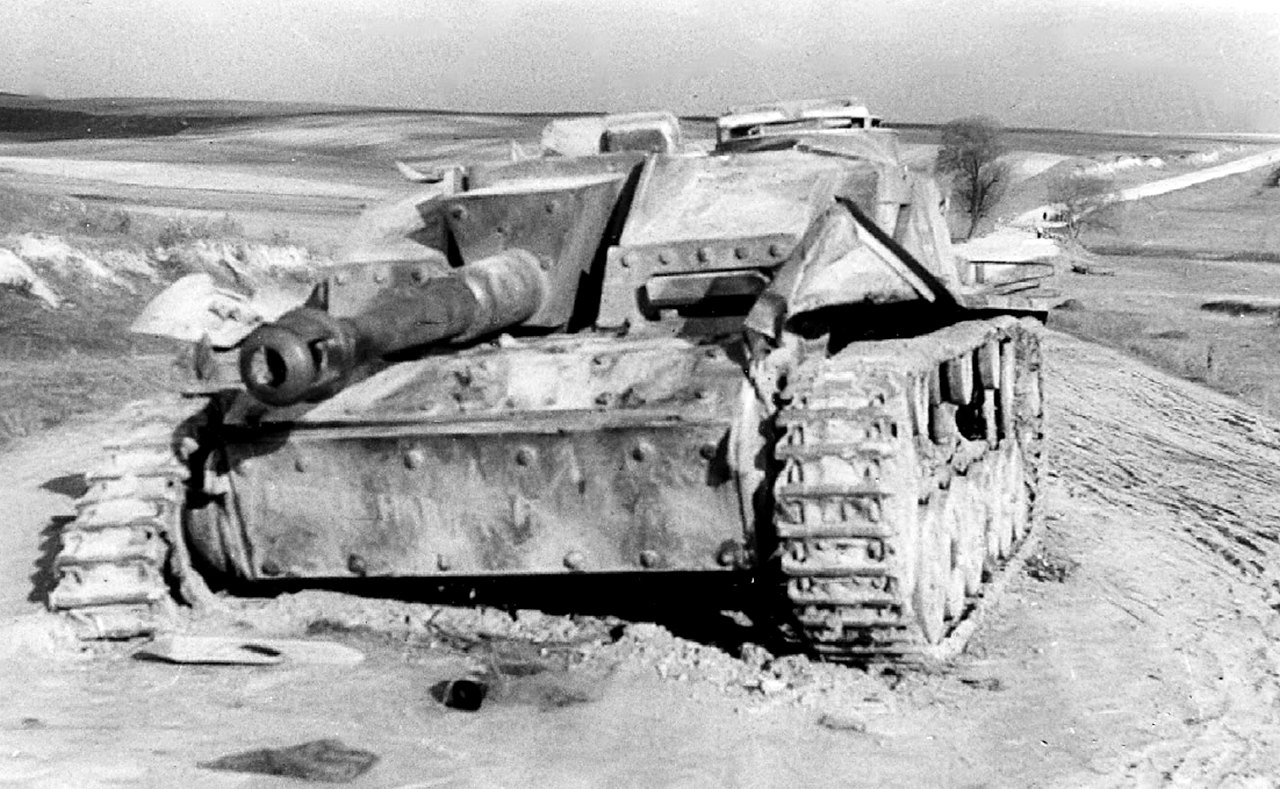 |
| 10,5 cm Sturmhaubitze 42 Ausf. G knocked out by Soviet troops. Kharkov area Winter – 1943. |
 |
| 10,5 cm Sturmhaubitze 42 Ausf. G late destroyed in Italy, 1944. |
 |
| 10,5 cm Sturmhaubitze 42 Ausf. G late somewhere in Russian Front, 1944. Notice the concrete armour |
 |
| Three 10,5 cm Sturmhaubitze 42 Ausf. G from Sturmgeschütz-Abteilung 210 with schürzen in a muddy field Russian front, 1944. |
 |
| 10,5 cm Sturmhaubitze 42 Ausf. G late Sturmgeschütz-Abteilung 325 – Notice the MG remotely operated roof-mounted and no muzzle brake in the howitzer Hungary – September, 1944. |
 |
| 10,5 cm Sturmhaubitze 42 Ausf. G “KRANICH” Sturmgeschütz-Abteilung 202 – 2. Batterie with with extensive foliage camouflage and side skikts (Schürzen), as extra-armour. Russian Front – Kurland, Latvia – September, 1944. |
 |
| 10,5 cm Sturmhaubitze 42 Ausf. G late Notice the logs in the sides of the vehicle and the MG remotely operated roof-mounted Eastern Front – Winter, 1944. |
 |
| 10,5 cm Sturmhaubitze 42 Ausf. G late no. 308 Notice the MG remotely operated roof-mounted Ukraine – 1944. |
 |
| 10,5 cm Sturmhaubitze 42 Ausf. G with concrete, KV russian links and metal sheet in the glacis, as extra-armour Russian Front, 1943 |
 |
| A well-worn 10,5 cm Sturmhaubitze 42 Ausf. G , with concrete and Russian T34 track links reinforcing the frontal armor. Russian Front, Summer 1944. |
 |
|
10,5 cm Sturmhaubitze 42 Ausf. G with muzzle brake similar
to the Wespe. Armor side skirts appear to be field adaptations.
|
 |
| 10,5 cm Sturmhaubitze 42 Ausf. G late no muzzle brake on the howitzer Hungary – Winter, 1944 – 1945. |
The importance of the StuH 42 on the battlefields can be confirmed by what was reported by the commander of the Sturmgeschütz-Ersatz und Ausbildungs-Abteilung (Assault Weapons Training and Replacement Division) when visiting the Sturmgeschütz units on the Eastern Front in 1943, to determine how the StuH 42s were faring in combat: “The Sturmhaubitze has completely proven its worth and is indispensable against infantry targets…”
This brave and important machine fought in Eastern Front and Europe until the end of the conflict, in 1945.
 |
| The last stand: a destroyed 10,5 cm Sturmhaubitze 42 Ausf. G, in the Reich Chancellery’s garage, during the Battle of Berlin. 1945. They fought until the end… |
Specs:


| 10,5 cm Sturmhaubitze 42 Ausf. G | |
|---|---|
| Type | Assault gun (howitzer) |
| Place of origin | Nazi Germany |
| Service history | |
| In service | 1942 -1945 |
| Used by | Nazi Germany |
| Wars | World War II |
| Production history | |
| Designer | Alkett |
| Manufacturer | Alkett |
| No. built |
1.299
|
| Specifications | |
| Mass | 24 tonnes |
| Length | 6.14 m |
| Width | 2.95 m (fenders) 3.41 m (Schürzen skirts) |
| Height | 2.16 m |
| Crew | 4 (driver, commander, gunner, loader) |
|
|
|
| Armour | 11 to 50+30 mm |
|
Main armament
|
|
|
Secondary armament
|
|
| Engine | Maybach HL120 TRM V-12 gasoline engine 300 HP @ 3000 rpm |
| Power/weight | 12 PS (9.2 kW) / tonne |
| Transmission | six-speed transmission |
| Suspension Speed |
torsion bar 40 Km/h (road) 15 Km/h (off road) |
|
Fuel capacity
Operational range
|
320 liters Road:155 km Off road: 95 km |