



The United Kingdom’s Supermarine Spitfire was first introduced by the Royal Air Force in 1938, and thousands would go on to serve during the Second World War. Later on, the aircraft would serve with Air Forces across the globe, including the US Air Force, Czech Air Force, Free French Air Force, Polish Air Force, and the Belgian Air Component.
The Supermarine Spitfire has a fascinating backstory and a unique operational history. As a single-seat fighter aircraft, the Spitfire helped the British win the momentous Battle of Britain and, along with the Hawker Hurricane, served in every theater of World War II. In this article, we will take a deeper look at the Spitfire and explore five cool facts about the fighter you may not have known.
1.The plane is named after Ann McLean
Daughter of the Chairman of Vickers Aviation, Sir Robert McLean
| RAF Aircraft: | Nickname: |
|---|---|
| Spitfire | Bomfire |
| Hawker Hurricane | Hurricane Burns |
| Avro Lancaster | Lanc |
| C47 Dakota | Gooney Bird |
While the Spitfire’s name is synonymous with its incredible firing power, according to several sources, it was named in honor of Vickers Aviation’s Chairman Sir Robert McLean’s young daughter.
As the story goes, the aircraft was initially designed by Reginald (RJ) Mitchell of Supermarine, which was a subsidiary of Vickers Aviation. It was the product of a calling by the Air Ministry for a high-performance aircraft in 1934 during the arms race built up between Nazi Germany and the United Kingdom. Before the plane had a name, it was known as prototype Type 224 and later earned the nickname Bomfire.

According to Aviation expert Paul Beaver’s Spitfire People book, despite being credited as the sole designer of the legendary aircraft, Mitchell was not allowed to choose its name. Beaver, who was given access to the archives of Supermarine, found that Micthell wanted to give his invention a more mammal-like name, such as the Shrew or the Scarab, and vehemently disliked the name Spitfire.
However, the name Spitfire was suggested by Sir Robert MacLean, director of Supermarine’s parent company Vickers-Armstrongs. MacLean wanted to name the aircraft Spitfire after his daughter Ann, known as the ‘little spitfire’ due to her fiery character. Mitchell lost his battle to MacLean, and the airplane was thus called the Supermarine Spitfire.
2.An ideally configured fighter aircraft
A powerful engine and an airframe designed for stability
| Wingspan: | 36 ft 10 in (11.2 m) |
|---|---|
| Length: | 29 ft 11 in (9.12 m) |
| Engine: | 1 x Rolls-Royce PV-12 12-cylinder, liquid-cooled engine |
| Height: | 11ft 5 in (3.63 m) |
The aircraft is a direct descent of multiple floatplanes designed by Mitchell to compete for the famous Schneider Trophy in the 1920s. One aircraft, the S6B, set a world speed record, traveling 357 miles (574 km) per hour in 1929. Following the world record, Mitchell began working on a new fighter aircraft named type 224, which was built extensively on the SB6’s aerodynamics and would lead to the famous design of the Spitfire. The Spitfire was a revolutionary design for military aircraft as it was built as a short-range, high-performance aircraft when most planes at that time were bulky, heavier, and made for long-range missions.

The famous elliptical wing that featured sunken rivets to achieve the thinnest possible cross-section allowed the aircraft to reach a top speed faster than most fighters of that time. As the Spitfire was designed to have a great turning radius, its elliptical wing created the lowest induced drag and had impressive stall characteristics, making it easier for pilots to keep the plane at its maximum turn rate without stalling out. Moreover, the elliptical wings made the Spitfire a very agile fighter in the sky, giving it an advantage in dog fights (one-on-one air battles). The Spitfire had a more extreme design than its British counterpart, the Hawker Hurricane, as in addition to the airfoil wings, it had a structure of aluminum-stressed skin. This, along with its powerful engine, gave the Spitfire a speed of 362 miles per hour, allowing the aircraft exceptional performance, especially at high altitudes.
3.Faster than the rest
Outmatched its formidable German opponent, the Bf 109
| Cruising Speed: | 243 mph (391 km/h) |
|---|---|
| Maximum Speed: | 406 mph (653 km/h) |
| Service Ceiling: | 43,000 ft (13,106 m) |
Supermarine’s Spitfire was far faster than other fighters of the time, able to compete with Germany’s Bf 109. The Spitfire featured a powerful 1,000 horsepower Rolls-Royce PV-12 engine (dubbed the Merlin) and a two-stage supercharger, allowing the aircraft to reach speeds 25-30 miles per hour faster for five minutes. Critically, the powerful engine enabled the Spitfire to fly faster than the Messerschmitt Bf 109 at altitudes above 15,000 feet, giving them a serious advantage.
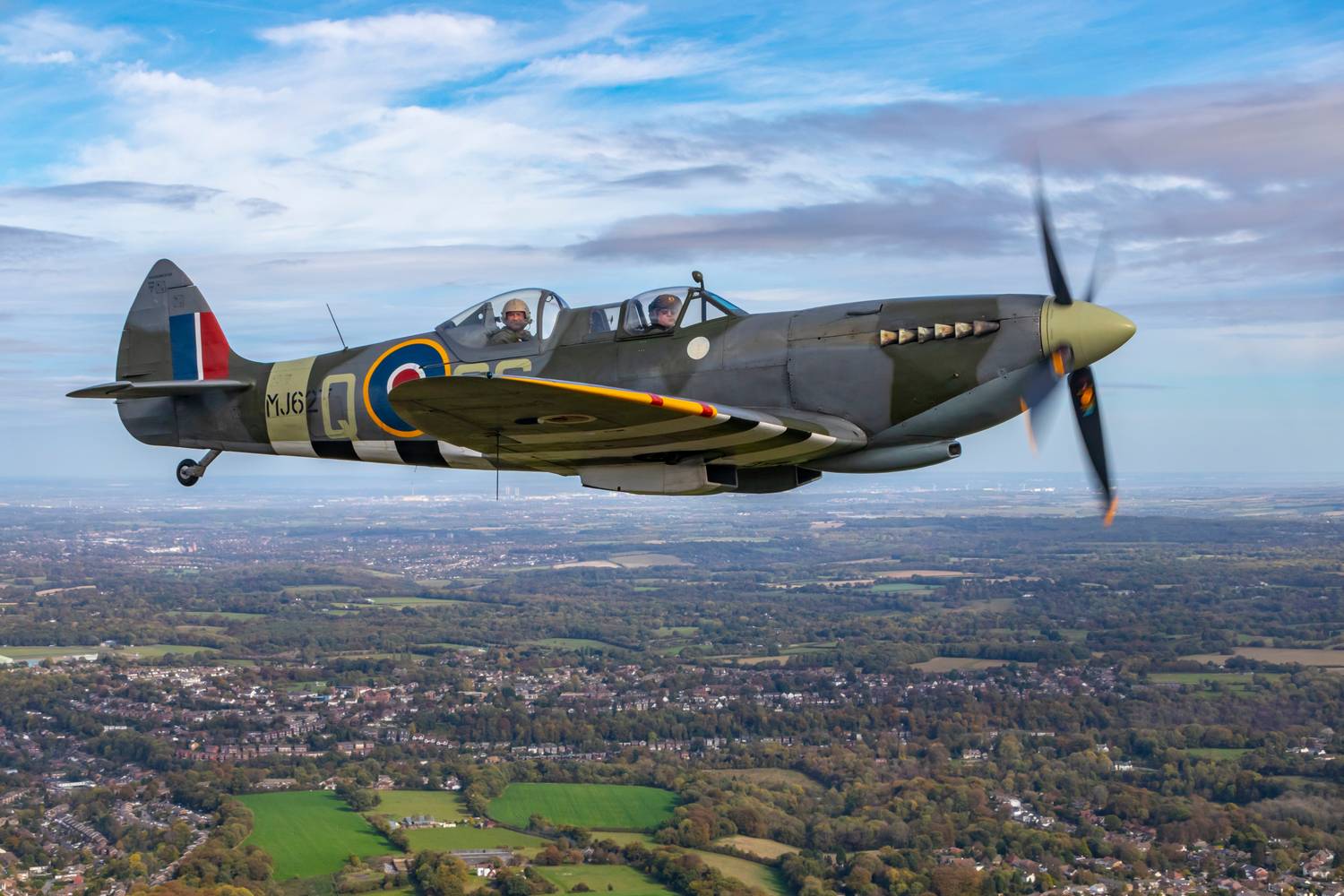
Another advantage the Spitfire had over the Messerschmitt Bf 109 was its superior turning radius, as the Spitfire’s elliptical wings created a substantial amount of lift without producing much drag. As alluded to above, this enabled the Spitfire to make sharper turns and improved efficiency. The Bf 109 had straight wings, which were less efficient at creating lift and low-speed stability. Furthermore, the wings of the Bf 109 were cumbersome, forcing the aircraft to reach a high speed to maintain lift. The Spitfire also had a high-power-to-weight ratio, allowing it to accelerate and maintain speed during tight turns quickly. As a result, the Spitfire was far more effective at outmaneuvering and dogfighting than many of its contemporaries.
4.The Spitfire’s most famous mission
Led to the famous British victory against the German raid on England
| Aircraft involved: | 372 Spitfires and 709 Hurricanes |
|---|---|
| Servicemen involved: | 2,945 aircrew |
| Damage: | 544 Fighter Command pilots killed and 1,000 RAF planes shot down |
The first major military campaign fought entirely by air forces was known as the Battle of Britain between the British Royal Air Force and Nazi Germany’s Air Force, the Luftwaffe. The battle, which occurred between July and September 1940, was a successful defense of Great Britain against destructive air raids by the Germans following the fall of France and blocked the possibility of an invasion. During the battle, Spitfires were sent to engage German Bf 109s while slower Hawker Hurricanes went after German bombers. Although the Hurricane and Spitfire played pivotal roles in the outcome, the latter was credited with the victory.

During the battle, the Royal Air Force faced an uphill battle as they had a fleet of just 1,081 aircraft (372 Spitfires and 709 Hurricanes) with only 749 combat-ready. These fighters had to go against the full might of the Luftwaffe, which had a staggering 2,500 aircraft. Against the odds, the Spitfires and Hurricanes allowed the Royal Air Force to have quicker turnarounds, enabling pilots to fly more missions. Following the victory at the Battle of Britain, the Royal Air Force flew its first patrols over France since it fell to Nazi Germany in December 1940. These patrols were flown by Spitfires, who were given the name ‘Rhubarbs.’
5.An incredibly durable aircraft
It could sustain significant damage when deployed
| Number built: | 20,341 |
|---|---|
| Number still airworthy: | 60 |
Throughout its operational history, the Spitfire was renowned for its brawn in battle and the ability to sustain incredible levels of damage. The body of the Spitfire was highly robust as the metal components of the aircraft were made out of alloys of aluminum, ensuring that the aircraft would be as light as possible while boasting astonishing strength. The Spitfire was the only aircraft that continued to be built throughout the war, and between 1939 and 1948, 20,341 of the type were made, according to the Royal Air Force.

Today, around 240 Spitfires are known to exist. Uniquely, 60 Spitfires remain airworthy, 70 are put on display, and over 100 are either in storage or currently being restored. Half of the airworthy Spitfires (30 out of 60) remaining are in the United Kingdom, with six of them flying on the Battle of Britain Memorial Flight.