



Ancient Babylon was an influential city that served as a center of Mesopotamian civilization for nearly two millennia, from roughly 2000 B.C. to 540 B.C. It was located near the Euphrates River, about 60 miles (100 kilometers) south of Baghdad in what is now Iraq.
Babylon had a significant impact on Mesopotamia. One of its early rulers, Hammurabi, created a harsh system of laws, while in later times, the Babylonian language was used across the Middle East as a way of communicating across borders. The law code, while not the oldest in the Middle East, is one of the most famous. The city is also famous for the construction of the Hanging Gardens of Babylon (if the ancient stories are true), a wonder of the ancient world that some people believe was built by the biblical king Nebuchadnezzar II.
The ancient scientists who lived in Babylon made important discoveries in mathematics, physics and astronomy. Among their many accomplishments, they developed trigonometry, used mathematical models to track Jupiter and developed methods of tracking time that are still used today. Ancient Babylonian records are still used by modern-day astronomers to study how Earth‘s rotation has changed.
The ancient city and its people’s accomplishments have affected people for thousands of years, and their impact can still be felt today.
“Babylon, in all its manifestations, is at once remote to us and all around us. Like no other city, its history has become bound up with legend…” researchers Irving Finkel and Michael Seymour wrote in the book “Babylon: City of Wonders” (Oxford University Press, 2008).
Archaeologically, little is known about the early history of Babylon. Ancient records suggest that more than 4,000 years ago, at a time when the city of Ur (in what is now southern Iraq) was the center of an empire, Babylon was a provincial administration center and was part of Ur’s empire, wrote historian Gwendolyn Leick in her book “The Babylonians: An Introduction” (Routledge, 2002).
Babylon was built in an area that’s “subject to very high temperatures and lies well beyond the reach of rain-fed agriculture,” Seymour, a research associate at the Metropolitan Museum of Art in New York City, wrote in his book “Babylon: Legend, History and the Ancient City” (I.B. Tauris, 2014). He noted that an irrigation system that distributed water from the Euphrates was required to grow crops. “Once established, however, such a system could reap the benefit of rich alluvial soils and support extremely productive agriculture on the levees of canals,” Seymour wrote.
Babylon’s position on the Euphrates River, along with the canal systems that Babylon’s rulers later constructed in the region, encouraged trade and travel, Stephanie Dalley, a retired teacher of Assyriology at the University of Oxford, wrote in her book “The City of Babylon: A History c. 2000 B.C. – A.D. 116” (Cambridge University Press, 2021). Prisoners captured in wars were sometimes forced to help build the canal network in the region, Dalley noted.
Leick noted that in 1894 B.C. after the Ur-based empire had collapsed, Babylon was conquered by a man named Samu-abum (also spelled Sumu-abum). He was an Amorite, a member of a Semitic-speaking people from the area around modern-day Syria. He turned Babylon into a petty kingdom made up of the city and a small amount of nearby territory. Babylon remained this way until, six kings later, a man named Hammurabi (1792 B.C. to 1750 B.C.) ascended the throne. He had a major impact on the city’s fortunes and transformed this once-small kingdom into a great empire.
The empire of Hammurabi
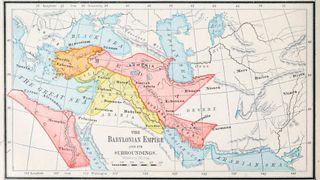
Hammurabi had to be patient before he could expand, Leick noted. Babylon was located between two large cities known as Larsa and Ashur, and Hammurabi had to be cautious. He used his time wisely. “At home he concentrated on improving the economic basis of his kingdom by building canals and strengthening fortifications,” Leick wrote.
When the king of Ashur died around 1776 B.C., Hammurabi took advantage of the resulting power vacuum and expanded Babylon’s territory by conquering Ashur. Following this, he conducted a series of campaigns against Larsa and defeated its ruler, Rim-Sin, who had ruled the large kingdom for nearly 60 years. “This victory signalled the annexation of all the old urban centers, such as Ur, Uruk, Isin and Larsa,” Leick wrote. Further campaigns against Assyria and Mari further expanded Hammurabi’s empire.
Archaeologists know little about what Babylon itself looked like during Hammurabi’s reign. “The remains of Hammurabi’s own city at Babylon are, unfortunately, almost inaccessible as the water table has risen too high to allow them to be explored,” archaeology researcher Harriet Crawford wrote in a paper published in the book “The Babylonian World” (Routledge, 2007).
While archaeological remains in Babylon dating to this period are scarce, textual remains reveal more information. Leick noted that Hammurabi was so well respected that he became regarded as a deity. She wrote that parents gave their children names that meant “Hammurabi is my help” or “Hammurabi is my god.”
Hammurabi himself discussed the nature of his divinity in his famous law code.
Code of Hammurabi
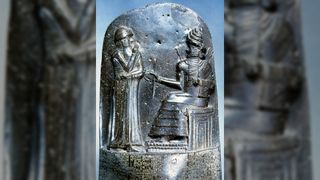
The Code of Hammurabi (now in the Louvre Museum in Paris) is well known for its “eye for an eye” style of lawmaking, but it also set out the nature of the relationship among Hammurabi, the gods and the people he ruled.
In Hammurabi’s view, the gods sent him to rule, with some level of compassion, over his empire. The preamble to the code says that “then Anu and Bel [both gods] called by name me, Hammurabi, the exalted prince, who feared God, to bring about the rule of righteousness in the land, to destroy the wicked and the evil-doers; so that the strong should not harm the weak.” (translation by L.W. King).
While Hammurabi claimed to be compassionate, his code was harsh and made liberal use of death sentences (in some cases, even for stealing) and allowed for the hacking off of body parts. This is a change from an earlier law code, created centuries ago by a ruler of Ur named Ur-Nammu, that was more inclined to impose fines.
Women did not always receive equal treatment to men under Hammurabi’s code. One law reads, “If a finger has been pointed at a man’s wife because of some male but she has not been caught copulating with another male, she shall leap into the river for the sake of her husband” (translation by H. Dieter Viel).
However, the code did have rules that protected women. For instance, if a man divorced his wife he had to give her back her dowry and give her some of his land. Other rules stipulated that a widowed woman should receive an inheritance and that an unmarried woman should receive financial support from her brothers after the death of her father so that she could live alone.
Kassite period
Ultimately, Hammurabi’s empire did not last; it fell into decline after his death in 1750 B.C. In 1595 B.C., Mursili I, ruler of the Hittites, a people from Anatolia, sacked Babylon, bringing the rule of Hammurabi’s successors to a close.
Adding insult to injury, the Hittites seized a statue of Marduk, who had become a principal god of the Babylonians, from his temple, historian Susanne Paulus noted in a 2011 paper published in Beihefte zur Zeitschrift für Altorientalische und Biblische Rechtsgeschichte (Supplements to the Journal of Ancient Near Eastern and Biblical Legal History). Stealing the statue of Marduk from his own temple would have been seen as being extremely disrespectful by the Babylonians.
In the chaos that followed, a people called the Kassites (also known as the Galzu), likely from the Zagros Mountains east of Babylon, came to power in Babylon around 1550 B.C. They had access to good horses, giving them a military advantage, according to Leick.
Following the conquest, the Kassites appear to have made an effort to win over the people of Babylon. “They brought back the statue of the major deity, Marduk, which had been stolen by the Hittites, and restored his cult in Babylon,” Paulus wrote. “The Kassite kings restored the temples of the Babylonian gods, while their own pantheon had little influence.”
During this period, Babylonian writing may have become more professionalized and exclusive (Leick noted that there appears to have been far fewer personal letters written), but the language itself became widely used across the Middle East.
It turned into a “lingua franca for the whole Near East from the fifteenth to the end of the thirteenth century,” Leick wrote. Babylonian works could be found in Turkey, Syria, the Levant and Egypt. “Babylonian scribes were very much in demand at foreign courts,” Leick noted.
Wars with Assyria and Elam
The period from roughly 1200 B.C. to 600 B.C. was a rocky one for Babylon, and involved many wars and some successes. Around 1200 B.C., the eastern Mediterranean faced calamity as a wave of migrants sometimes called the “Sea People” swept through much of the Middle East, destroying cities in Turkey and the Levant and contributing to problems that caused the breakup of ancient Egypt.
While Babylon was not hit directly by the Sea People they faced wars with other powers. A war with Assyria resulted in a Babylonian king being led to Ashur in chains, while a conflict with Elam led to the statue of Marduk being stolen yet again. A new Babylonian ruler named Nebuchadnezzar I (1126 B.C. to 1105 B.C.) defeated Elam and brought the statue back once more. Leick noted that his success added greater importance to the Babylonians’ New Year festival.
“This complex ritual, which involved the gathering of all important Babylonian deities at Babylon, the recitation of the Creation Epic (enuma elish) and the confirmation of kingship by the god Marduk, was given new impetus, if it was not altogether invented at this time,” Leick wrote.
However, these successes were short-lived. Babylon struggled over the following centuries, and the Assyrians invaded again. Leick noted that the city was put under direct Assyrian rule from 729 B.C. to 627 B.C,. and during a Babylonian rebellion in 689 B.C., the city was supposedly deliberately flooded, and the statues of its gods were seized or destroyed by the Assyrians. Babylon eventually broke free of Assyrian rule following a war waged by a king named Nabopolassar (allied with an Iranian people called the Medians), and the Babylonians eventually conquered Nineveh, the Assyrian capital, in 612 B.C.
Nabopolassar’s efforts brought Babylon into a new golden age. In 605 B.C., Nebuchadnezzar II, of biblical fame, ascended the throne, and he was in a strong position to build an empire.
Nebuchadnezzar II’s Babylon
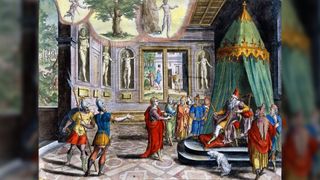
Through military conquests, Nebuchadnezzar II came to rule an empire that stretched from the Persian Gulf to the borders of Egypt. He captured Jerusalem twice, in 597 B.C. and 587 B.C. — events that led to the destruction of the First Temple, the deportation of many Jewish inhabitants to Babylonia and the capture of the Ark of the Covenant.
In Babylon, Nebuchadnezzar II began a major building and reconstruction program. “Babylon reached its greatest glory as a city during the reign of Nebuchadnezzar II,” SOAS University of London professor Andrew George wrote in a chapter of the book “Babylon: City of Wonders” (Oxford University Press, 2008). Religion played a key role. “At its heart were fourteen different sanctuaries, and another twenty-nine were distributed throughout the rest of the city. That was quite apart from the hundreds of street site chapels and shrines,” George wrote.
One of the biggest shrines, called Esangil (also known as Esagila), was dedicated to Marduk. It was located south of a great ziggurat (temple tower) and measured 280 by 260 feet (86 by 79 meters), with gateways 30 feet (9 m) high, George noted. “Nebuchadnezzar lavished attention on the cult-rooms: there were gold, silver and gemstones everywhere,” he wrote.
Prior to Nebuchadnezzar II, much of Babylon was made of unbaked bricks, but during the rebuilding program, “good baked bricks” were widely used, Olof Pedersén, professor emeritus of Assyriology at Uppsala University in Sweden, wrote in his book “Babylon: The Great City” (Zaphon, 2021). These baked bricks would have appeared sturdier and had a somewhat different appearance.
Palaces
Nebuchadnezzar II’s city boasted three major palaces. The southern palace measured 1,065 by 720 feet (325 by 220 m). It included a throne room with a glazed brick panel showing palmettes, floral reliefs and lions. The tiles were glazed in blue and yellow — a common feature among the most important structures in Nebuchadnezzar II’s Babylon, George wrote.
The king also had a northern palace, which was about 985 feet (300 m) long on each side, Pedersén wrote. It had a series of terraces with a canal beside it. These terraces could have been used for planting trees and other vegetation — possibly inspiring stories about a “Hanging Garden of Babylon,” Pedersén wrote.
On the northern tip of the city’s outer wall, Nebuchadnezzar II had another palace, known as the “summer palace” today. Measuring 568 by 502 feet (173 by 153 m), it was “for use in summer when the city air was stifling and its smells at their worst,” George wrote.
Ishtar Gate
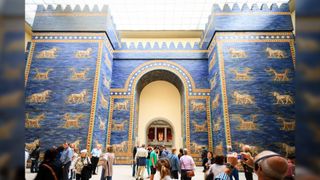
Built by Nebuchadnezzar II and named after Ishtar, a goddess of love and war, the Ishtar Gate served as the ceremonial entrance to the inner wall of Babylon — a route that led to the ziggurat and Esangil shrine. People passing by it in antiquity would have seen glazed blue and yellow bricks with alternating images of dragons and bulls carved in relief. A reconstruction of it that incorporates surviving materials is currently in the Vorderasiatisches Museum in Berlin.
The “amazing Ishtar Gate, composed of an ante-gate in the outer wall and the main gate in the larger inner wall of the city, with a 48-meter-long [157 feet] passage, was decorated with no fewer than 575 depictions of animals (according to calculations made by excavators),” Joachim Marzahn, a retired curator at the Vorderasiatisches Museum, wrote in another chapter of the book “Babylon.” He noted that these “pictures, of bulls and dragons, representing the holy animals of the weather god Adad and the imperial god Marduk, were placed in alternating rows.”
In addition, Marzahn wrote that a processional way ran through the Ishtar Gate and, for about 590 feet (180 m), had images of lions carved in relief. The mouths of the lions were open, baring their teeth, and the manes of the creatures were finely detailed.
Every spring, the king, his courtiers, priests and statues of the gods traveled along the processional way to the Akitu temple to celebrate the New Year festival.
“The dazzling procession of the gods and goddesses, dressed in their finest seasonal attire, atop their bejeweled chariots, began at the Kasikilla, the main gate of the Esagila (a temple dedicated to Marduk), and proceeded north along Marduk’s processional street through the Ishtar Gate,” Julye Bidmead, an associate professor of religious studies at Chapman University in California, wrote in her book “The Akitu Festival: Religious Continuity and Royal Legitimation in Mesopotamia” (Gorgias Press, 2004).
The Tower of Babel?
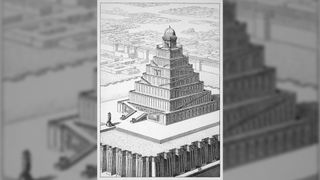
Although largely destroyed today, in ancient times the ziggurat of Etemenanki (which roughly translates to the “Temple Foundation of Heaven and Earth”) towered over the city, and was located just to the north of the Esangil shrine. Like the shrine, the ziggurat was dedicated to the god Marduk.
The ancient Greek writer Herodotus, who lived in the fifth century B.C., described Etemenanki as a “solid tower” that is “two hundred and twenty yards [200 m] long and broad; a second tower rises from this and from it yet another, until at last there are eight …”
Herodotus wrote that “in the last tower there is a great shrine; and in it stands a great and well-covered couch, and a golden table nearby. But no image has been set up in the shrine, nor does any human creature lie there for the night, except one native woman, chosen from all women by the god, as the Chaldaeans say, who are priests of this god” (translation by A.D. Godley).
Although the tower was initially constructed earlier in the city’s history, Nabopolassar and Nebuchadnezzar II ordered it to be rebuilt; when this was complete, the structure was about 300 feet (91 m) in length, width and height, Pedersén wrote.
Rebuilding the structure would have been an impressive feat, and it’s been speculated that this structure may have inspired the biblical story of the Tower of Babel. The story of the tower “may have taken its inspiration from the well-publicized repairs of Assyrian kings in the seventh century,” Dalley wrote, noting that the story of the tower also could have come from a Babylonian religious text known as the “Epic of Creation.”
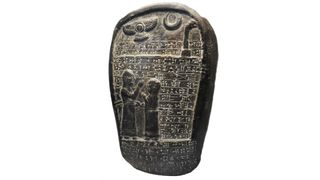
In 2011, an ancient stele, or inscribed stone, with an image of Nebuchadnezzar II was translated and published. In it, the king is shown standing beside the ziggurat. The artifact has been given the name “The Tower of Babel Stele.”
Hanging Gardens
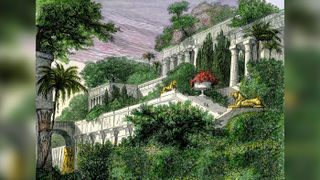
Babylon also supposedly featured spectacular gardens, known as the Hanging Gardens. Scholars don’t know where the Hanging Gardens were in Babylon, or even if they really existed, but ancient writers described them in detail. The gardens are considered one of the seven wonders of the ancient world.
In about 250 B.C., Philo of Byzantium wrote that “The Hanging Gardens [structure is so called because it] has plants cultivated at a height above ground level, and the roots of the trees are embedded in an upper terrace rather than in the earth. This is the technique of its construction. The whole mass is supported on stone columns, so that the entire underlying space is occupied by carved column bases” (translation by David Oates).
A later account was recorded by Greek historian Diodorus Siculus in the first century B.C. He wrote that the Hanging Gardens were built “by a later Syrian king to please one of his concubines; for she, they say, being a Persian by race and longing for the meadows of her mountains, asked the king to imitate, through the artifice of a planted garden, the distinctive landscape of Persia.”
Modern-day scholars have noted that Herodotus, who lived earlier than Philo, does not mention the Hanging Gardens. Moreover, there are no known Babylonian records of the site.
Loss of independence and ruin
Ultimately, Nebuchadnezzar II’s empire didn’t last much longer than the one built by Hammurabi. In the sixth century B.C., the Achaemenid, or Persian Empire rose to the east of Babylon and became so powerful that it would later invade territories as far west as Greece.
The fall of the Babylonian empire was very swift and occurred during the reign of Nabonidus, which lasted from 556 B.C. to 539 B.C. At the start of Nabonidus’ reign, the Babylonian empire stretched from the Persian Gulf to the Mediterranean, and Nabonidus expanded it even further, capturing parts of what is now Saudi Arabia. Ancient records say he even chose to live at Tayma, a city in what is now Saudi Arabia, until around 543 B.C. An engraving depicting Nabonidus was found in Al Hait, in Saudi Arabia, in 2021. However, in the last years of his rule, the Babylonian empire was attacked by the Persians and ultimately destroyed.
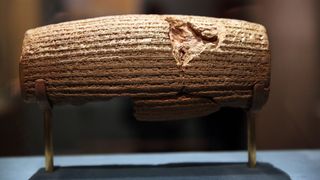
Leick noted that on Oct. 29, 539 B.C. the city of Babylon fell to Cyrus the Great, the legendary Persian ruler. Nabonidus was taken to what is now Iran to spend the rest of his life in exile. In an ancient inscription called the “Cyrus Cylinder,” now housed in the British Museum in London, Cyrus claimed that his troops faced no resistance when he took Babylon. “I went as harbinger of peace into Babylon,” he said. “I founded my sovereign residence within the palace amid celebration and rejoicing” (translation by Irving Finkel).
If there was a warm welcome for the Persians, it didn’t last. From 528 B.C. to 526 B.C., Babylon and the area around it was hit by a famine brought about by the failure of barley crops, Kristin Kleber, a lecturer at Vrije University Amsterdam, wrote in a paper published in 2012 in the journal Zeitschrift für Assyriologie und vorderasiatische Archäologie. The workers “who rebuilt the city wall of Babylon in the years 528–526 B.C. must have felt as though they were in the antechamber of hell,” Kleber wrote, noting that ancient texts mention discontent among the Babylonians.
However, Babylon would never be independent again. Over the following millennia, the city fell under the sway of several empires, including that of Alexander the Great (who died in Babylon in 323 B.C.), the Seleucids and the Parthians.
When Alexander the Great captured Babylon in 331 B.C., the ziggurat of Etemenanki had fallen into ruin. Alexander planned to rebuild it along with other sites in the city with a force of 10,000 men, Dalley wrote. However, Alexander died, and his empire descended into civil war before the plan could be brought to fruition.
Babylon was abandoned in the centuries thereafter. “According to the testimony of classical writers, the site of Babylon had become deserted by the second century A.D.,” Paul-Alain Beaulieu, a professor of Assyriology at the University of Toronto, wrote in his book “A History of Babylon: 2200 B.C.- A.D. 75” (Wiley Blackwell, 2018). “The memory of Babylon was preserved mostly in the Bible and the work of Berossus [a third century B.C. writer who wrote in Greek and lived in Babylon], Herodotus and a few others,” Beaulieu wrote, noting that the cuneiform writing system used by the Babylonians stopped being used in the first century A.D. and the memory of how to read it was lost. The script was not deciphered until the 19th century.
By the Middle Ages, Babylon’s ruins were known mainly as a good place to get bricks, Pedersén wrote in his book. The ruins continued to be quarried for bricks into the 19th century.
Modern day
The city was excavated by a German team led by Robert Koldewey between roughly 1899 and 1914, the team unearthing a sizable amount of the city and bringing some of their finds back to Germany. Their excavations help further public interest in Babylon and Middle East archaeology in general.
In the 1980s, Iraq’s leader, Saddam Hussein, took an interest in the ancient city. “Most of the city was rebuilt by Saddam in the mid to late 1980s to recreate it as it was in the era of King Nebuchadnezzar, 600 B.C.,” photojournalist Robert Galbraith wrote in his book “Iraq: Eyewitness to War – A Photojournalist’s Diary” (self-published, 2004). Galbraith reported from Iraq after the 2003 U.S.-led invasion and visited Babylon shortly after the U.S. occupation of Iraq began. Galbraith noted that the city was looted around the time of the invasion, and a group of U.S. Marines was eventually assigned to guard the site.
Prior to the occupation, Hussein had constructed a palace at Babylon that “looms over the city” but “is strikingly out of place,” Galbraith wrote. “It is a beautiful, finely carved sandstone castle, and looks like an Arabian palace. But that’s the problem; it is obtrusive, misplaced and tacky to the limit. It appears that Saddam tried to buy his way into the history books by building his monument overlooking the ancient city,” Galbraith wrote.
Babylon was later turned into a U.S. military base. While this deterred some looting, it caused damage to the ancient city and left modern remains (including a basketball hoop) that had to be cleaned up. After U.S. forces left, some cleanup and conservation work was done, and the ancient city has been reopened for tourists.
More recently, Islamic State group (also called ISIS, ISIL or Daesh) forces failed to reach Babylon during their 2014 offensive in the region, and as such, the city was spared the destruction that befell other ancient sites occupied by the terrorist group.
Groundwater has also been a problem at Babylon, and a proposal to use underground dams to lower and control groundwater at the site was published in 2015 by a team of scientists from the University of Babylon, in Iraq, in the International Journal of Civil Engineering and Technology.
Additional resources
Babylon is a UNESCO World Heritage Site, and its listing can be seen on the UNESCO website. Between 2009 and 2015, the World Monuments Fund supported a conservation project at Babylon. An essay on Babylon’s history written by Michael Seymour, associate curator at the Met, can be viewed on the Met’s website.