



The ancient Greek city of Pergamon was a major center of culture and learning of the Hellenistic world, standing out for its magnificent architecture and monuments.
Located in Anatolia (modern day Turkey), sitting on a 300-meter-high hill in Caicus valley, only 16 miles (26km) from the Aegean Sea, Pergamon was home to a vibrant community of scholars, philosophers and artists.
The ancient Greek city flourished during the Attalid Dynasty, from 282 to 133 BC. The Attalids made Pergamon a model city and, at the same time, a powerful state that became famous in the ancient world and expanded in Anatolia due to a favorable alliance with Rome. It was the cultural patronage and political acumen that made the Attalids worthy descendants of Alexander the Great.
Pergamon was a jewel in Anatolia. Its extensive city wall surrounded marvelous monumental temples, a theater, stoa or porticoes, a gymnasium and an altar and library.
The famous Library of Pergamon, which was said to contain over 200,000 scrolls, was one of the most important libraries of the ancient world and rivaled that of Alexandria. The theater was one of the largest in that time holding around 10,000 spectators.
Architecture and art of Pergamon
The magnificent architecture and the famous works of art of Pergamon were projects of the Greek Attalid dynasty and its buildings and structures were later embellished by the Romans.
The Pergamon Altar or the Great Altars of Zeus in the upper Acropolis was a monumental construction built during the reign of the Greek King Eumenes II in the first half of the 2nd century BC on one of the terraces of the Acropolis.
“At Pergamon there is a large marble altar, 40 feet high with massive sculptures; it also contains a gigantomachy [a battle between Giants and the Olympian gods],” wrote Roman author Lucius Ampelius.
A second, smaller high relief frieze on the inner court walls surrounded the actual fire altar on the upper level of the structure at the top of the stairs. In a set of consecutive scenes, it depicts events from the life of Telephus, legendary founder of the city of Pergamon and son of the hero Heracles and Auge, one of Tegean king Aleus’s daughters.
The Theater, also in the upper Acropolis, was the steepest in the ancient world with a height of 36 meters at a 70 degree angle. It held around 10,000 people, in 78 rows of seats. The seating area (koilon) is divided horizontally by two walkways, called diazomata.
The lower part of the theater consists of seven pieces with neatly made staircases with a width of 29 inches (74cm) so that the audience can easily enter and exit their seats; the upper parts are divided into six parts.
Temple of Trajan (Traianeum) Also called the Temple of Zeus Philios, as both Zeus and Trajan were worshiped in the Temple. The former was sharing it with the latter. The temple sits on a podium on top of a vaulted terrace.
It was a Corinthian peripteros temple, with six columns on the short sides and nine columns on the long sides, as well as two rows of columns in antis (on either side of the doorway). A high stoa on the north side closed the area off, while on the west and east sides it was surrounded by simple ashlar walls.
Temple of Dionysus Ancient Greek god Dionysus had the epithet Kathegemon, ‘the guide.’ The Attalids made him the chief god of their dynasty. In the 2nd century BC, Eumenes II built a temple for Dionysus at the northern end of the theater terrace.
The marble temple sits on a podium, 4.5 meters above the level of the theater terrace and was an Ionic prostyle temple. The pronaos was four columns wide and two columns deep and was accessed by a staircase of 25 steps.
Temple of Athena Pergamon’s oldest temple is a sanctuary of Athena from the 4th century BC. It was surrounded by Doric columns, six to the front and rear and 10 columns on each side with a divided room inside.
A double-aisled stoa with the famous library attached as an addition on the northern side of the temple precinct in the same time of Eumenes II. In the main room of the library the podium and wall sockets designed to support the book shelves are visible.
On the pedestal centered in front of the northern wall of the room stood a smaller copy of the Acropolis of Athens’ famous statue of Athena Parthenos. The reputed 200,000 scrolls kept there were carried off by Anthony and presented to Cleopatra in 41 BC.
On the eastern side of the precinct a single aisled stoa with an entrance gateway decorated with reliefs was also added in the time of Eumenes II. The single aisled stoa on the southern side was probably added later in the second century AD.
Within the sanctuary court the art collections of the Pergamene kings and the votive offerings celebrating victories over the Gauls were displayed. On the round base in the center of the stood a statue of the Roman emperor Augustus (31 BC – 14 AD).
Library The library building location is not certain. However, inscriptions in the gymnasium which mention a library might indicate that the building was located in that area.
Lower Acropolis architectural structures
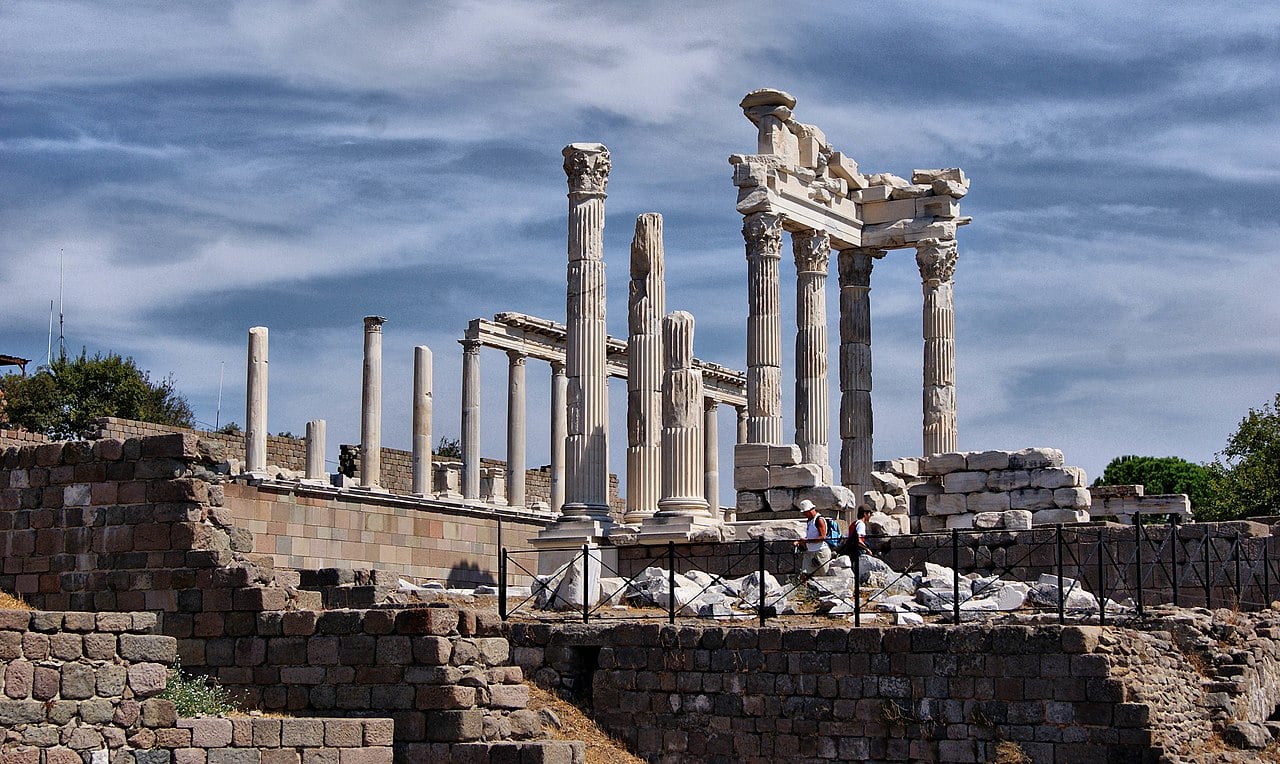
In the Lower Acropolis of the ancient Greek city there were more impressive structures:
Gymnasium It was built in the 2nd century BC on the south side of the Acropolis. It served not only as a center for physical training but also as a cultural hub for education and social gatherings.
The Pergamon gymnasium was one of the largest in the Greek world and one of the largest public buildings of the city. The Attalid kings engaged in this manner to provide Pergamon with such a civic building, in order to educate the young members of the polis elite.
The Gymnasium consisted of three terraces, with the main entrance in the lowest terrace. The lowest and southernmost terrace is small and almost bare. It is known as the Lower Gymnasium and has been identified as the boys’ gymnasium. On its north side there was a two-story hall. In the east part of the terrace there was a small prostyle temple in the Corinthian order. A roofed stadium, known as the Basement Stadium is located between the middle terrace and the upper terrace.
Sanctuary of Hera Basileia (‘the Queen’), erected by Attalus II, lay north of the upper terrace of the gymnasium. Its structure sits on two parallel terraces. The Temple of Hera sat in the middle of the upper terrace, facing to the south, with an exedra to the west and a building whose function is very unclear to the east. The two terraces were linked by a staircase of eleven steps descending from the front of the temple.
The temple sat on a three-stepped foundation. It was a Doric tetrastyle prostyle temple, with three triglyphs and metopes for each span in the entablature. All the other buildings in the sanctuary were made out of trachyte, but the visible part of the temple was made of marble, or at least had a marble cladding.
Sanctuary of Demeter It occupied an area of 50 x 110 meters on the middle level of the south slope of the citadel. It preceded the Attalids as its activity can be traced back to the 4th century BC.
The entrance is on the southeast side, near a fountain and a sacrificial pit, used to collect the blood of the victims. Surrounded by porticoes on three sides, the sacred precinct has, on the side opposite the entrance, the temple dedicated to the goddess, originally in antis, of the Ionic order and later transformed into a Corinthian prostyle, distyle temple for Demeter and Kore.
In front of the temple stand the large main altar and four smaller altars. To the northeast there is a theatron of 10 tiers created to seat around 800 persons, enabling them to watch the ceremonies from a position separate from the crowd. This is the only religious building of such a large size in this quarter.
The rest of the structure was of Hellenistic date, built in local marble and had a marble frieze decorated with bucrania. In front of the east-facing building, there was an altar. The temple and the altar were built for Demeter by Philetaerus, his brother Eumenes, and their mother.
In the east part of the courtyard, there were more than 10 rows of seating laid out in front of the northern stoa for participants in the mysteries of Demeter. Roughly 800 initiates could fit in these seats.
Sanctuary of Asclepius (Asclepieion) Three kilometers south of the Acropolis is the Sanctuary of Asclepius, the god of healing. People had to walk an 820-meter colonnaded sacred way to enter. People with health problems could bathe in the water of the sacred spring, and in the patients’ dreams Asclepius would appear in a vision to tell them how to cure their illness.
The monumental architecture of the sanctuary informs us as to how this unique space was shaped and how rituals were shaped. Galen, the most famous doctor in the ancient Roman Empire and personal physician of Emperor Marcus Aurelius, worked in the Asclepieion for many years.
Serapis Temple The great temple of the Egyptian gods Isis and/or Serapis, known today as the Red Basilica lays south of the Acropolis.
The temple was built during the Roman Empire, probably in the time of Hadrian and possibly on his orders. It is one of the largest Roman structures still surviving in the ancient Greek world. It is believed to have been used for the worship of Egyptian gods – specifically Isis and/or Serapis.
It consists of a main building and two round towers within an enormous sacred area. The temple towers flanking the main building had courtyards with pools used for ablutions at each end, flanked by stoas on three sides. The forecourt of the Temple of Isis/Sarapis is still supported by the 193-metere-wide Pergamon Bridge, the largest bridge substruction of antiquity.
The interior hall of the Temple of Serapis has a podium at its east end, on which stood a cult statue of Serapis. In the foreground is a marble stairway that leads into the temple.
The magnificence of the ancient Greek city of Pergamon and its architecture can be seen at the Pergamon Museum in Berlin, Germany.
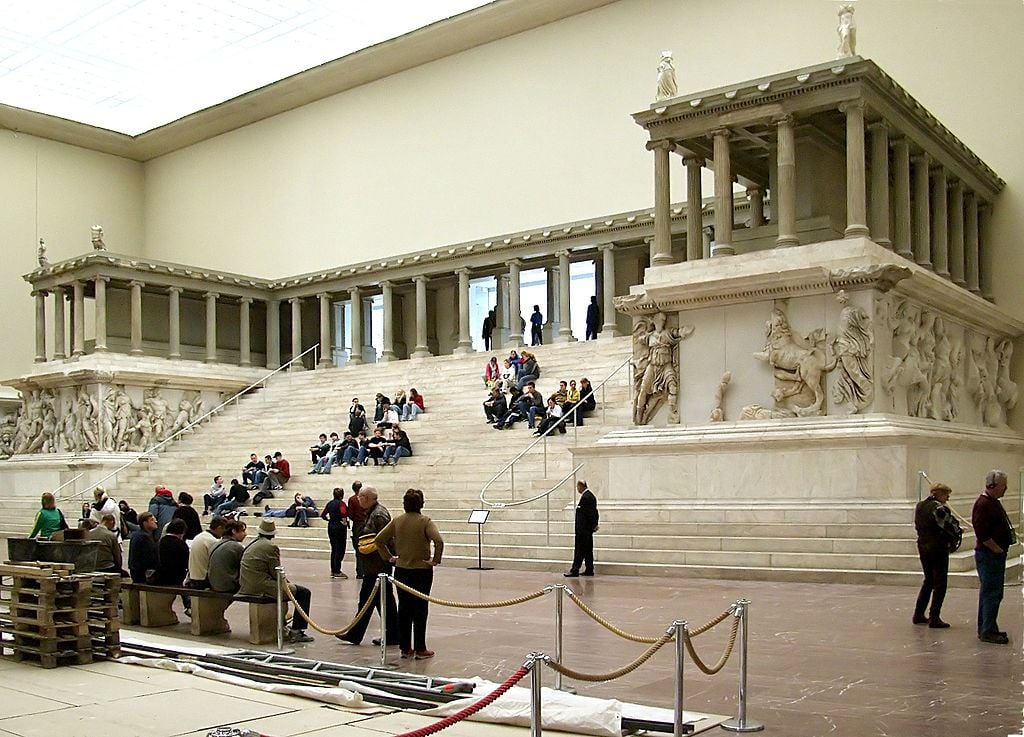
The highlight of the Greek collection of the Pergamon Museum is the breathtaking Pergamon Altar. The massive structure, dating back to the 2nd century BC, is a life-size reproduction inspired by the ancient Greek city of Pergamon.
The 113-meter-long (371 feet) frieze brings back to life the Greek mythological clash between the Olympian gods and the Giants.