



Archaeologists working at an ancient Peruvian burial site have unearthed the first intact ruins belonging to a tribe which existed centuries before the mighty Incas…
Researchers at the Huaca Pucllana ruins in Lima discovered the tomb which is thought to date back to Wari tribal times.
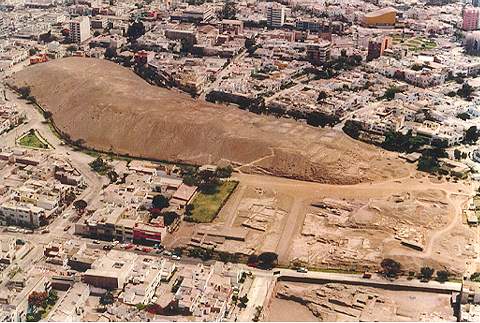
Ancient Huaca Puccllana Ruins Rise up in the Midst of Lima, Peru
It is the first intact Wari burial site discovered in the capital and researchers estimate it is more than 1,300 years old.
Archaeologists also discovered the remains of two other adults and a child.
‘We’d discovered other tombs before,’ said Isabel Flores, director of the ruins.
‘But they always had holes, or were damaged. Never had we found a whole tomb like this one – intact. This enriches Lima’s story.’
Workers wrapped the female mummy in tissue paper before lifting it onto a flat wood board. They exposed her face, revealing two big, bright blue orbs in her eye sockets.
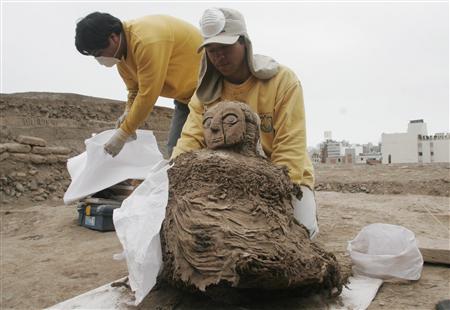
Workers removing the 1,300-year-old “Lady of the Mask” mummy from her tomb in Lima, Peru
They extracted other adult mummies, which were also whole, earlier in the week.
‘Her face startled me at first,’ said Miguel Angel, 19, a worker at Huaca Pucllana who helped unearth the tomb.
‘I wasn’t expecting to find anything like that,’ he said.
The Wari people lived and ruled in what is now Peru for some 500 years, between 600 AD and 1100 AD.
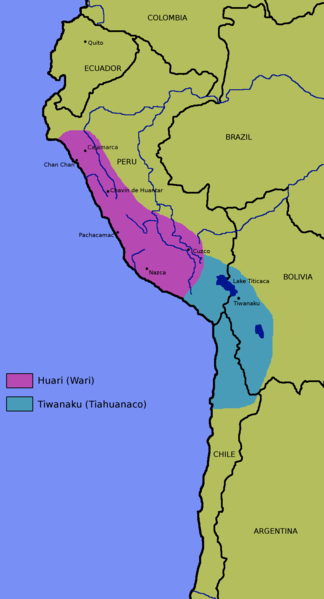
The Wari culture flourished for half a millennium, from 600 to 1100 AD, to the north of the Tiwanaku culture
Their capital was near modern-day Ayacucho, in the Andes, but they traveled widely and are known for building Peru’s first extensive network of roads.
Ms Flores said about 30 tombs have been found so far at Huaca Pucllana, surrounded by Lima’s busy streets.
When in good condition, Wari tombs can be identified by the ceramic and textile offerings placed around the dead.
Small children were often sacrificed and it is common to find their bodies alongside adult ones.
Archaeologists said the child discovered with the adult mummies at Huaca Pucllana was most likely sacrificed.
The discovery confirms the Wari people buried their dead in what is now Lima and offers a more complete picture of how burials were carried out.
Scientists also discovered the remains of a child as well as an assortment of artefacts.
Archaeologists Unearth 1300-Year-Old Mummy in Peruvian Capital
AFP
Archaeologists have unearthed a well-preserved 1,300-year-old female mummy in a residential area of the Peruvian capital.
The woman was from the Wari culture, said archaeologist Isabel Flores, who heads work at the Huaca Pucllana, a mud-brick complex several blocks large located in the Miraflores district of Lima.
“It is an important find, because we have found over the years several tombs that have been looted, but never one that was intact,” Flores told AFP on Tuesday.
Flores described the find as “a multiple tomb in which three funeral bundles were found. One has an impressive mask with the human characteristics of a woman.”
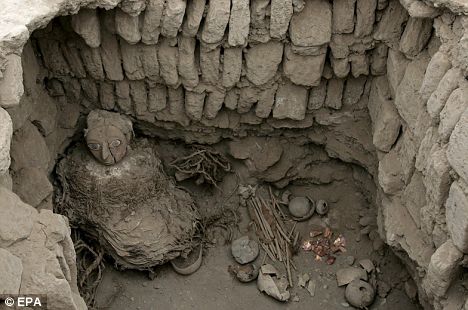
Wari mummy in tomb
The multi-layer fabric funeral bundles contain the mummies of the deceased, who were placed in a crouching position with their knees under their chin.
The mask has an aquiline nose, narrow lips, large eyes with white iris and round black pupils. The other mummies are believed to be those of a child and an adult.
The Waris were an influential Andean society that thrived between 700 and 1000. At its height the Wari kingdom encompassed much of the Peruvian Andes and coastal region.
Flores said the Waris commonly attached funeral masks to the mummies of noble women.
“It is a woman because in the surrounding area we found offerings and textile items like those of a (female) weaver,” Flores said. The archaeologists also found ceramics and the remains of children who were offered as sacrifices to accompany the dead person in the afterlife.
Archaeologists made the find, dubbed “The Lady of the Mask,” in the first week of August.
They believe the Huaca Pucllana is one of the most important pre-Columbian ceremonial and administrative centers in Lima.