



By October 1944, the U.S. Army in the ETO had four armies in the field. Bradley’s 12th Army Group had three armies operating along the German frontier: Gen. Courtney Hodges’s First Army and Gen. William Simpson’s Ninth Army north of the Ardennes, with Patton’s Third Army to the south, still stalled in the Metz fortifications in France while attempting to reach the German frontier along the Moselle River in Lorraine. Gen. Jacob Devers’s 6th Army Group to the south of Patton had two armies in the field, the U.S. Seventh Army and the French First Army, both of which were fighting in Alsace. The 6th Army Group’s operations are described in the next chapter while this chapter focuses on the actions by Bradley’s 12th Army Group.
After the narrow penetration toward Aachen in September, the U.S. First Army attempted to broaden the penetration of the German defensive belt by a major assault around Ubach on 2-7 October. After the initial infantry attack stalled, the 2nd Armored Division was inserted into the battle, fighting a bitter weeklong battle that brought its forces through the Siegfried Line to the north of Aachen. Aachen finally fell on 21 October 1944 after bitter fighting, the first German city to fall into Allied hands.
With Aachen in American hands, plans for further operations began to take shape. The primary U.S. objective was to reach the Roer River as a first step to crossing the Rhine. The tactical problem in this area was the Roer dams. If the dams were left under German control, any American advance over the Roer would be pointless since the Germans could open up the dams and cut off any advance U.S. forces by flooding the plains behind them. As a result, the capture of the darns became the focus of American attention in October-November 1944. This proved to be far more difficult than anticipated, as the dams were located beyond the heavily wooded Hurtgen Forest.
The attacks toward the dams began in earnest in early October 1944. German infantry resisted with tenacity, and the fighting soon became dominated by deadly artillery barrages from both sides. After many setbacks, the U.S. Army attempted to deploy armor into the Hurtgen Forest in early November when the 28th Division began a second attack on Schmidt, but the terrain did not favor the use of tanks.
In early November 1944, in an attempt to circumvent the bloody quagmire in the Hurtgen Forest, the First and Ninth Armies staged Operation Queen, a combined infantry-tank assault through the industrial region on the edge of the Roer River. The attack began on 16 November with a heavy air bombardment, the heaviest since Operation Cobra in July 1944. Although the bombing suppressed Germany artillery, it did little to soften the German defenses. The U.S. 3rd Armored Division pushed down the Stolberg corridor but was unable to crack
the German defenses. By the beginning of December, the U.S. Army had finally fought its way through the Hurtgen Forest and the fortified towns east of Aachen, finally placing it on the Roer plains.
South of the Ardennes, Patton’s Third Army fought its own campaign, largely disconnected from the battles along the Siegfried Line. Instead, Patton faced another fortified zone around the city of Metz, a traditional battleground between France and Germany that had been heavily fortified over the centuries. The fortresses were gradually overcome in bruising infantry battles in November and December, finally putting Patton’s forces next to the Siegfried Line in the Saar. Patton planned to launch a major armored drive toward Frankfurt in midDecember-code-named Operation Tink-but events to the north in the Ardennes intervened.

During the attempts by Patton’s Third Army to overcome the fortifications around Metz, the 735th Tank Battalion made one of the few uses of the M2 demolition snake in combat. This consisted of up to 400 feet of explosive-packed tubing that was pushed in front of the tank and detonated to blow gaps in minefields. Of the four snakes pushed against Fort Driant on 31 October, three broke up on the approach to the fort, and the last failed immediately short of the fort. This shows the assembly of one of the snakes near Gorz on 2 October.
This shows the appearance of the front end of the M2 demolition snake, which is being welded on near Gorz on 2 October. The front section was intended to make it easier to push the demolition device in front of the tank, but the system proved to be very unwieldy. No snakes were successfully used in the fighting, even though there were experiments in using them to breach dragon’s teeth obstacles along the Siegfried Line.
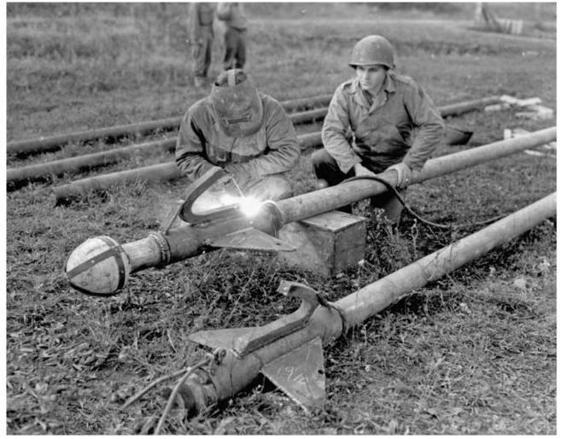

The length of the demolition snake can be seen in this view outside Metz on 2 October as the crew assembles the individual lengths of pipe. The extreme length of the device made it very difficult to use in rough terrain.

On 6 October, the crew of an M4 tank of the 7th Armored Division helps ordnance repair crews swap out a Continental R975 radial engine. This radial aircraft engine powered both the M4 and M4A1 versions of the Sherman tank.
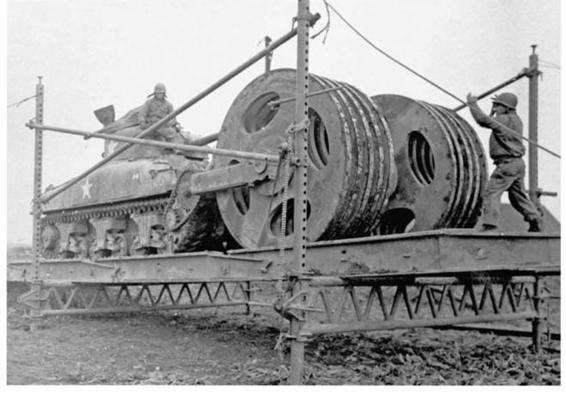
This M32B1 of the 712th Tank Battalion has been adapted to carry a length of treadway bridge on the front. This field conversion was undertaken for use in crossing moats protecting the fortresses near Metz during the fighting there in October.
The M3 half-track was widely used for utility tasks. Here, troops of the 146th Armored Signals Company, 6th Armored Division, lay field telephone wire from the rear of an M3 half-track on 5 October.


A T1 E3 Aunt Jemima mine exploder temporarily attached to the 25th Armored Engineer Battalion, 6th Armored Division, rolls down a road near Nancy, France, on 7 October. These types of engineer tanks became more common in the ETO in the autumn of 1944 because of the increasing threat of mines along the heavily fortified German frontier.

A T1 E3 of the 25th Armored Engineer Battalion, 6th Armored Division, crosses the Moselle River on a treadway bridge near Liverdun, France, on 7 October.
An M4 with a T1 E3 Aunt Jemima mine exploder of the 25th Armored Engineer Battalion, 6th Armored Division near Nancy. This provides a good view of the rear pusher plate; if the mine-exploder tank became stuck, another tank could be moved up behind it and use this plate to give it a push.
On October 8, Mobile Regiment von Fritzchen attempted to push the 30th Division out of Alsdorf. Here, the 117th Infantry has established an antitank defense in the streets of neighboring Schauffenburg using a 3-inch antitank gun of the attached 823rd Tank Destroyer Battalion along with a bazooka team and a .50-caliber heavy machine gun.
An M4 medium tank of the 707th Tank Battalion provides fire support for the 28th Division during fighting against pillboxes of the Siegfried Line along the German frontier east of Elsenborn, Belgium, on 9 October. On the rear hull is painted “Phone,” showing where the field telephone is stowed to allow accompanying infantry to communicate with the tank crew. This became an increasingly common fixture on the tanks in separate tank battalions to assist in tank-infantry cooperation in close combat.
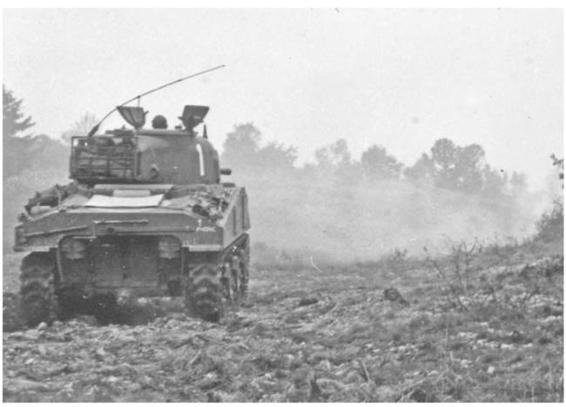
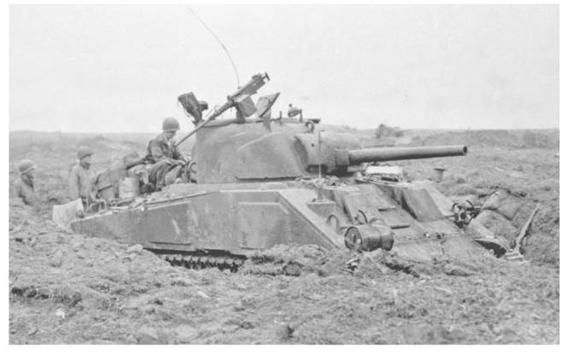
In early October, the 2nd Armored Division was used to enlarge a gap in the Westwall around Ubach. An M4 tank of the 3/67th Armored Regiment, 2nd Armored Division, stands guard in an entrenchment on 10 October. Americans having fought through the Siegfried Line, the front turned into a stalemate by early October. This M4 is of the laterproduction type with the M34A1 gun mount and a full set of hull and turret applique armor. The attachment of a spare ten-gallon oil can on the right fender was common practice in some tank units in 1944.
The crew of an M12 155mm gun motor carriage (named The Babe) loads a round into the gun during the bombardment of Fort Driant, part of the Metz fortifications, during Patton’s difficult campaign around the fortified city on 10 October. Metz was a thorn in Patton’s side for most of the autumn of 1944.


Because of shortages of American minefield-breaching equipment, the U.S. Army obtained small numbers of Crab flails from the British. They were first used by a platoon of the 747th Tank Battalion during Operation Cobra in July. Due to the small number available, the U.S. Army frequently requested the assistance of the British 79th Armoured Division to provide flail tank support, and this Crab is in use near Breinig, Germany, on 11 October.
The most common method used by the U.S. Army in the ETO for rapidly breaching minefields was the use of mine rollers like this T1 E3 near Nancy, seen on 11 October. They were first used in combat by the 6th Armored Division in July, but there was no extensive use until the fall.
The commander of a new M4A3 tank of the 6th Armored Division observes an air strike by fighter-bombers of the Ninth Air Force on 13 October in eastern France. This particular version of the Sherman tank was powered by a Ford in-line engine in place of the Continental radial used in the M4 and M4A1 versions. It was not widely seen in the ETO until September-October.

The short-range street fighting along the German border in October saw far more extensive use of German Panzerfaust antitank rockets. As a result, American tank units began adding sand bags to the glacis plate of the tank in an attempt to improve protection. This is an M4 of the 3rd Armored Division carrying troops of the 36th Infantry during operations near Stolberg on 14 October.
The crew of an M8 75mm howitzer motor carriage of Company E, 2nd Cavalry Group, prepares for a fire mission near Parroy on 14 October. The crew is lined up in a chain to pass ammunition from the M10 ammunition trailer to the howitzer crew.
An M8 75mm howitzer motor carriage crew of Company E, 2nd Cavalry Group, cleans out the barrel of its vehicle during a lull in the fighting near Parroy, France, on 14 October.
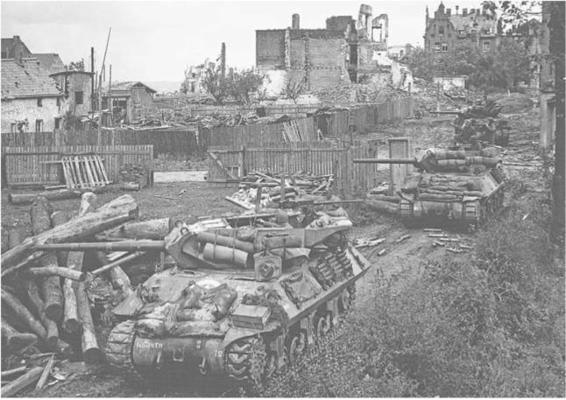
M103-inch gun motor carriages of Company A, 634th Tank Destroyer Battalion, fight their way into the outskirts of Aachen on 14 October. Aachen was the first German city entered by Allied forces, and the fighting there was particularly intense. The M1 Os are lateproduction types with the improved duckbill turret counterweights. Notice that these vehicle have started to carry sand bags on the glacis plate, an attempt to provide added protection to the thin frontal armor against German Panzerfaust antitank rockets.

A pair of M10 3-inch gun motor carriage tank destroyers of the 634th Tank Destroyer Battalion in action inside Aachen. This battalion was assigned to the 1st “Big Red One” Infantry Division for most of the ETO campaigns.

Infantry from the 1st Infantry Division advance behind an M10 3-inch gun motor carriage of the 634th Tank Destroyer Battalion during the fighting in Aachen.
The extent of the damage in Aachen is evident in this view of an M10 of the 634th Tank Destroyer Battalion. The city had suffered from both aerial bombardment and preparatory artillery bombardment, and much of the debris had already been cleared up by German civilians before the actual street fighting began.
The M10 3-inch gun motor carriage accompanying the 1st Infantry Division team fires down a street in Aachen on 15 October.

Catalina Kid, an M4 medium tank of Company C, 745th Tank Battalion, follows the tank dozer through the entrance to the Aachen-Rothe Erde railroad station during the fighting around the city viaduct.
An M4 dozer tank of the 745th Tank Battalion breaks an opening at one of the Aachen railroad stations during the fighting for one of the viaducts leading into the city at the start of the Aachen fighting in mid-October.
A counterattack by the 3rd Panzer Grenadier Division in Aachen on 15 October is met here by elements of the 26th Infantry, 1st Infantry Division, supported by M4 tanks of the 745th Tank Battalion. The M4 on the left is still fitted with its wading trunk from the landing in Normandy. The 745th Tank Battalion supported the 1st since Normandy, and the tank to the left is still fitted with its rear wading trunk from the landing.
The tactics of the 26th Infantry during the Aachen street fighting used firepower to reduce German defenses. Here, infantrymen of 2/26th Infantry look on while an M4 medium tank of the 745th Tank Battalion blasts away on 15 October.

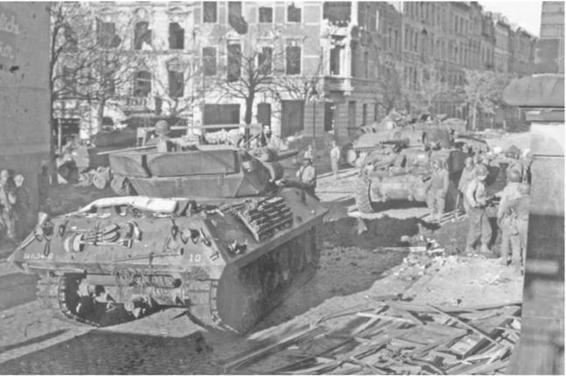
The armored support elements of the 1st Infantry Division meet at an intersection in Aachen. In the foreground is an M10 3-inch gun motor carriage of the 634th Tank Destroyer Battalion while in front of it is an M4 tank of the 745th Tank Battalion. Barely evident in the upper left is one of the new M4A3E2 assault tanks, a newly arrived type of Sherman with added armor and specifically intended for fighting against fortified objectives.
Another view of the M 10 tank destroyers and M4 medium tanks supporting the 26th Infantry, 1st Infantry Division, during the fighting around one of the city viaducts. A bulldozer has been brought in to help clear up rubble.


An M2A1 half-track car attached to an antitank company brings a 57mm antitank gun forward during the bitter street fighting in Aachen on 15 October. The 57mm gun was an American copy of the British 6-pounder, and its auxiliary splinter shield can be seen stowed on the side of the half-track.
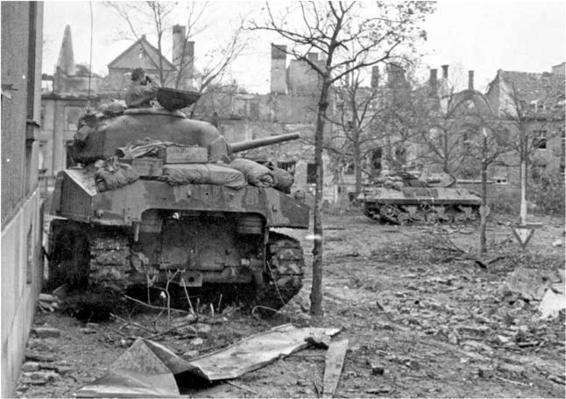
An M4 of the 745th Tank Battalion provides overwatch as an M10 tank destroyer moves forward on 20 October during the final stage of the Aachen fighting. The German troops finally surrendered the next day when an M12 155mm gun motor carriage was used to reduce the commander’s bunker at pointblank range.
A heavily camouflaged M10 3-inch gun motor carriage tank destroyer in action with Patton’s Third Army in Lorraine.


Kampfgruppe Rink (Battle Group Rink) from SS Panzer Grenadier Regiment 1 attempted to evacuate its wounded out of Aachen on 20 October using their surviving Sd.Kfz. 251 half-tracks but were captured by an American tank roadblock on Oststrasse in Kohlscheid.

An M31 armored recovery vehicle provides assistance in repairing an M4 tank of the 66th Armored Regiment, 2nd Armored Division, in the city of Alsdorf, Germany, on 15 October. The crew appears to be replacing the T51 rubber block tracks seen on the left side with T49 metal grouser track. Once the wet autumn weather arrived in 1944, the smooth rubber block track developed a reputation as “suicide track” since it provided poor traction in the mud.
The 88mm flak gun was the most feared nemesis of American tanks during the 1944 fighting. This example has been abandoned by the road in Gradvillers and is seen on 13 October.
The crew of Idle, an M4 tank of the 3rd Battalion, 66th Armored Regiment, 2nd Armored Division, does its daily chores in the outskirts of Alsdorf on 15 October. While some of the crew handle suspension repair, one of them shaves.
An M31 (named Invader) of the 3rd Battalion, 66th Armored Regiment, 2nd Armored Division, pulls a damaged M4 across an engineer bridge near Palenberg, Germany, on 15 October.


The Wehrmacht made frequent use of captured equipment, especially French motor transport equipment. In 1943, some French Unic Kegresse P107 halftracks were armored, and this particular example was captured by the Third Army. This Leichter Schutzenpanzerwagen U304(f) differs from the more common style in that it is fully enclosed. This was done since this particular vehicle was used as a radio command vehicle for three tactical radios.
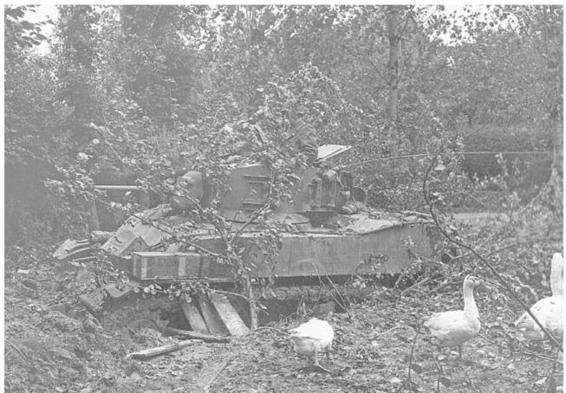
A heavily camouflaged M5A1 light tank (named Malt) from the 2nd Armored Division occupies a depression near Baeswiller on 19 October while a clutch of geese look on. The 2nd Armored Division, alongside the 30th Division, had pushed a gap through the Siegfried Line the previous week.

This photo provides a clear idea of how cramped the turret of the M8 75mm howitzer motor carriage was with the full crew in place. This is a vehicle from the 24th Cavalry Reconnaissance Squadron near Monshau, Germany, on 20 October.
An M7 105mm howitzer motor carriage of Battery B, 253rd Armored Field Artillery Battalion, sits under a camouflage net while awaiting firing instructions with Patton’s Third Army in Lorraine on 23 October.

An M31 tank-recovery vehicle of the 32nd Armored Regiment, 3rd Armored Division, towing a disabled M3 half-track passes by an aqueduct near Stolberg, Germany, on 24 October. Although the new M32 tank-recovery vehicle was the authorized equipment in tankmaintenance units, a number of older battalions still employed the M31 through the end of the war.
A view of the holding area of the 25th Ordnance Battalion near Eupen, Belgium, on 6 October. This shows one of the first shipments of the new M36 90mm gun motor carriage tank destroyers to the left. In the lower foreground is an M8 75mm howitzer motor carriage, and behind is an M4 105mm assault gun. Ordnance units were tasked with removing the waterproofing from armored vehicles that had recently arrived on board ships from the United States or Britain and preparing them to be issued to combat units.
Two German officers inspect an M5A1 of Company D, 747th Tank Battalion, knocked out in Geilenkirchen in late October while supporting the 29th Division. The officer on the right is pointing with his cane to the Culin hedgerow cutter, still fitted on the bow.

The first M36 90mm gun motor carriages arrived in France in September, but they were not commonly deployed until October because of the need to train the crews and create adequate logistical support. Here, a unit trains on the new vehicles in France on 14 October.

This interesting comparison view shows the M10 3-inch gun motor carriage in front of one of the new M36 90mm gun motor carriages in Stolberg with the 703rd Tank Destroyer Battalion on 24 October. The new M36 helped redress the problem of dealing with heavier German tanks such as the Panther and Tiger I.

A close-up view inside the turret of a M36 90mm gun motor carriage near Toul, France, on 24 October. As is evident in this view, tank destroyer crews usually wore the normal steel helmet in combat, as the tanker’s helmet offered no ballistic protection.
U.S. artillery units occasionally used captured German artillery until stocks of captured ammunition were exhausted. Here, ordnance troops in Rheims prepare a number of 88mm PaK 43 antitank guns prior to being issued to U.S. Army artillery units.
This is a view of one of the captured 88mm PaK 43 antitank guns seen after being emplaced by the 733rd Field Artillery Battalion on 25 October. Curiously enough, the battery used a captured and repainted Sd.Kfz. 251 Ausf. D half-track as the prime mover for the gun.

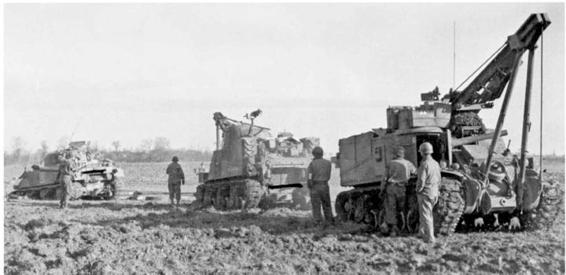
Mud was a major obstacle in tank operations along the Siegfried Line in October-November because of the unusually wet weather. Here, a pair of M31 tank-recovery vehicles try to extract an M4 tank of the 747th Tank Battalion that became bogged down during operations on 29 October.

The rainy autumn of 1944 created mobility problems for tanks due to the mud. To improve the traction of the Sherman and other American tanks, the U.S. Army began to fit the tank tracks with extended end connectors, also known as duck bills, which increased the track area and so lowered ground pressure. Here, the crew of an M4 of the 3rd Armored Division fastens extended end connectors to the track of their tank in the Stolberg area on 31 October.
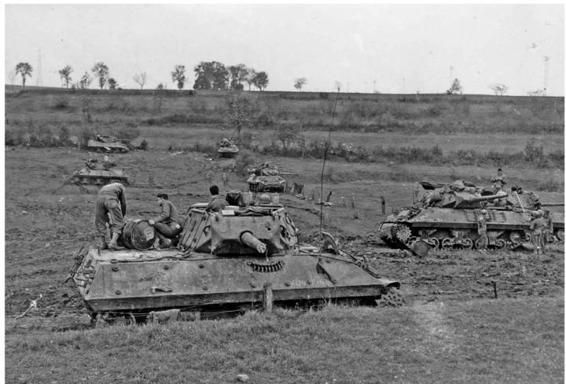
M10 3-inch gun motor carriage of the 818th Tank Destroyer Battalion in a night bivouac during the fighting in Lorraine on 29 October while supporting the 5th Infantry Division.
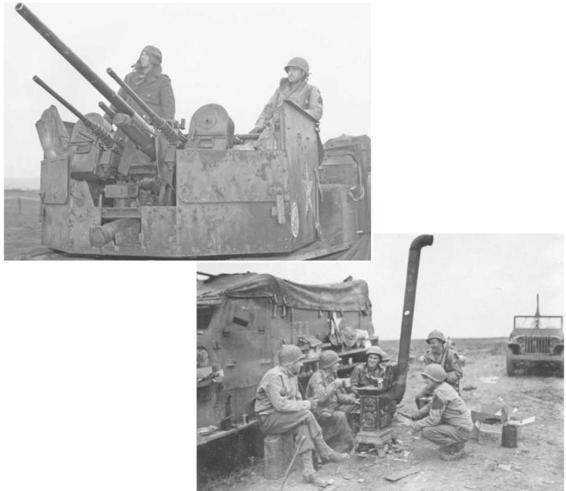
A Patterson antiaircraft half-track conversion on an M2 half-track serving with the 460th Anti-Aircraft Artillery Automatic-Weapons Battalion (Mobile) in Germany on 2 November. This view shows the characteristic skate ring around the M2 fighting compartment, and spare .50-caliber barrels can be seen wedged in behind the skate ring. The Maxson turret is fitted with a mechanical ring sight instead of the usual optical sight.

The crew of an M3 half-track warm up around a stove near Zwiefall, Germany, on 3 November. Senior commanders often complained that armored infantry battalions equipped with half-tracks developed the appearance of “a gypsy caravan” because of their tendency to haul around anything that would fit in and on their half-tracks.
An M15A1 combination gun motor carriage of the 390th Anti-Aircraft Artillery Battalion in operation near Hoeville, France, on 3 November with Patton’s Third Army. Although the Luftwaffe was very weak in the West, raids became more frequent in the autumn of 1944 as Allied forces pressed toward Germany.
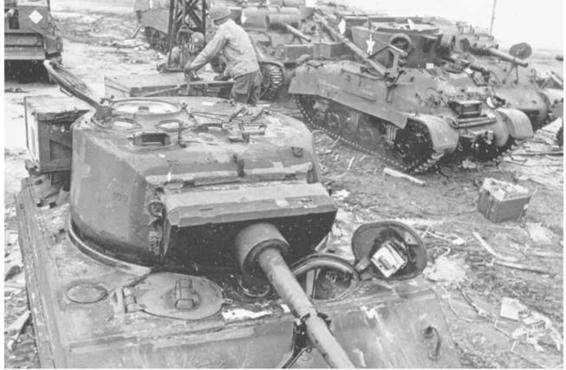
The intense fighting along the Siegfried Line and in Aachen convinced the U.S. Army of the need for a more heavily armored tank to provide close support. A solution was already in the works since February 1944 in the form of the M4A3E2 assault tank. This tank had the same 75mm gun as the normal M4, but had thicker armor on the turret and hull. This is an M4A3E2 in one of the ordnance yards in France on 4 November being prepared after shipment for issuance to a tank unit. It provides a good view of the new turret and the thick gun mantlet.
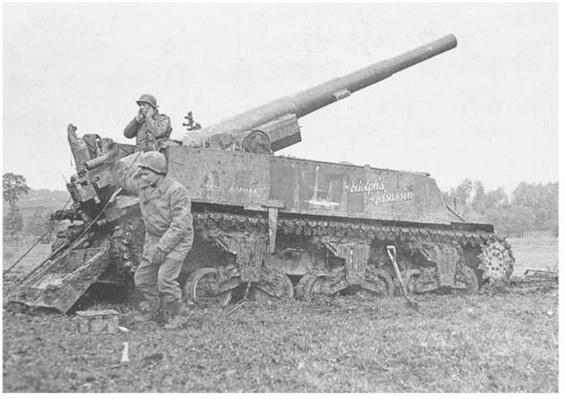
An M12 155mm gun motor carriage (named Adolph’s Assassin) from Battery A, 991st Armored Field Artillery Battalion, prepares to fire near Kornelimunster, Germany, on 4 November. This view shows the 155mm gun elevated near its maximum. By this stage, the battalion’s distinctive unit insignia has been painted over compared to photos of the unit seen earlier in this book.

An M10 3-inch gun motor carriage of the 893rd Tank Destroyer Battalion drives down a road toward Schmidt in the Hurtgen Forest in Germany on 4 November. The tank destroyers were brought up in an attempt to reinforce American infantry that had been subjected to a tank attack by Panthers of the 116th Panzer Division that day. Three M4 tanks were the first to arrive and blunted the German attack. The fighting in the Hurtgen Forest, mainly by U.S. Army infantry units, was one of the army’s bloodiest campaigns in Europe in 1944-45.
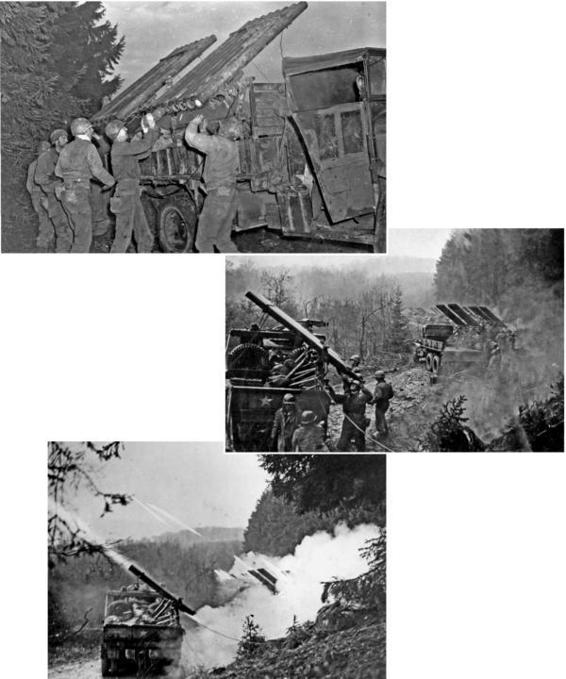
The crews of the 18th Field Artillery finish loading the Xylophone rocket launchers during operations on 26 November.
The Hurtgen Forest fighting saw one of the rare uses of mobile rocket launchers by the U.S. Army with the deployment of the 18th Field Artillery Battalion for fire support. They were equipped with the 4.5-inch T32 Xylophone launcher, which consisted of two pairs of eight 7.5-foot launch tubes for a total of thirty-two tubes, mounted laterally on the rear of a 2.5-ton truck and firing the fin-stabilized M8 4.5-inch rocket. Here the crews are loading the launcher.
Here, the 18th Field Artillery Battalion fires a salvo of 4.5-inch rockets during the Hurtgen Forest fighting on 26 November.
The commander of an M5A1 light tank of F Troop, 113th Cavalry Recon Squadron, fires his .45-caliber Thompson submachine gun at targets near Kievelberg on 5 November.

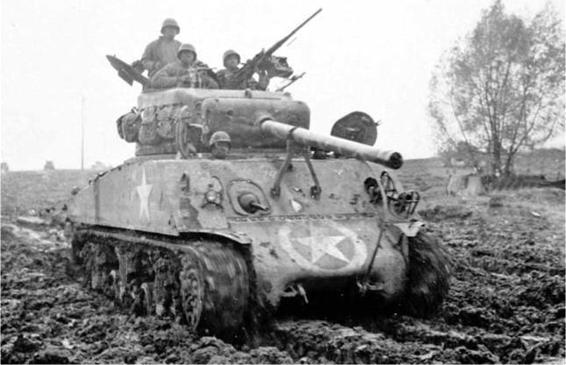
The U.S. Army was still segregated in World War 11, and this extended to tank units as well. Two black tank battalions saw combat service in Northwest Europe in 1944. The 761st Tank Battalion is the more famous, receiving the Presidential Unit Citation for its combat performance. This is an M4A3 (76mm) of the unit operating near Nancy, France, on 5 November.
The crewmen of Company D, 761st Tank Battalion, prepare their M5A1 light tanks.


An M4A3 (76mm) of Company A, 761st Tank Battalion, passes over a Bailey bridge in Vic-sur-Seille on 9 November during operations by Patton’s Third Army in Lorraine.

An armored bulldozer is used to clear up the streets of Gersonsweiler on 2 November.

Although few LVT amphibious tractors had been used in the Normandy campaign, they were deployed to the ETO in the autumn of 1944 for potential use in river crossings. Here is an LVT-4 entering the water on 7 November.
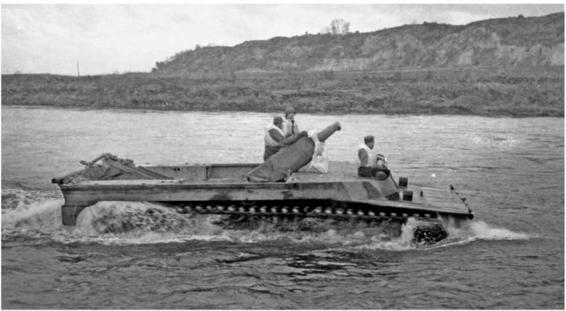
Another view of an LVT-4 during a training exercise on 7 November. These amtracs were often operated by tank battalions, and some practice was needed for crew familiarization.

Another problem addressed in the autumn of 1944 was the poor camouflage discipline of American tank crews. The First Army decided that the best solution would be for specialized engineer troops to take care of the matter. As a result, starting in October, the 602nd Engineer Camouflage Battalion developed a standardized method for applying camouflage paint to the tanks and adding a layer of Sommerfield matting over the main surfaces for the attachment of foliage. Entire tank battalions were painted during refits. The usual camouflage was black over olive drab, but some units had other colors added if paint was available. This is an M4A3 (76mm) of the 9th Armored Division, one of the units that was systematically camouflaged in the autumn of 1944.

This photo shows the 602nd Engineer Camouflage Battalion welding Sommerfield matting to the side of an M4A3 (76mm). Surprisingly, this tank still has sand shields fitted. There was an official policy in 12th Army Group to have sand shields removed as they interfered with maintenance.

This is a good example of an M4 (named Bucks) of the 4th Armored Division near Eupen, Germany, on 8 November after the Sommerfield matting has been added. They are listening to the results of the 1944 elections over the tank radio.
Surrendering German troops pass near an M4 tank of Company C, 735th Tank Battalion, near Vigny, France, during the fighting near Metz on 10 November.
An M16 antiaircraft half-track (named Chief) covering a river ford near Pont-aMusson, France, on 10 November with the Third Army. The lack of internal stowage space due to the moving turret forced M16 crews to place most of their stowage over the bulkhead separating the driver’s compartment and the fighting compartment or on the winch bumper frame.


A mud-covered M10 3-inch gun motor carriage of the 774th Tank Destroyer Battalion in support of the 5th Infantry Division around Metz on 12 November.
An M10 3-inch gun motor carriage tank destroyer (named Burnside) in a dug-in position near Geilenkirchen in the U.S. Ninth Army’s sector on 10 November. This town was on the border between Bradley’s 12th Army Group and Montgomery’s British 21st Army Group and was the scene of intense fighting through the late autumn of 1944.
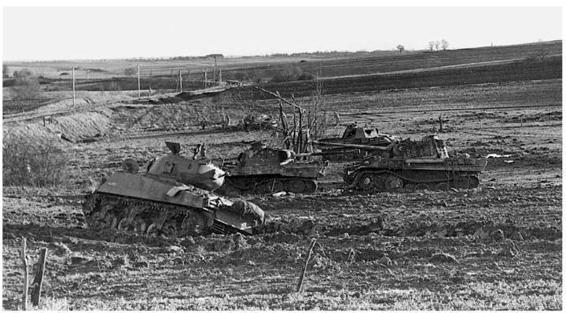
During mid-November, Patton’s Third Army fought a series of engagements with the 11th Panzer Division in Lorraine, east of Chateau Salins. The 4th Armored Division engaged in a string of savage tank battles starting on 14 November near Guebling, which saw additional fighting on 19 November when the 761st Tank Battalion was supporting the 26th Infantry Division in the area. This is a scene along the road between Guebling and Bougaltrof showing three knocked-out Panther Ausf. G’s and an Sd.Kfz. 250 of the 11th Panzer Division. In the foreground is an M4A3 (76mm) (named All Hell) of Company A, 35th Tank Battalion.
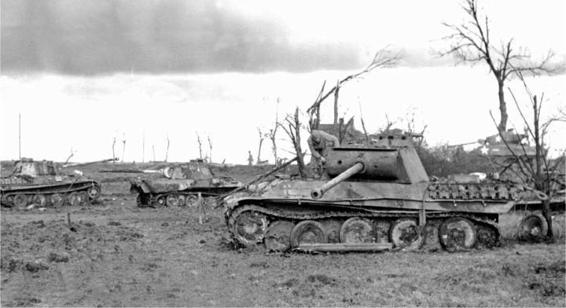
This is a view of the same scene from the opposite direction, showing three of the knocked-out Panthers from the 11th Panzer Division near Guebling.

An M10 3-inch gun motor carriage (named Duke of Paduka) of the 712th Tank Destroyer Battalion rolls through Metzervisse, Germany, on 17 November while in support of the 90th Division near the French Maginot Line fortifications. This unit had repulsed an armored attack by a battle group of the 25th Panzer Grenadier Division two days before near the Moselle River crossing, and on 14 November, it was part of a large U.S. armored force attempting to clear out the area on the east bank of the river north of the fortress city of Metz.
Tank units frequently used the shelter of small towns when not committed to the fighting. These are M4A3 tanks of the 10th Armored Division on the streets of Tetange, Luxembourg, on 13 November.

A view of the muddy fields around Conthil, France, on 14 November during fighting by CCB of the 4th Armored Division. This is the headquarters company of the 37th Tank Battalion, and the M4A3 (76mm) is Thunderbolt V1, the command tank of Lt. Col. Creighton Abrams, the battalion commander.
The 6th Armored Division received a number of M4A3E2 assault tanks in November, and this one was hit with six 88mm rounds during fighting near Neid, France, on 16 November. It is seen here being repaired by divisional maintenance crews.

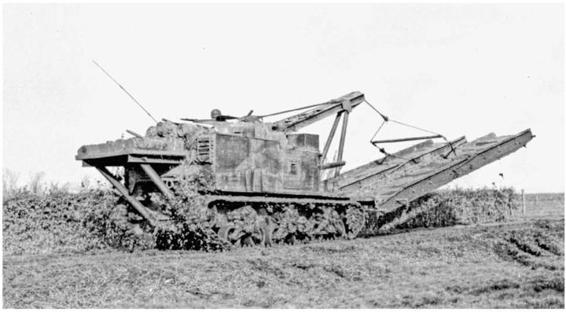
Antitank ditches and other obstructions were a constant hindrance during operations along the Siegfried Line, leading to many improvisations by the armored engineers. One particularly popular innovation was the development of fittings that permitted M31 tank-recovery vehicles to carry and deploy treadway bridge sections to breach these gaps. This example is being used by the 17th Armored Engineer Battalion of the 2nd Armored Division near Beggendorf on 16 November at the start of Operation Queen, the failed offensive to reach the Roer River.

The crew of an M4 medium tank refuel its tank in Beggendorf on 17 November.
An M31 tank-recovery vehicle of the 2nd Armored Division near Loverich, Germany, on 18 November. Two large attachments have been welded to the final drive housings for use as an improvised treadway bridge layer.

German prisoners aid a wounded comrade past an M4 medium tank during the fighting on the German frontier, 18 November.
A patrol of infantry of the 29th Division passes a burned-out Panther of the 9th Panzer Division in Immendorf on November 16 at the start of Operation Queen.
The gun of this M12 155mm gun motor carriage is in full recoil as it fires on a German pillbox near Grossenich, Germany, on 16 November. The substantial amount of gas created by firing kicked up a quite a storm of mud and dirt in front of the vehicle when fired at low elevation. These self-propelled guns were one of the most popular methods used by the First Army in its attempts to crack open bunkers along the Siegfried Line.

The M20 armored utility vehicle was frequently used as a command car for senior commanders. This is the armored car of Gen. George S. Patton, commander of the Third Army, near Metz in November. Typical of command cars, it carries the red metal flag on the front with Patton’s rank insignia. Sitting in the armored car with the general is Averill Harriman, American ambassador to the Soviet Union, who was visiting troops at the time.
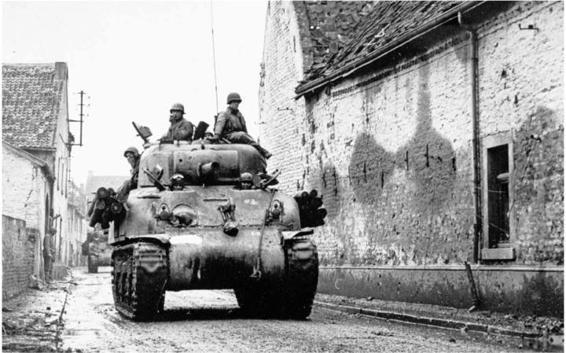
An M4A1 of the 2nd Armored Division passes through Beggendorf on 17 November, one of the towns taken in the Aachen fighting that served as the First Army’s salient toward the Roer River. The tank is carrying logs that were used to drop under the tanks as unditching beams if the tank got stuck in the mud. This was a common practice in the division during the November Roer River offensive.

Two M31 tank-recovery vehicles of the 2nd Armored Division during operations near Beggendorf on 17 November.
The crew of an M31 tank-recovery vehicle of the 6th Armored Division tries to extract its bogged vehicle during operations near Luppy, France, on 17 November.

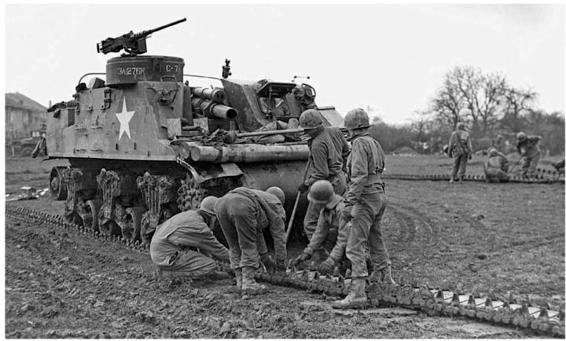
Track repairs on an M7 105mm howitzer motor carriage of Battery C, 276th Armored Field Artillery Battalion, 6th Armored Division, near Brulange, France, on 17 November.

Daily chores, including swabbing out the barrel of the vehicle’s 75mm howitzer are completed by the crew of an M8 75mm howitzer motor carriage.

An M7 105mm howitzer motor carriage of Battery A, 78th Armored Field Artillery Battalion, 2nd Armored Division, passes through Beggendorf, Germany, on 18 November during the fighting with the 9th Panzer Division.
An M2A1 half-track car of the Third Army passes through the ruins of Xousse, France, in the Nancy area on 18 November. The side mine rack has been converted to carry jerricans of fuel or water.
Two M1 Os move up a steep forest road in the Hurtgen Forest on 18 November during attempts to reinforce American infantry units fighting in the forest during the second phase of the battle that started on 16 November. The U.S. units were not able to fight their way through the shell-shattered woods until early December, after suffering horrible casualties.

This Sd.Kfz. 251 Ausf. D half-track from Aufklarungs Abteilung 11 (11th Reconnaissance Battalion), 11th Panzer Division, was knocked out in the fighting for Grostenquin on 19 November by CCB, 6th Armored Division, during the fighting along the Maginot Line.
On 19 November, an M3A1 half-track passes through a gap of metal antitank “dragon’s teeth” that had been laid near the French-German border.
During the Roer River offensive in late November, the 84th Division was the northernmost American unit in Europe, rubbing shoulders with the British 43rd Infantry Division to its north. The town of Geilenkirchen straddled the British and American zones, so the British provided tank support for U.S. infantry operations in the town, as seen here on 19 November, with British Shermans providing fire support for the GIs.
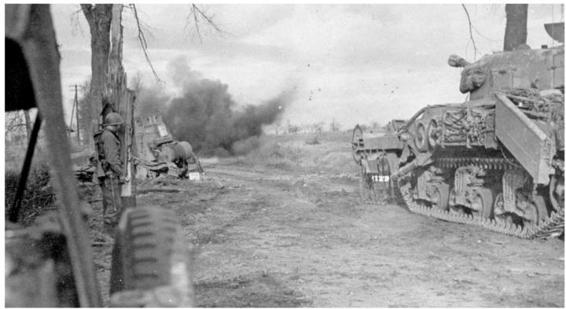
Next to the Dutch border, Geilenkirchen was the start of a major line of German fortifications and mine fields. So British Crab flail tanks helped the U.S. 84th Division clear approaches near the town during the 19 November fighting.

While not as common a practice as in Italy, tanks in Northwest Europe were sometimes used to provide indirect artillery fire support. This M4A1 of the 32nd Armored Regiment, 3rd Armored Division, along with other tanks from the unit are being used as improvised artillery during the Roer River offensive on 19 November.

An enormous heap of 75mm ammunition transport containers have built up alongside an M4 medium tank being used to provide artillery fire support near Vicht, Germany, on 17 November.
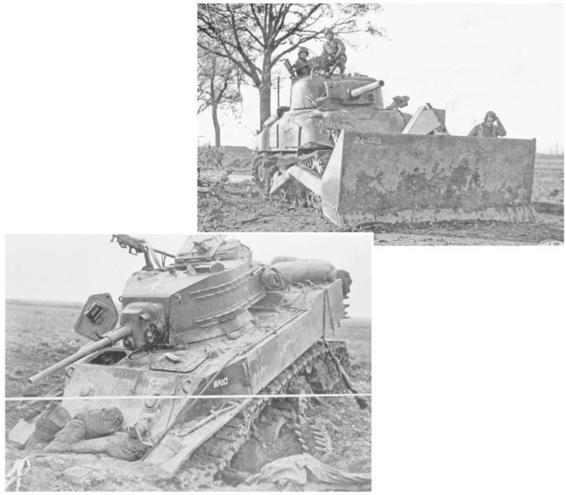
An M4A1 dozer tank from Company I, 3rd Battalion, 66th Armored Regiment, 2nd Armored Division, clears a road during the Roer River offensive on 19 November. It ran over a mine on its right side, which has bent the M1 dozer assembly and ripped up the front bogie.
An M5A1 light tank (named Bric) from the 2nd Armored Division sits in a crater after having its front bogie blown off by a mine near Loverich, Germany, in late November. The fighting for the Roer area took place in very muddy conditions, which made it difficult to employ armor.

One of the first units into combat with the new M4A3E2 assault tank was the 743rd Tank Battalion, which was allotted fifteen in November while supporting the 30th Infantry Division. This tank was knocked out near Fronhoven in late November after having been hit by four 88mm rounds from an antitank gun about 800 yards away near Lohn. One bounced off the glacis plate and two off the mantlet before a lucky hit actually entered the telescope opening. Although not immediately apparent, this vehicle was fitted with a flamethrower in the hull machine-gun position. This shot provides a unique view of the contours of the lower turret.

This German StuG IV assault gun was abandoned in a shell hole after having suffered a catastrophic internal ammunition fire, which blew off its roof.

This is a front view of the same M4A3E2 knocked out near Fronhoven. An 88mm hit on the glacis plate obliterated some sand bags on the hull front. Three other hits are evident on the front, including one near the gun tube, one on the upper edge of the mantlet, and one on the upper edge of the glacis plate.
Another M4A3E2 assault tank of the 743rd Tank Battalion was knocked out in late November near Fronhoven after having run over an American mine, immobilizing it. It was then hit by eight 88mm antitank projectiles at a range of about 800 yards. One round penetrated the right sponson and set the tank on fire, but the other rounds failed to penetrate. The M4A3E2 was the only U.S. tank able to absorb this amount of punishment.
The turret interior of the Sherman was more spacious on the left side to permit the loader to access the gun. This is a view down into the loader’s station of an M4A3 of the 774th Tank Battalion near Welfrang, Luxembourg, on 20 November. He is placing rounds in the forward wet stowage bin on the floor. The coaxial .30caliber machine-gun breech can be seen immediately above his left shoulder, and the gun breech to the right of the photo.

An M8 75mm howitzer motor carriage of the 82nd Armored Reconnaissance Battalion, 2nd Armored Division, leads a column through Setterich, Germany, on 20 November during the fighting with the 9th Panzer Division. The open turret of the M8 75mm howitzer motor carriage left the crew exposed to the wet autumn weather, and a tarp was often draped over the opening to shield against the cold rain.
Pvt. Robert Starkey of the 16th Infantry, 1st Infantry Division, stands beside the burnt-out hulk of the Jagdpanzer IV tank destroyer he knocked out with his bazooka near Hamich, Germany, on 22 November. The bazooka explosion detonated the vehicle’s ammunition, leading to a catastrophic internal fire that blew open the vehicle superstructure.
An M8 armored car of the 17th Cavalry Group, supporting the Ninth Army, passes the wreck of a German StuG I I I assault gun from the 3rd Panzer Grenadier Division in Kinzweiller, Germany, on 21 November. The town was taken on 19 November by the 117th Infantry Regiment, heavily supported by armor.

An M36 90mm gun motor carriage of Company C, 607th Tank Destroyer Battalion, takes up position in Metz on 20 November. Patton’s Third Army made a failed attempt to seize the city in September and finally succeeded on 19 November when two infantry regiments and Task Force Bacon made their way into the city.
A Panther Ausf. G of I I./Panzer Regiment 33, knocked out during the fighting around Immendorf and photographed on 23 November.
Another view of the same M36 taken a day later in Metz, with the French civilians finally emerging from their basements. Metz is a fortress city on the German-French frontier that has often been contested. Patton later boasted that his troops were the first to capture the fortress city since Attila the Hun in 415.
An M10 from a tank destroyer battalion of Patton’s Third Army near Fort Koenigsmacker in the Metz defensive belt on 21 November. This unit was supporting the 90th Division and Task Force Bacon during the final assault on Metz, where resistance finally collapsed the next day after having held out for almost two months. This vehicle appears to have an armored roof fitted over the rear of the turret, but it is obscured by the tarp.


American troops advance through the outskirts of Metz as the German defenses were in the final stage of collapse after two months of determined resistance. Behind the GI is an M8 light armored car and an abandoned 88mm PaK 43 antitank gun.

This Jagdpanzer 38(t) Hetzer was knocked out by a bazooka hit during the fighting in the U.S. Ninth Army’s sector near Aldenhoven on 21 November.
The Flakpanzer IV Wirbelwind was a quadruple 20mm FIaK 38 mounted in an open turret on Pz.Kpfw. IV hulls. These were first deployed in France in the late summer of 1944, and this example was knocked out during the fighting around Metz.
A Jagdpanzer IV from the 11th Panzer Division knocked out in the fighting with the 6th Armored Division near St. Jean Rohrbach on 22 November. The gun mantlet was knocked off by a tank-gun hit.

This Sd.Kfz. 250/9 was captured in France in 1944 from the 116th Panzer Division and is on the later Neu chassis with the Hangelafette gun mount.
A rear view of the Sd.Kfz. 250/9 of the 116th Panzer Division showing the division’s standard leaping greyhound insignia, as well as the tactical insignia for a half-track reconnaissance unit. There is also a unit insignia in the shield to the right.


This rear view of the same M4A3 (76mm) tank shows that it is fitted with the T49 metal grouser tracks, one of the better solutions for muddy conditions compared to the rubber block track but still far from perfect.
One of the main problems facing tank crews in the autumn of 1944 was the poor mobility of the M4 in muddy conditions. This new M4A3 (76mm) has completely bogged down in the mud while supporting the 84th Division during fighting in Germany on 24 November.

One of the most serious tactical shortcomings in American tanks was the difficulty in communicating with neighboring infantry. The tank radios could not communicate with the infantry’s radios. The solution was either to rackmount an infantry radio like the SCR-300 into some tanks or to attach an exterior phone to the tank. This is an M4 of the 709th Tank Battalion with an exterior phone added inside a .30-caliber metal ammunition box. It is put to use here during operations with the 81st Division near Zweifall on 24 November.

In the autumn of 1944, two secret Leaflet tank battalions, the 738th and 739th, were converted into specialized tank battalions for the use of minefieldclearing equipment. These had a company with eighteen T1 El mine rollers, two companies with twelve T1 E3 mine-roller tanks, and six dozer tanks. The 739th Tank Battalion (Special) was deployed with the Ninth Army on 24 November. This M4 is fitted with the T1 E3 mine rollers and is passing through Beggendorf, Germany, on 10 December.
An M12 155mm gun motor carriage (named Buccaneer) prepares for a fire mission in France on 25 November. The crew waits behind with another round, and the gunner at the far right can be seen holding another propellant bag charge.
An interesting photo of an E4-5 flamethrower mounted on an M4 tank of the 709th Tank Battalion near Zweifall, Germany, on 24 November. The photo is doubly interesting as the tank is still fitted with one of the rare “Green doze” hedgerow cutters more commonly associated with the 747th Tank Battalion in Normandy.

This shows the same tank a few days later. Engineers have marked the vehicle with tape to prevent the curious from stumbling into the minefield. The tank is so deeply bogged in the mud that an armored-recovery vehicle would be needed to repair it. In the days since it was knocked out, it has become draped with field telephone wires as well as a means to keep the wires out of the mud and puddles.
An M4A3 (76mm) of the 6th Armored Division disabled by a German mine near Hellimer and Grostenquin on 25 November. It has become thoroughly trapped in the mud.

The M4’s floatation problem in mud became even worse after the troops began adding improvised sand-bag armor on the hull front and hull sides. This is an M4A3 (76mm) of the 743rd Tank Battalion near Eschweiler, Germany, in November.
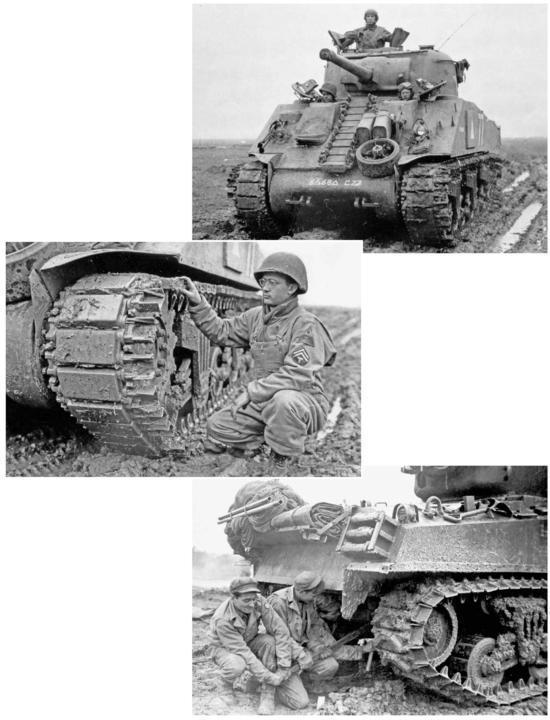
The solution to the floatation problem was to attach extenders to the track end connectors, and these can be seen on this tank from Company C, 69th Tank Battalion, 6th Armored Division. These were given various nicknames by the troops, such as “duck bills” or “duck feet.”
Troops from the 531st Heavy Maintenance (Tanks) Company tighten the track tension on an M4A3 (105mm) at the maintenance yard in Etain, France, on 27 November. They have just added duck-bill extenders to the track.
This close-up shows the extended end connectors fitted to the track. The extra several inches of ground contact reduced the overall ground pressure of the tank, improving its mobility in muddy terrain.

The crew of a new M4A3 (105mm) assault gun shown in the previous photo try out the new duck-bill extenders in the yard at the Etain tank depot in November.

An M4 (105mm) assault gun of the 3rd Armored Division sits well concealed under improvised camouflage in the ruins of Eschweiler on 26 November during the Roer River offensive.
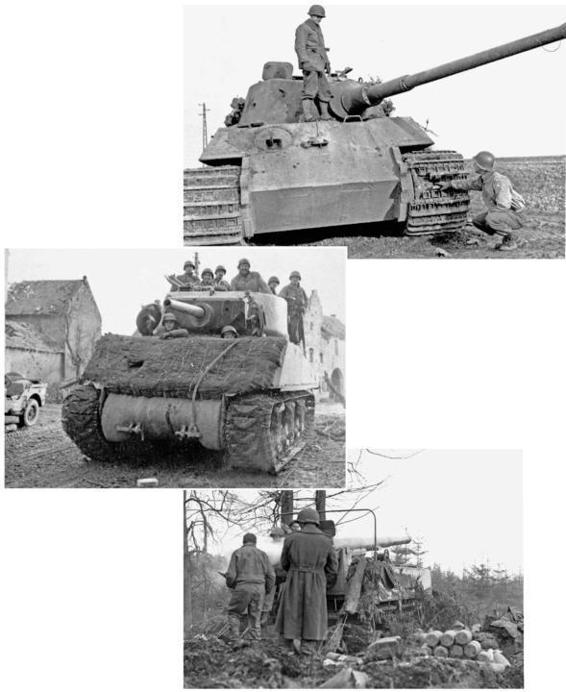
During fighting near Freialdenhoven on 28 November, this King Tiger heavy tank from schwere Panzer Abteilung 506 (506th Heavy Tank Battalion) was hit repeatedly by tank destroyers from the 702nd Tank Destroyer Battalion, 2nd Armored Division. The King Tiger was first stopped by a hit on the left track, and then an M36 90mm gun motor carriage hit the turret side from a range of 1,000 yards, destroying the tank. This King Tiger unit supported the 9th Panzer Division in a mid-November counterattack to stop the 2nd Armored Division.
An M12 155mm gun motor carriage of the 981st Field Artillery Battalion provides fire support for U.S. infantry formations during the bloody battles for the Hurtgen Forest near Kleinhau, Germany, on 30 November.
A good example of the M4A3E2 assault tank in service. This is an M4A3E2 of the 743rd Tank Battalion, supporting the 30th Infantry Division near Altdorf on 27 November. It has been reinforced with additional sand-bag armor on the glacis plate, which was then covered with camouflage netting.

As in the case of the 2nd Armored Division, the 771st Tank Battalion had suffered from enough experiences of bogged-down tanks that its tanks carried unditching logs during the Roer fighting. Here, the headquarters company of the 771st Tank Battalion takes a breather in Welz on 29 November while supporting the 102nd Division’s attempts to gain a foothold on the Roer River. The tanks are M4 assault guns, armed with a 105mm howitzer and used for indirect fire support of the battalion.

An M4 of the 6th Armored Division takes a break near a pock-marked pillbox of the Siegfried Line near Kappel, Germany, on 1 December.

An M18 76mm gun motor carriage tank destroyer crosses a length of treadway bridging. Besides being used to cross rivers, treadway bridge sections were also used by engineer units to cross antitank ditches or other terrain obstructions.
An M5A1 light tank of the 8th Tank Battalion, 4th Armored Division, helps to evacuate a wounded tanker in the muddy conditions on the Saar front on 1 December.

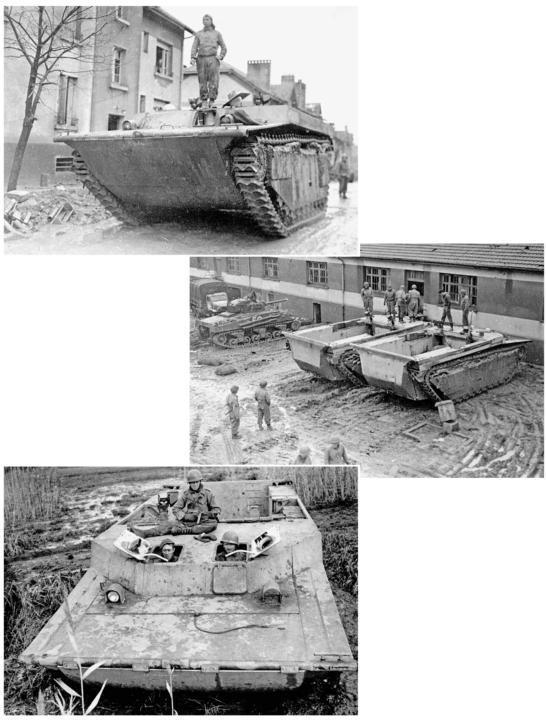
A pair of LVT-4 amtracs are given an inspection by crews from the 6th Armored Division prior to trials in local waterways. In the event, the 6th Armored Division did not use the LVTs in combat, though they were used on a limited scale by divisional engineer troops.
In early December, a number of amtracs were delivered to the divisional trains of the 6th Armored Division to familiarize crews in anticipation of river-crossing operations over the Roer and Rhine. This is an LVT-4 from the original batch delivered to Valette, France, on 2 December.
An LVT-4 in the hands of the 6th Armored Division during trials in marshy lands near Valette in early December. In early March 1945, the 747th Tank Battalion turned in its tanks and swapped them for seventeen LVT-2 and eight LVT4s, which were used on 24-26 March for the Rhine crossing.

An LVT-4 returns from a test-spin in a local lake on 7 December with mud caked up on the tracks. As can be seen, this particular amtrac has several armor panels added over the pontoons to protect the crew and drive train.
The final version of the German Sd.Kfz. 251/17 half-track had its 20mm autocannon in a small turret mount sometimes called the Schwebelafette. This particular example was captured in the Saar by Patton’s Third Army.
A more commonly encountered tank destroyer in the winter of 1944-45 was the Sd.Kfz. 251/22, which mounted the 75mm PaK 40 on the standard army halftrack. This particular vehicle belonged to the 11th Panzer Division, which was committed to the Saar fighting in December.
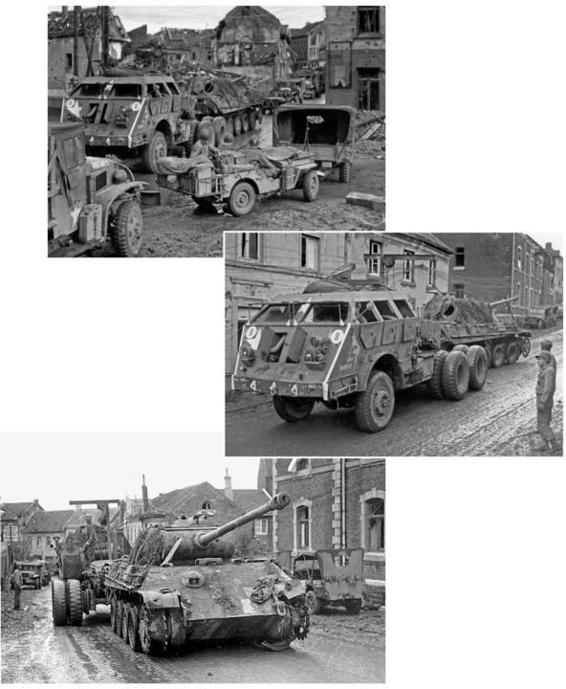
A closer view of the M26 tractor towing the Panther through Geilenkirchen.
During the last two weeks of November, the U.S. First and Ninth Armies conducted Operation Queen to push past Aachen to the Roer River. The area was tenaciously defended and included panzer units such as the 9th Panzer Division. This is a Panther Ausf. G captured during the fighting and being hauled away from the battlefield through Geilenkirchen by an M26 tractor on 4 December after the offensive. This M26 belonged to the 464th Ordnance Evacuation Company, U.S. Ninth Army.
A rear view of the M26 tractor providing a clearer look at the Panther Ausf. G. The tracks have been removed from the tank to make it easier to haul on the road.
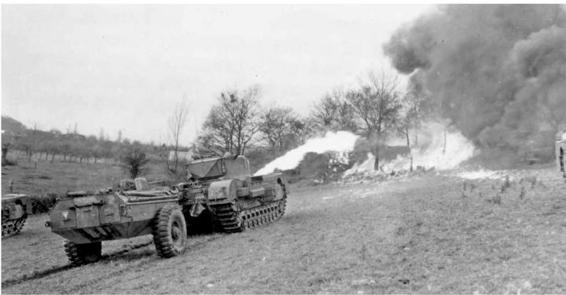
Because of shortages of flamethrower tanks, British tanks were often seconded to American units for support. In this case, a Churchill Crocodile of the 9020 Tank Squadron, 1st Fife and Forfar Yeomanry, was attached to the U.S. 2nd Armored Division during operations in late November along the Siegfried Line. Here, a Crocodile is attacking a target near Merkstein, Germany, on 3 December.

An M4A3E2 assault tank of the 745th Tank Battalion wades through the water and mud under a destroyed railroad viaduct in early December during the fighting for the industrial town of Langerwehe by the 1st Infantry Division.

The Sd.Kfz. 7/2 antiaircraft half-track mounted the 37mm FIaK 36, and the markings appear to indicate a vehicle of the 3rd Company of Panzerjager Abteilung 256 (256th Tank Destroyer Battalion). This example was captured by the Third Army in the Saar.
The Sd.Kfz. 7/1 antiaircraft half-track mounted the quadruple 20mm FIaK 38. This particular example shows the armored cab configuration. It was captured by Patton’s Third Army.
A close-up view of the front armored cab of an Sd.Kfz. 7/2.
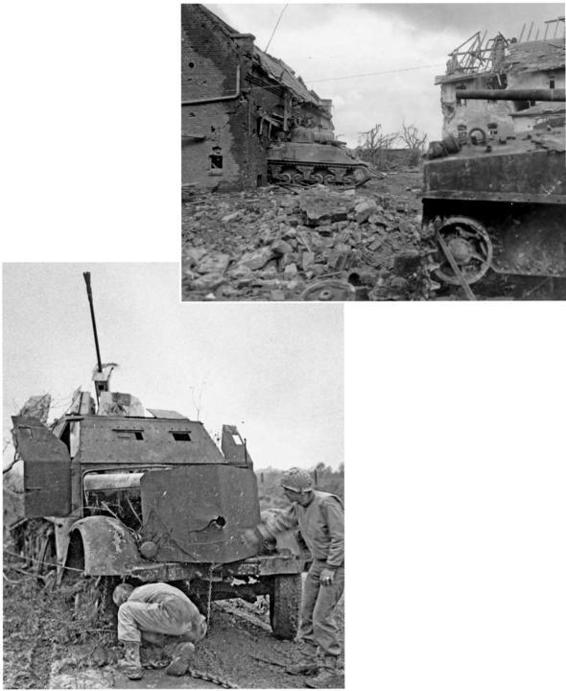
An M4 of the 709th Tank Battalion uses the shelter of a shattered house on Kirchstrasse in the devastated town of Hurtgen on 5 December after the town was taken by the 121st Infantry. The M4 is still fitted with a “rhino” hedgerow cutter. In the foreground is a burned-out M4 tank lost in the earlier fighting on 28 November.
American troops inspect a knocked-out Sd.Kfz. 7/1 with a prominent hole through the front armor panel.

A GI inspects an Sd.Kfz. 251 Ausf. D found in a garage in Ederen during clean-up operations along the Roer River on 5 December. The half-track carries the name Hannelore and a tactical marking on the bow that is apparently that of the 9th Panzer Division, which defended the area until late November when it was pulled out to refit prior to the Ardennes offensive.
A group of M8 75mm howitzer motor carriages provides fire support for the 47th Armored Infantry Battalion, 5th Armored Division, during the fighting for the Hurtgen Forest on 7 December. By then, U.S. forces had finally fought their way to the eastern edge of the woods and on to the approaches to the Roer.

The ground is littered with spent 105mm howitzer casings near an M4 (105mm) assault gun of the HQ company, 70th Tank Battalion, providing fire support during the fighting near Schevenhutte, Germany, on 7 December.
The crew of an M4 tank of the 2nd Armored Division attach “duck bills” to their tank track during a refit in Baesweiller, Germany, on 5 December. The end connectors without “duck bills” can be seen in the left foreground; the end connectors with “duck bills” are seen on the track to the right.

An M7 105mm howitzer motor carriage (named All American) from Battery A, 231 st Armored Field Artillery Battalion, 6th Armored Division, has been positioned on an improvised ramp to get higher elevation during a fire mission near Kleinbittersdorf, Germany, on 7 December. The logs on the side were a common sight in the autumn of 1944 and were used to help extract vehicles from the thick mud.

This Pz.Kpfw. 38(t) was knocked out by an M18 Hellcat of the 704th Tank Destroyer Battalion during the fighting along the Siegfried Line in the Saar near Ober Pearl in December. This obsolete tank was no longer in frontline service and was probably attached to a training company.
An M4 medium tank of the 2nd Armored Division advances through Dochamps, Belgium, on its way toward the fighting around Samree on 8 December. The snowfall at this time of the year was intermittent, with frequent cold rains washing away the snow.
An M4 tank fitted with a T1 E3 Aunt Jemima mine roller moves down a road along the German border while supporting the 712th Tank Battalion and 30th Infantry Division on 10 December. The 739th Tank Battalion was one of two battalions specifically configured for mine-clearing operations and had one company with eighteen T1 El mine rollers, two companies with twelve, and six dozer tanks.


A T1 E3 Aunt Jemima of the 739th Tank Battalion (SMX) in operation near Beggendorf, Germany, on 10 December.
A crew from the 739th Tank Battalion (SMX) mounts a Ti El Earthworm mine exploder on the front of an M32B1 while supporting the 30th Division in Germany on 10 December.

An M32 pushing a T1 E1 Earthworm mine exploder of the 738th Tank Battalion (SMX) supports the 3rd Armored Division near Langerwehe, Germany, on 10 December.

Another view of the same tank with mine exploder prepares to clear a road near Beggendorf on 11 December. The M4 tank is fitted with nonstandard grouser stowage on the hull side.
One of the concerns about using the T1 E3 was the effect of its combined fiftyfour-ton weight when moved over treadway bridges. Here, the 739th Tank Battalion (SMX) tests an M4A1 pushing a T1 E3 mine exploder on 10 December.

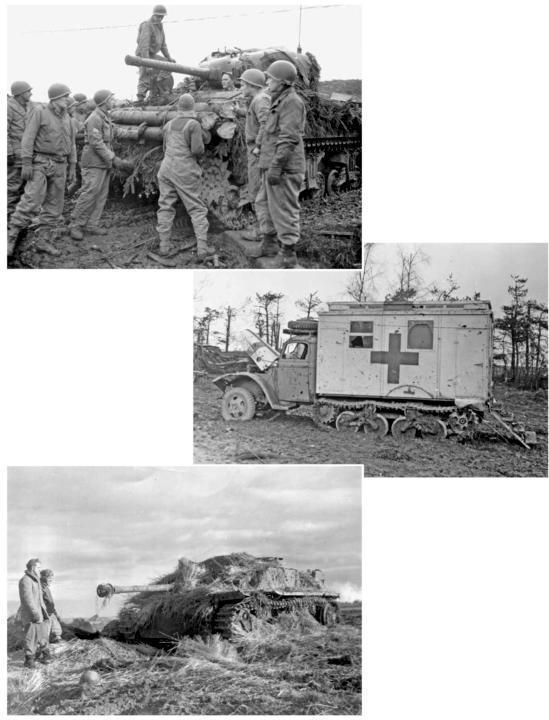
Another view of the test of a T1 E3 mine exploder in Germany showing details of its configuration between the two roller assemblies.
This German half-track ambulance was captured by the 121st Infantry, 8th Infantry Division, in the concluding phases of the Hurtgen fighting and is seen here on 6 December.
The Roer front in November was a sea of mud, leading to many improvisations. Here, troops from the 39th Infantry, 9th Division, help the crew of an M4 tank of the 746th Tank Battalion attach a section of corduroy matting on the front of the tank on 10 December. That day, the division started a new attack on Merode along the Siegfried Line along with the 3rd Armored Division. The matting consisted of several logs tied together with wire and could be laid down as a carpet in front of the tank when particularly deep mud was encountered.
On 11 December, following the Hurtgen fighting, some GIs from the 3rd Armored Division look at a heavily camouflaged StuG III Ausf. G knocked out in the fighting around Obergeich the day before in an encounter with the 33rd Armored Regiment.

An M10 3-inch gun motor carriage tank destroyer advances through Hurtgen on 12 December while advancing toward the Roer battlefront.
On 11 December, the 2nd Battalion, 60th Infantry, 9th Division, teamed with Task Force Hogan of the 3rd Armored Division to assault the village of Geich beyond the Langerwehe industrial area. This is an evocative picture of the harsh field conditions during the winter of 1944 in Germany as two GIs huddle under the shelter of an M4 tank on 11 December. This tank has been fitted with an external tank telephone as can be seen in the form of the .30-caliber ammo box attached to the engine door above the head of the GI to the right.

A GI peers inside an M4 that has slid into a water-filled hole in the ruins of Duren, Germany, during the fighting there in December.
An M18 76mm gun motor carriage in Immendorf, Germany, on 11 December. This view clearly shows the mud guards designed for this vehicle. These were frequently lost in action or removed by the crew as they interfered with maintenance on the suspension. Three weeks earlier, Immendorf had been the site of a major tank battle with the 9th Panzer Division.
An M31 armored-recovery vehicle of the 463rd Ordnance Battalion tows an M4 tank of the 746th Tank Battalion that has struck a mine. The mine has completely blown off the lead bogie assembly. The M31 appears to be impressively armed, but in fact, the 75mm hull gun and 37mm turret gun are dummies intended to make it appear like the normal M3 medium tank on which it was based.
A late-production M10 3-inch gun motor carriage of the 773rd Tank Destroyer Battalion, Third Army, crosses the Saar over a treadway bridge on 12 December. While much of the Third Army was fighting around Bastogne, the XX Corps remained in the Saar River area in preparation for a later offensive into Germany. This particular M10 has a metal cover over the turret rear and pipes welded to the four corners of the hull to attach stakes for camouflage.


An ordnance collection yard in Verdun accumulates worn-out and battledamaged equipment in Patton’s Third Army sector. In the foreground are a pair of M4 medium tanks while behind the tank on the left is a captured German Jagdpanzer IV tank destroyer.
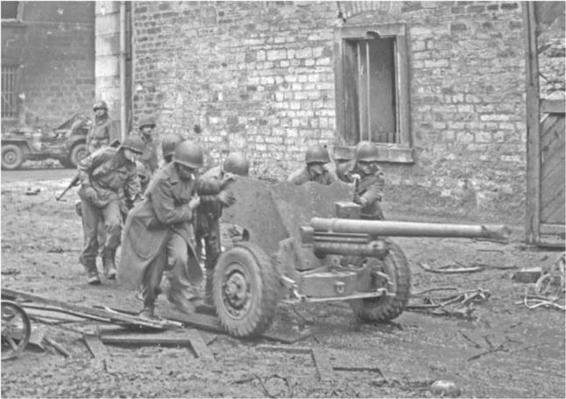
A 57mm antitank gun crew manhandles its weapon on the streets of a town in the Saar on 12 December during the fighting there by the Third Army. This view illustrates why the infantry was reluctant to acquire heavier antitank guns as the 57mm gun was at the outer limit of the size and weight that could be managed by a crew.

The crew of an M4 tank of the 709th Tank Battalion watch as a column of German prisoners walk by in Lammersdorf on 14 December. The fighting for this stretch of the Siegfried Line by the 78th Division continued over the next few days and even after the start of the Battle of the Bulge a few miles south in the Monschau Forest two days later.
Shortages of equipment occasionally led to substitution. This M4A3 (76mm) is being used by the 629th Tank Destroyer Battalion in Gurzenich, Germany, during the fighting there on 14 December. The battalion was normally equipped with the M10 3-inch gun motor carriage.


A wrecker truck is used to recover an M32B1 of the 771st Tank Battalion. It has lost a track near Immendorf on 14 December.

A pair of Jagdpanzer 38 assault guns of Panzerjager Abteilung 272 (272nd Tank Destroyer Battalion) were disabled along Hauptstrasse in Kesternich during the bitter fighting in December between the 272nd Volksgrenadier Division and the U.S. 78th Division in the days before the outbreak of the Ardennes offensive.
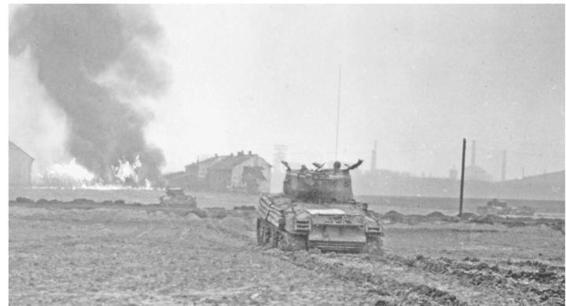
British Crocodile flamethrower tanks provide support for the U.S. 2nd Armored Division during the fighting around Alsdorf. An M4A1(76mm) can be seen in the foreground and two British Churchill Crocodiles in the distance.

In anticipation of the Ardennes fighting, German panzer units were brought up to near full strength. The schwere Panzer Abteilung 506 (506th Heavy Tank Battalion) was rebuilt, but lost this tank (tactical number 2-11) near Geronsweiller on 15 December, a day before the start of the Ardennes offensive. It was recovered by the U.S. 129th Ordnance Battalion.

This King Tiger of schwere Panzer Abteilung 506 is driven away by a U.S. Army ordnance team near Gersonsweiler on 15 December.

Under new ownership. The Geronswiler King Tiger has been given new markings so that it can be safely driven back through American lines.
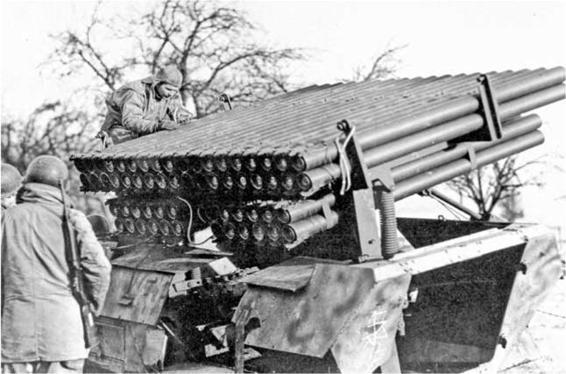
Many American tank battalions were not keen to burden their tanks with T34 Calliope launchers, so the 350th Ordnance Battalion, attached to the 7th Armored Group, tried mounting one of the launchers on a captured German Sd.Kfz. 251 Ausf. D half-track as seen here on 15 December.
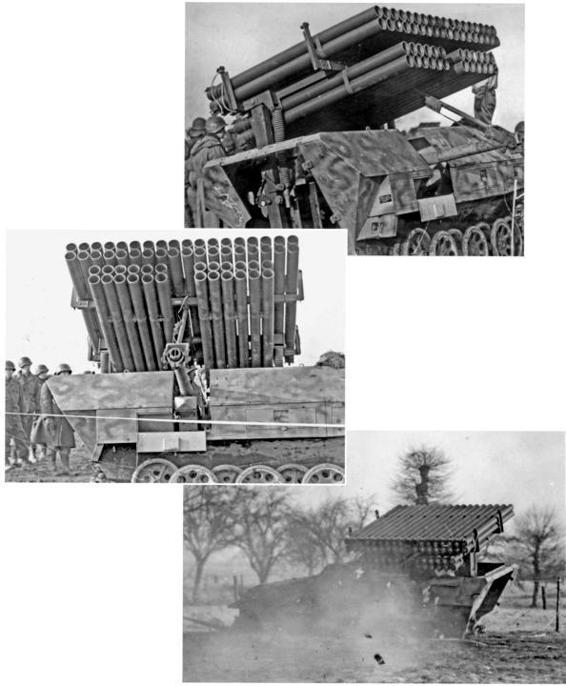
The Calliope rocket launcher required extensive modification to the Sd.Kfz. 251, including a large cut on the right side armor to accommodate the elevating arm.
This shows the improvised Sd.Kfz. 251 Calliope launcher being fired in Belgium on 15 December.
Another view of the Sd.Kfz. 251 halftrack converted by the 350th Ordnance Battalion to carry a 4.5-inch Calliope multiple rocket launcher.

An M10 3-inch gun motor carriage of the 654th Tank Destroyer Battalion covers a street intersection while supporting the 134th Infantry, 35th Division, during fighting in Habkirchen, Germany, on 15 December.
An M7 105mm howitzer motor carriage moves through Hagenau during the fighting along the German border on 15 December in the days before the Ardennes offensive.
Even though the Battle of the Bulge had already started in neighboring Belgium, the fighting continued along the Siegfried Line to push out of the dreaded Hurtgen Forest. Here, an M4A3 (76mm) from the 774th Tank Battalion and an M10 tank destroyer move past a StuG I I I Ausf. G in Gurzenich in support of the 83rd Division on 17 December. By this stage, the U.S. First Army had emerged from the Hurtgen Forest and reached its objective on the plains approaching the Roer River.

Another view of an M4 tank supporting the 83rd Division while clearing out Gurzenich on 17 December. This may be an M4A3E2 assault tank, although precise identification of the type is made difficult by the camouflage on the turret. The commander’s cupola has a .30caliber light machine gun mounted.
An M8 light armored car of the 86th Cavalry Reconnaissance Squadron (Mechanized), 6th Armored Division, passes through a German street barrier on the outskirts of St. Nikolaus on 17 December.
One of the 57mm antitank gun platoons in the 104th Division decided it would rather operate this captured German StuG III assault gun than its little 57mm gun. The vehicle is seen passing through lmden on 17 December with its new owners.

An M32B1 tank-recovery vehicle tries to help extricate a T1 E3 mine roller of the 739th Tank Battalion that has become bogged down while conducting mine-clearance operations for the 30th Infantry Division on 19 December. The weight of these mine rollers was one of their main drawbacks, especially in the muddy weather typical during the autumn of 1944 along the German frontier.

When one M32B1 did not prove enough to move the disabled M4 and T1 E3 mine-roller combination, another M32 was brought in to assist. It has been fitted with sand bags for added protection. Notice also that the M4 tank has a section of corduroy matting on the hull side.

A close-up of an M45 Maxson turret of the 473rd Anti-Aircraft Artillery Automatic-Weapons Battalion (SelfPropelled) on Christmas Day in Ubach, Germany.
Tank destroyers were not organic to armored divisions, but most armored divisions had at least one tank destroyer battalion attached during most of the fighting in the ETO. This is one of the new M36 90mm gun motor carriages of the 703rd Tank Destroyer Battalion supporting the 3rd Armored Division near Malempre, Belgium, on 16 December.
Here, a British Crab flail tank detonates a mine near Geilenkirchen while supporting the U.S. XII Corps on Christmas Day.
