



Soon after the attack on Hitler Germany, the Soviet Union had to face a number of serious problems. One of these was the poor condition of the roads, in some cases capable of seriously impeding the transfer of troops. Bad roads hindered the movement of military and auxiliary equipment, and also hampered the towing of artillery pieces. A certain way out of the current situation was needed, capable of providing the required mobility of the troops while bringing the firepower to the required values. One attempt to solve this problem was an armored personnel carrier mittlerer Schützenpanzerwagen 3,7 cm PaK 35 / 36 or Sd.Kfz.251 / 10.
By the beginning of the war with the Soviet Union, Germany had an average semi-tracked armored personnel carrier Sd.Kfz.251 for several years. By the fall of the 1941 of the year, it turned out that this technique has an acceptable maneuverability and, unlike some other models, has certain perspectives in the context of the Eastern Front. The result of this, among other things, was the emergence of a significant number of projects of specialized equipment based on the existing semi-tracked chassis. It was proposed to mount both special equipment for various purposes and weapons of one type or another on this chassis.
In the summer of 1941 of the year (according to other data, a little earlier, in May), the German army placed another order for the development and production of a special modification of the Sd.Kfz.251 armored personnel carrier. This time it was necessary to equip the combat vehicle with weapons in the form of an 37-mm anti-tank gun of the existing model. It was assumed that such self-propelled artillery installations would be used as combat vehicles by platoon commanders, armed with standard BTR. With the help of certain improvements it was supposed to significantly increase the firepower of the unit, giving it the opportunity to fight not only with infantry, but also with light armored vehicles.
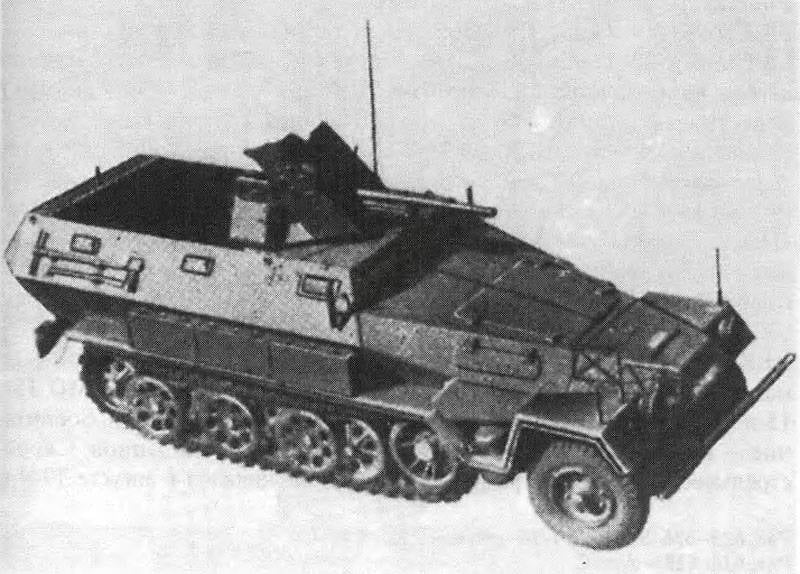
By the names of the main components, the project was named mittlerer Schützenpanzerwagen 3,7 cm PaK 35 / 36 – “Medium armored vehicle with an 37-mm PaK 35 / 36 cannon”. The designation Sd.Kfz.251 / 10 was also used, reflecting the type of the base technique and the serial number of the modification. Used and the factory designation Gerät 910. Similar designations were applied to other equipment projects based on the available armored personnel carrier, but there were no complete matches, thereby avoiding confusion.
The standard Sd.Kfz.251 armored personnel carrier of the early modifications was chosen as the basis for the advanced ACS / command vehicle. This technique was produced serially in large quantities and was actively used by the army. Thus, a change in the composition of the weapons should not have a significant negative impact on the operation of equipment by military units. Moreover, the new project was developed in such a way that the minimum changes necessary were made to the design of the base machine.
The Sd.Kfz.251 BTR had a body with anti-bullet and anti-splinter protection, consisting of a significant number of armor plates of various shapes and sizes. In the frontal part of the machine, parts from 10 to 14,5 mm were used, and the sides and feed were made of 8-mm armor. The case was divided into two main compartments, motor and habitable. The front of the case was given under the placement of the power plant and was a unit of complex shape with a roof bent forward and beveled upper parts of the sides. The habitable compartment on the most part of its length had an asymmetrical hexagonal section. The lower side plates were installed with a collapse to the side, and the upper ones were mounted with a slope inward. Aft hull was made wedge-shaped.
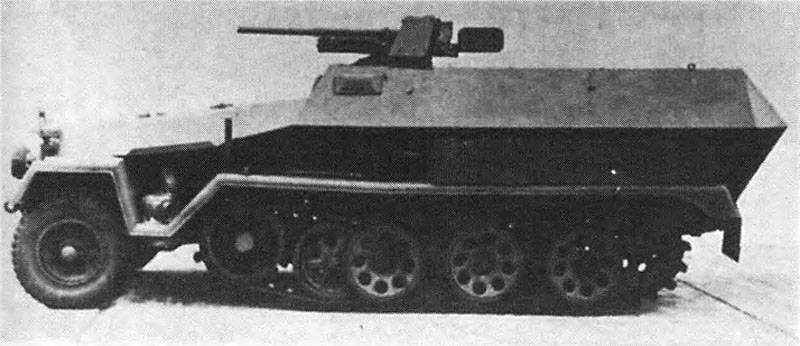
Side view. Another copy of the machine with a different shield guns. Photo of Chamberlain P., Doyle H. “Complete reference book of German tanks and self-propelled guns of the Second World War”
In the fall of 1943, a new modification of the armored personnel carrier, known as Sd.Kfz.251 Ausf.D., went into the series. From the previous versions of the machine, it differed in the case of a simplified design. Thus, the thickness of the frontal armor was brought to 15 mm, the configuration of some sheets changed, and also part of the hatches, grilles, etc. were removed. A characteristic change was the new form of the stern of the hull with a single leaf, piled back.
Under the hood of armored personnel carriers of all modifications, the Maybach HL 42TUKRM carburetor engine was installed with 99 hp power. Through a dry single-plate clutch, torque was delivered to the manual gearbox Hanomag O21-32785 U50, built according to the planetary scheme. The box had four forward speeds and two rear speeds, with separate modes for driving on the highway and rough terrain. The mechanical transmission transmitted torque to the drive wheels of the tracks, placed in the middle of the hull.
The machine was equipped with a semi-tracked chassis. In front of the case was placed controlled axle with spring suspension. With the help of steered wheels, the BTR could turn through small angles. For sharper maneuvering, turning the wheels and redistributing the torque on the tracks were used. As part of the tracked propulsion unit, it was envisaged six support rollers of chess arrangement, equipped with an individual torsion suspension. Driving wheels were placed in front of the track, guides – in the rear of the hull. From above, the tracks were covered with oblong shelves, which in all modifications of the car carried boxes for property.
The crew of the Sd.Kfz.251 armored personnel carrier consisted of two people: the driver and the commander. They were located in the front of the habitable compartment and observed the situation through the viewing instruments in the front and side hull sheets. Along the sides of the hull there were benches for ten paratroopers. The crew and the landing could get to their places through a swing door or through the side. To support the landing or in self-defense, it was proposed to use one or two MG 34 or MG 42 machine guns mounted in the front and rear of the habitable compartment. In some versions, the front machine gun had a shield.
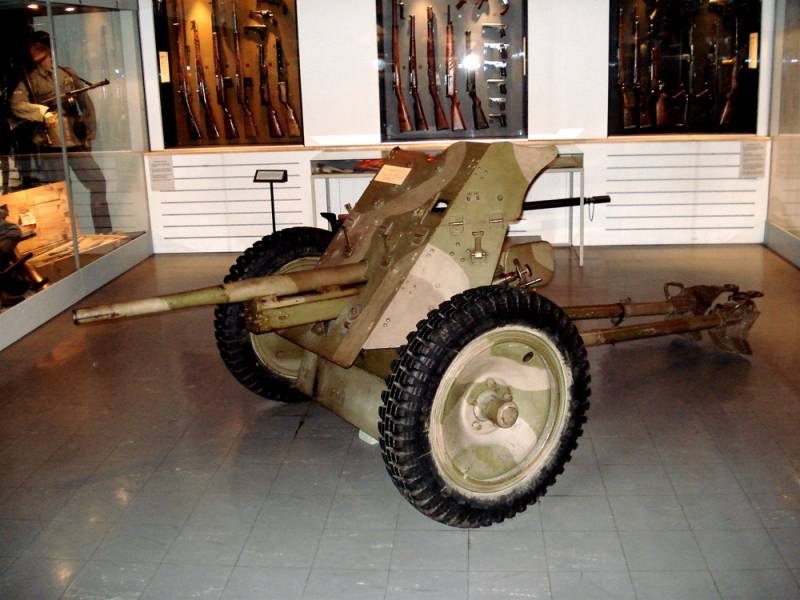 37-mm gun PaK 35 / 36 in the original configuration. Photo of Wikimedia Commons
A prospective platoon commander mittlerer Schützenpanzerwagen 3,7 fighting vehicle cm PaK 35 / 36 was supposed to get a new one weapon increased power. To combat the enemy’s light armored vehicles, it was proposed to use the anti-tank gun 3,7 cm PaK 35 / 36 in order to enhance the firepower of the unit. Such guns were actively used by the army and still could solve the tasks assigned to them, although limited. However, the towed carriage imposed significant restrictions on the operation of weapons. Thus, the installation of guns on armored personnel carriers made it possible to immediately solve two important tasks: to strengthen the infantry units with their own artillery, and also to significantly improve the mobility of the guns. Taking into account the parameters of the original armament of the Sd.Kfz.251 BTR, even a relatively low-powered PaK 35 / 36 gun could give a significant increase in performance.
In the original configuration, the anti-tank gun arr. 1935 / 36 mounted on a light two-wheeled carriage with sliding bed. To improve the performance characteristics of the carriage had springs wheel travel, as well as equipped with an armored shield. On the gun carriage mounted gun with recoil devices and sighting equipment. With the help of hand drives, it was possible to carry out horizontal guidance within the sector width 60 °. Vertical guidance angles varied from -8 ° to + 25 °. Used hydraulic brake recoil and spring knurled.
37-mm gun was equipped with a barrel length 45 calibers. For use with the PaK 35 / 36 gun, several types of unitary projectiles for various purposes have been proposed. Over-caliber mines with charges of various types were also developed. The initial velocity of the shells, depending on the type, reached 760 m / s. Armor-piercing shells could be used at ranges up to 800 m, fragmentation – up to 7,2 km. The armor-piercing shells of the gun had the opportunity to penetrate up to 50 mm of homogeneous armor from the 300 distance. There was also a cumulative above-caliber ammunition with armor penetration at the level of 180 mm.
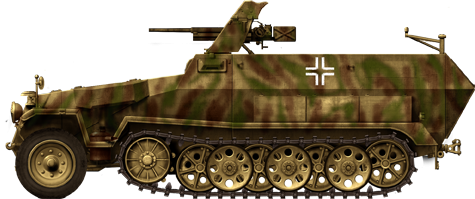
Variant of reconstruction of the appearance of the front machine Figure Tanks-encyclopedia.com
For the use of new weapons base armored Sd.Kfz.251 had to undergo some minor changes. In front of the habitable compartment it was proposed to install a small narrow roof with fixtures for mounting the gun. In addition, on the site of the troop compartment should be placed laying for ammunition and other equipment, the use of which was caused by the new role of the machine. For installation on a self-propelled chassis with a wheel carriage guns removed the barrel group with guidance devices and armor shield. With the help of standard parts, the instrument was to be mounted on the hull mounts.
Interesting changes in the design of weapons were associated with the armor shield. Both in mass production and in combat units, they repeatedly changed the design of this device. For one purpose or another, the base plate of a characteristic oblique form was cut or increased. In addition, there are pictures of armored vehicles with a reduced “half” shield, covering only the gunner.
The additional armament of the cannon armored personnel carrier was to consist of a machine gun or an anti-tank gun. In the first case, the MG 34 or MG 42 product was used, in the second case, the PzB 39 system. Machine guns and anti-tank guns had a caliber 7,92 mm. To transport this weapon should be in the installation, if necessary, removing it.
Inside the fighting compartment, we managed to place several racks for transporting 168 projectiles to the cannon. Machine gun ammunition reached 1100 ammunition, anti-gun – 40 ammunition.
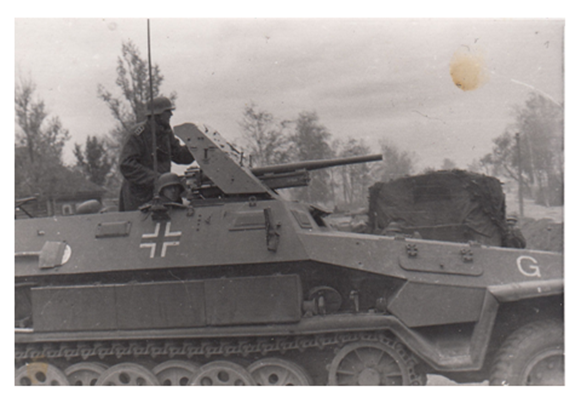
To manage the commander of the machine was a crew of five. In front of the case were placed the driver and the commander. Behind them, in the fighting compartment, was placed the calculation of the gun of three people. The main task of these crew members was to use an anti-tank gun in order to increase the firepower of the entire unit.
After the proposed improvements, the Sd.Kfz.251 / 10 vehicle generally retained the dimensions of the base armored personnel carrier, but its height and combat weight increased slightly. With a length of 5,8 m, the new model had a width of 2,1 m. Due to the gun, the height of the machine increased to 2-2,2 m, depending on the configuration of the gun’s armored jacket. Combat weight was increased from the original 7,8 to 8,02 t. Despite this, the driving performance remained at about the old level. The maximum speed reached 50 km / h, power reserve – up to 300 km.
Development of the mittlerer Schützenpanzerwagen 3,7 cm PaK 35 / 36 or Sd.Kfz.251 / 10 project was completed in just a few weeks. After carrying out the necessary work, the industry presented for testing the first prototype of an armored personnel carrier with an anti-tank gun. Soon the serial modification of existing armored personnel carriers using new weapons began. By the end of the summer, the army received 80 units of new equipment.
After the construction of eight dozen armored personnel carriers with guns, it was decided to roll up such work. However, after about a year and a half, the military decided that they needed these machines again. In 1943, the production of Sd.Kfz.251 / 10 armored vehicles was resumed. As a basis for such equipment were used mainly armored personnel carriers returned to the rear for repair. Nevertheless, a certain number of cars could be made on the basis of the BTR of new releases. The first 1943 series of the year was based on old-style equipment. Later mittlerer Schützenpanzerwagen 3,7 cm PaK 35 / 36 were built on the basis of Sd.Kfz.251 Ausf.D. The assembly of armored personnel carriers with guns lasted until the beginning of 1944. During this time, released about three hundred cars.
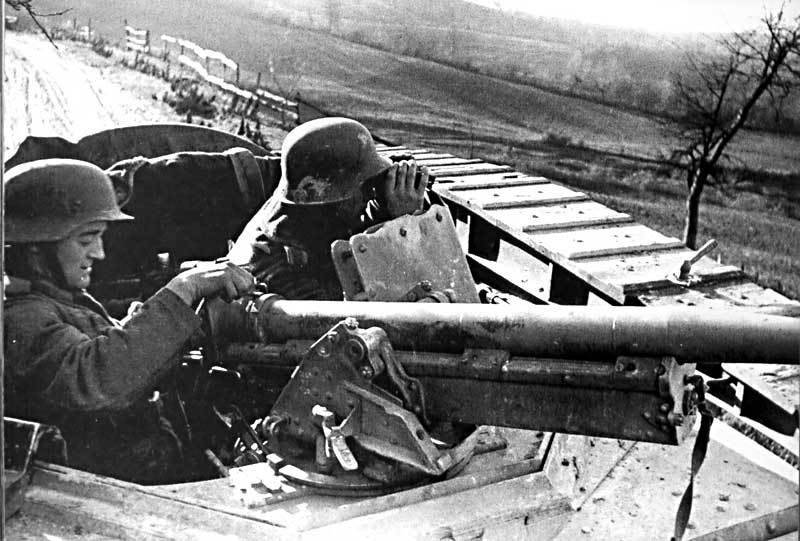
The Sd.Kfz.251 / 10 project was originally developed for the additional armament of infantry units with new equipment. Such machines were supposed to be used by platoon commanders who were armed with standard armored personnel carriers. All 380 produced machines of the new type were handed over to the troops and distributed between the combat units. In the army, this technique was used in accordance with the original plans – as a means of increasing the firepower of the units.
For obvious reasons, the operation of an armored personnel carrier with cannon armament was associated with both positive aspects and problems. Indeed, the combination of a semi-tracked chassis and an anti-tank gun had a positive effect on the firepower of the first and the mobility of the second. However, the existing chassis did not differ in serious armor, and the parameters of the gun did not allow to deal with well-protected enemy equipment. As a result, the commander’s armored personnel carrier differed from the linear ones with more powerful weapons, but in some situations even such advantages could not be used with maximum efficiency.
The weak protection of the base chassis adversely affected the course of service of armored personnel carriers. The bulletproof booking did not allow the crew and internal units to be protected from artillery shells. For this and other reasons, until the end of the war, the vast majority of Sd.Kfz.251 / 10 machines were put out of action in battles. There were also losses due to technical reasons. At the time of the surrender of Germany, only a handful of such machines remained in the ranks.
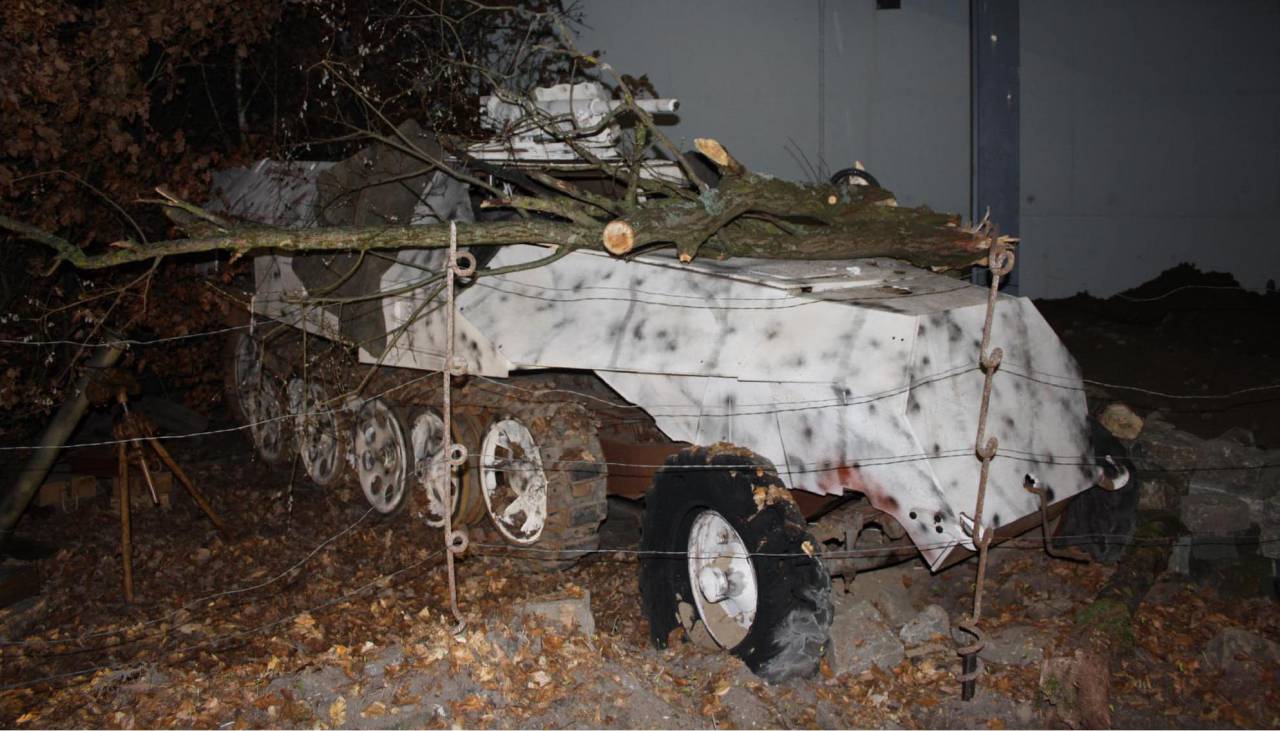
The only surviving sample is Sd.Kfz.251 / 10. Photo The.shadock.free.fr
According to some data, due to insufficient firepower of Sd.Kfz.251 / 10, as early as in 1944, they were removed from the line parts. This equipment was sent for repair with the restoration of one of the other projects, which involved the installation of special equipment on the semi-tracks. The further fate of the gun armored personnel carriers serves as a kind of confirmation of this version. Apparently, a significant number of survivors of the APC battles were rebuilt and received new equipment or weapons.
After the war, the remaining cars that no longer had prospects were disposed of. According to reports, only one instance of mittlerer Schützenpanzerwagen 3,7 cm PaK 35 / 36 has survived to this day. This car based on the Sd.Kfz.251 Ausf.D chassis without a gun shield and in a characteristic winter colouration is currently stored in the Museum of Bastogne (Belgium). It should be noted that this museum exhibit was restored from a damaged car, including the use of new production parts. In the course of such a restoration, an armored personnel carrier received an 37-mm cannon.
The Sd.Kfz.251 / 10 project was an interesting attempt to combine the existing semi-tracked platform with a serial anti-tank gun in order to improve the characteristics of both components of such a complex. In general, this problem was successfully solved. Nevertheless, the project proposed to equip a decent chassis with a rapidly aging gun. As a result, the real characteristics of the finished sample left much to be desired and did not allow to fully use it in combat. Operation of the finished equipment lasted for some time, but much success was not achieved.