



FS Jean Bart was the sister ship of Richelieu, the last class of French battleships. And if the first was barely completed when the 1940 summer offensive commenced, the second still was months ahead before completion. She had to sail out in emergency from St Nazaire yard, Britanny, and steam to safety in North Africa, expecting a completion that never happened. Still, she exchanged volleys with USS Massachusetts during Operation Torch before being silenced. Postwar, the French naval staff had the choice to have her scrapped, or modernized. The second option was chosen, but completely redesigned and rebuilt as an “AA battleship”. She is an interesting conversion at an age where the aircraft carrier reigned supreme, but only served for a short time, notably in the Suez crisis. She was put in reserve from 1957 to 1970. Was she a massive waste of taxpayer’s money ? Her case in detail.
The backstory of Jean Bart is one of a class of four ships, Richelieu and Jean Bart as first pair, and Gascogne, plus Clemenceau for the second pair. Their genesis dates back of the interwar, and notably of the 1935 Anglo-German agreement and construction of the two “fast battleships” of the Scharnhorst class launched in 1936 as an answer to the French Dunkerque class battleships, themselves an answer to the German Deutchland class cruisers. They were also to answer the announcement of the Littorio class.
The first two indeed were authorized in 1935; the second pair in 1938, this time to answer the second pair of Littorios (Roma and Impero).
Thy were designed to carry eight 15-in (380mm),fifteen 6-in (155 mm), eight 37mm and twenty-four 13.2 mm AA HMGs. The armament of the first two was subsequently altered owing to the exigencies of war, while more substantial changes were made to the design of the uncompleted pair. They followed the general design of the Dunkerque class with a high proportion (37 per cent) of displacement given over to protection (against 15in shellfire). The 38Omm (1935 pattern) main armament fired a 19381b shell at between 1 and 2 rounds per minute to a range of 50,000yds at 35° elevation.
Magazine capacity was originally 832-15in and 2800-6in, but in 1943 this became 650-15in, 3000-6in and 6500-3.9in. The Richelieu’s machinery was built by A C de la Loire, St-Nazaire, and Jean Bart’s by F C de l’Atlantique.
Richelieu was 95 per cent complete when France surrendered and she proceeded to Dakar, where she was damaged during the British attack. In 1942 she joined the Allies and was sent to the USA for a major refit, emerging in October 1943 with radar added, aircraft and catapults removed, and the 37mm and 13.2mm AA replaced by 56 40mm (14×4) and 48-20mm (48×1), This increased displacement
by 3000t, 500t of which was increased bunkerage. Range Was 5500/2500/1800nm at 18/26/32kts and during postwar trials she reached 179,000shp = 32.5kts. Richelieu was employed with the British Eastern Fleet in 1944 45 and later off French Indo-China. She paid off in 1959 and was hulked at Brest as an accommodation ship.
Jean Bart was an estimated 77 per cent complete when France was overrun, but she escaped to Casablanca in June 1940 under her own power, leaving A C de la Loire et Penhoët, St-Nazaire with a nucleus volunteer’s crew. Only the forward 15in turret was mounted and it was late 1942 before this was in any condition to fire. At the time of the US invasion of North Africa Jean Bart also carried 8-90mm (4×2), 5-37mm (2x 2, 1 xl) and 22-13.2mm (4×2, 14x 1) AA; during this attack the ship was badly damaged and the work of completion did not begin until 1946 at Brest, although various proposals for make-shift completion (with one main turret or as an aircraft
carrier) were put forward during the latter stages of the war. Sea trials began on 16.1.49 when she obtained 162,855shp = 31.84kts over 6 hours, and 176,030shp = 32.13kts for 2 hours, In May l955 she was finally completed with 8-15in/45 (2×4), 9-6in (3×3), 24-3.9in AA (12×2), 28-57mm (14×2), 20-20mm (20× 1).
She was stricken in January 1961, and hulked at Toulon.
Clemenceau, like her sisters, was built in drydock and was only 10 per cent complete in June 1940. The incomplete hull was floated out in 1943 and later bombed by Allied aircraft, on 27.8.44. The design incorporated some modifications to the secondary armament (12-6in) and AA guns, with aircraft facilities deleted. Gascoigne was to have had the main armament turrets mounted one forward and one aft. She was never laid down. Two sisters were approved in April 1940 – although they may have been built to a new design – but were not begun.
Redesign of the Jean Bart (1945-1949)
The Jean Bart being a sister-ship of Richelieu, she obeyed to the same basic design elaborated from 1936 onwards. Above: Richelieu as rebuilt in the US, 1944. There were several possibilities, one of which was to complete Jean Bart quickly to the same standard as Richelieu in the USN, 1944, with good AA and modern radar. That would probably included a trip to the US, and Richelieu in the meantime would have been deployed in the far east.
Given the work remaining compared to a scrapping, despite the cash-stripped context of post-war France, there was no debate about the question of completing her, but no consensus as to how the ship was to be finished. This debate however started right after France was liberated in the summer of 1944.

Tzoli attempted rendition of the conversion. secretprojects.co.uk more on the topic of the carrier conversion
One faction comprising Admiral Fenard, Pierre Barjot, Louis Kahn (Chief of Naval Construction, CNO), advocated the most radical approach, a conversion into an aircraft carrier. This had pros and cons. The idea was to provide quickly a modern (fast), large carrier, and compensate to the unbuilt Joffre class of 1939, or to the acquisition of foreign carriers, like Arromanches, a 1942 light fleet carrier, or Dixmude, an escort carrier. However at that stage, many saw the conversion of a battleship as a bad idea, pointing at the Béarn. At best it would have a sub-par air group for high maintenance costs and an armour not really needed for the purpose.
The second faction argued the ship should be completed as a battleship. But there were debates wether completing her the same way as Richelieu, or with an French upgraded AA, fire control systems and radars, a generation further.
A third faction suggested she ship should be scrapped, focusing on other, more modern projects. It had some strong support in the political class of the time.
In July, Admiral Kahn this prepared a proposal of a carrier conversion to feed the debate and try to win the cause. The one prepared has a capacity of forty aircraft plus fourteen spares, and was armed with sixteen 130 mm (5.1 in) AA guns, all in twin mounts, protected with an armored flight deck 90 mm thick, made of part of the dismantled armour frol the battleship. Displacement was setup at 40,000 t (39,000 long tons). The project was estimated to 5 billion francs, five years until completion. This estimation naturally cause a stir in the naval command, including Fenard himself, as it negated the advantage of a convesion in the first place. Cost and delays plus its limited air group were clearly a letdown compared to contemporary allied carriers. Even Arromanches with half the displacement carried a bit more. This buried the proposal for good.

As it was, Jean Bart left Casablanca on 25 August 1945 bound for Cherbourg, arriving after four days of quiet navigation. On 21 September, a meeting of the naval command ruled out scrapping the ship, and a serrious doubt was cast on the aircraft carrier conversion. The construction department made new estimates however for a completion as battleship, estimated the time to manufacture the missing 380 mm gun barrels, rebuild the missing “B” turret, stockpile ammunitions, and figures in the new French context of the time was four years until completion of the ship herself, one mire for the shells and charges. Decision to complete Jean Bart as Richelieu with improved anti-aircraft defenses, given the delays, seemed to get more traction. Naval historians John Jordan and Robert Dumas noted that even the “battleship faction” get support from the French naval air arm, opposed to a carrier conversion in the current conditions.
Jean Bart was towed to Brest, entered the dry-dock for hull repairs from 11 March 1946. The propulsion system was thoroughly examined, and completed as originally intended. Her main and secondary turrets were installed. The superstructure was modified, strenghtened for a future radar and fire control, that were planned to ba more extensive and modern than on Richelieu. The hull was completely modernized (many portholes were plate over, electric lighting had a rewiring) on 26 November 1947
Thus she could move from the drydock to the fitting-out berth, and further modifications brought to the superstructure, primary and secondary turrets, installed completely this time. She would return to the dry dock from 20 March to 9 October 1948 however for the installation of bulges and new propeller shafts. Initial propulsion machinery tests started on 4 December, and full tests by January 1949.
Redesign of the class

Hull and general design
The hull was pretty much unchanged compared to the previous Richelieu, apart the bulges added later to compensate for the added weight of the AA, radars and more extensive masts. The shape of the prow and bow were unchanged, just a few portholes were plated over, notably the lower prow serie. The changes were all made on the superstructures. Like Richelieu, her main and secondary artillery was unchanged, with the two main quad turrets forward, the three triple turrets aft. Although the latter left to be desired, not being able of dual purpose fire, there was no replacement for them at that stage, and they were just kept for practicity.
The most interesting aspect was their complete revision of the superstructure and AA armament on either side.
The conning tower was also kept, despite the concept being obsolete, also for practicity. The former lower bridge anchored around it was removed. Instead a single projector was anchored on a platform in front of it.
The main bridge structure was simplified, supporting a single two-storey bridge with portholes instead of a glassed bridge. The was no open bridge. The main director was of a new model, modernized version of the original, dispensing with the complicated three-tiered “turret” director arrangement of Richelieu. A second main director was installed on the “mack” aft. The mack combined funnel exhausts, directed aft, and a tower like platform for both the second artillery director and the aft mainmast. Both masts were not derrick but single piece style, but heavy duty to support heavier radars. The two frypan dish style fire direction radars were placed (see later) on either masts platforms in complement to the directors.
There were four service boats in the same previous space between the bridge and aft mack, served by boom cranes.
The sides were shaped in order to support the 24 (12 twin) main 100 mm AA guns in three-tiered positions, three facing forward and three aft. Four gunnery directors for them were installed abaft the bridge and mack. This was completed by 28 (fourteen twin) mounts wherever space was available, three on the upper superstructure, superfiring over the 100 mm, four aft on the poop deck, two on the upper bridge deck and two on the main forward deck.

Main dimensions were unchanged. The Jean Bart still measured 247.85 m (813 ft 2 in) overall for 33.08 m (108 ft 6 in) in beam. However displacement rose, and as a result, draft also rose to Full load: 10.9m (36 ft) instead of 9.9 m (32 ft 6 in) on Richelieu as built in 1940. However Richelieu rose to 10.68 m (35 ft) in 1945, for a Standard ported to 43,957 t (43,263 long tons) and 47,728 t fully loaded instead of 37,250/43,992 long tons. Jean Bart was noted depending on sources at 43,052 t (42,372 long tons) and 49,196 t (48,419 long tons) fully loaded, so she flirted with 50,000 tonnes. After all the losses of WW2, she was 10,000 tonnes shy of an Iowa class, or lighter than the 51,420 long tons Vanguard. It is assumed she was also much taller than Richelieu with her new masts. Overall, the added weight was recoignised by engineers which fitted new counterkeels and larger bulges in drydock in 1949.
Armour protection layout

Jean Bart in 1949, note her US graded camouflage. src navypedia.
The armour was unchanged compared to the original. In short, Jean Bart kept the same armoured Belt, 330 mm (13 in) thick running between barbettes and defining the citadel. The main deck, closing the top of the citadel, was 170 mm (6.7 in) string with sloped ends on both sides. The main deck was down to 150mm beyond the citadel, and the lower deck was 40 mm thick with 50 mm slopes. The torpedo bulkheads were 30 to 50mm thick fore and aft. Turrets were protected for the frontal part of 430 mm (17 in), 170 mm to the back and roof, Barbettes were 405 mm. Secondary turrets ranged from 70 mm back and roof to 115 mm faces and sides, frontal arc. The Conning tower was 340 mm (13 in) thick as well. ASW compartimentation was at the best standards of the day, with internal bulges, longitudinal bulkheads, deformation zones and void compartments to buffer any torpedo hit. Puumps could be used also to compensate any list.
Powerplant
This part is also little changed compared to the original. Jean Bart had the same two pairs of propeller shafts, outer and inner, driven in turn by widely spaced Parsons geared turbines and fed in turn by six Indret Sural boilers. All were widely separated in their own compartments for anti-flood measures and redundancy. This produced in total 155,000 shp (116,000 kW). In addition the ship was equipped with two diesel generators to feed the electronics and AA armament when “cold”.
Top speed was 32 knots (59 km/h; 37 mph), always and argument in any bad encounter, and Range was 9,500 nautical miles (17,600 km; 10,900 mi) at 15 kn (28 km/h; 17 mph). Less than US or British standards, but the Richelieu class was originally designed for mid-Atlantic operations and the Mediterranean.
Armament
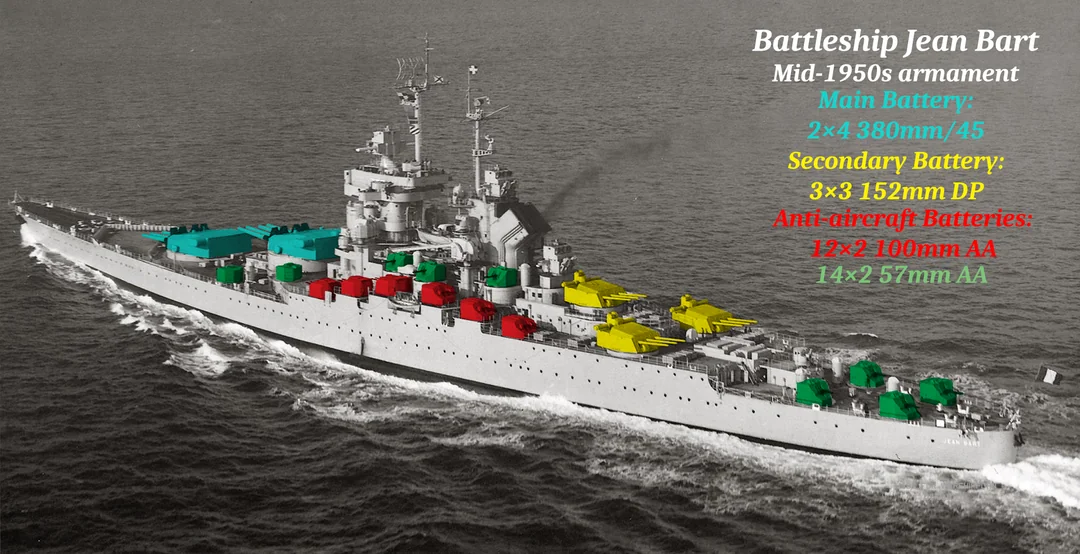
The Jean Bart artillery in a nutshell. Src warshipporn, reddit
Main: 2×4 380mm

One of Richelieu’s guns in Brest.
Eight (Two quad turrets) 380 mm (15-inch)/45 Modèle 1935 guns: These in 1950 were still an argument. Gunfire was used in shore operations in Korea, Suez, Vietnam and the Gulf war as well. The “classic” French recipe of all guns forward came from an idea expressed shortly after WW1 after “barring the T” tactics and the advantages of a forward artillery in several configurations of naval combat, but also the rationale of a restricted immune zone compared to a classic configuration with turrets fore and aft – Washington treaty obliges -. This was an elegant, albeit unusual and radical solution to the eternal issue of tonnage restrictions. Still the Richelieu were far better protected than the Dunkerque, Scharnhorst, and some argues, Littorio or Bismarck.
The two quad turrets were designed however with a catch. The two pairs of each turret were separared by a bulkhead inside the turret. The idea one fatal hit on the turret could only disable one of the pairs. This way, these quad turrets were designed like paired twins with a lot of redundancy.

The sides of the turrets sported two small guns each. They were saluting guns. Each turret had its own backup telemeters in case the main ones were disabled.
The modernized fire control system and radars allowed far more accuracy in naval bombardments compared to Richelieu anyway.
These guns used Welin breech block, were hydro-pneumatically powered with a 132.5 cm (4 ft 4 in) recoil. They could elevate to 6°/s with a 300° at 5°/s; and they had a rate of fire of 1.8 /min per gun, with a muzzle velocity of 830 m/s (2,700 ft/s) 41,700 m (45,600 yd) range at 35° elevation, with streamlined shells, HE or AP.
Jean Bart used the same shells as Richelieu (the lates ones were made in USA). The outfit for Jean Bart as completed in 1950 comprised the following: 368 APC and 386 HE.
By 1957, this changed to 328 APC and 406 HE according to her bombardment role, as well as 3,000 quarter charges.

Jean Bart’s main guns
3×3 130mm DP
Jean Bart sported three triple turrets, so the equivalent of a light cruiser, with nine Canon de 152 mm Modèle 1930. They were designed originally as single purpose on cruisers, but were modified as dual-purpose in new turrets designed specifically for the Richelieu class. The turrets had cutouts enabling an angle almost up to 90° and the mounts were modified for high angle fire accordingly.
They however in practice were quite limited. In theory they could fire up to 85°, but this was reduced to 45° for practical reasons. Decent in naval gunfire, they were ill-suited to engage AA targets as most heavy dual purpose guns of that generation: It was planned to load at any angle, but this was limited +45°. They were slow to train and elevate and had a slow rate of fire. They only could have been use in “deliberate fire” on an incoming formation, but not engage at closer ranges. In this case, the secondary AA was taking over.
12×2 100mm DP
These were the same as the ones essentially carried by the contemporary AA cruisers of the French Navy (De Grasse and Colbert) as well as the T47 and T53 destroyers.
These twin M1948 5-in or 127mm/54 were placed in in tiered superfiring positions on either flank. This configuration enabled the best lateral arc of fire as well as still six guns in chase and retreat. They could not cover each others, being separated by the massive bridge and mack.
The Model 1948, was a 54 caliber gun made fully compatible with USN and NATO standard 5-in/38 ammunition. They recalled thos of the Sumner/Gearing but they were noticeably smaller, more compact. They had been designed as heavy dual purpose weapons, first high-angle mountings, and development of 1940 twin 130mm mountings. Not automated, they needed each a crew of 11 to operate, and thus were criticized for being over complex and failing to meet requirements in rate of fire: 12-13rpm in practice.
They fired the AAC Mark 41, HC Mark 41, Illum. Mark 48, HE Com Mark 42 or VT Mark 41 rounds averaging 69 Ibs (31 kgs) at 2,650 fps (808 mps), at 24,060 yards (22,000 m) or AA Ceiling (85°) of 29,530 feet (9,000 m).
14×2 57mm AA
Second standard postwar French AA mount, these were essentially scaled-up variants of the Bofors, used also by the Netherlands and Sweden. Bofors proposed it in 1948. France adopted the 57 mm/60 (2.25″) Model 1951, and still needed loaders dropping individual rounds into ammunition boxes instead of clips, but they could fire at all angles. Their “shelf life” was short with rapid jet development, despite a rather good rate of fire of 120 rounds per minute cyclic, at 45° to 15,860 yards (13,000 m) in range and 18,040 feet (5,500 m) ceiling. More on navweaps.
More surprisingly, the 1950 Jean Bart still sported thirteen 20-mm/70 Oerlikon single Mark 1.2 light AA guns: Two on either of the “B” main turret nacelles, and four in the “square” aft of the triple secondaries. Pas 1956 they were removed and the spaces aft used for extra bins.
Closeup of the Bridge while in Toulon, showing the secondary fire control systems
Sensors
DRBV 11 air/surface search radar
DRBV 20 air search radar
DRBV 30 navigation radar
DRBC 10A fire control (FC) radar
Six ACAE FC radar
Five DRBC 30B FC radar
⚙ Jean Bart 1949 specifications |
|
| Displacement | 42,806 tons standard, 49,850 tons fully loaded |
| Dimensions | (242pp) 247.9m oa x 35.4m* x 9.22-9.90 m mean draft |
| Propulsion | 4 shafts Parsons geared steam turbines, 6 Sural-Indret boilers, 16,200 shp |
| Speed | 32 knots (59 km/h; 37 mph) |
| Range | 5,850 nm at 18 kts, 9,500 nm (17,600 km; 10,900 mi) at 15 kn |
| Armament | 2×4 380mm/45 M1935, 3×3 152mm/55 M1936, 12×2 100mm/55 M1945, 14×2 57mm/60 M1951, 20x 20mm/70 Mk 4 |
| Protection | Main belt 330mm, deck 150-170mm, Turrets 170-430mm, CT 340mm |
| Crew | 1,569 |
*After adding extra bulges, originally 33 meters (108 ft).

 See the version colorized. She was in Toulon, pending scrapping.


Netmarine.net via pinterest. Toulon, late career.