



Göbekli Tepe: The Ancient Monument that Challenges Human History
Göbekli Tepe, located in the Anatolian region of Turkey, is considered the world’s oldest known man-made monument. This remarkable archaeological site, which consists of massive stone pillars arranged in circles, dates back to around 11,000 years ago, during the late Ice Age, and challenges conventional views about early human civilization. It has sparked immense interest among archaeologists, historians, and scientists, as it predates even the construction of Stonehenge and the Pyramids of Giza, reshaping our understanding of ancient societies.
The Discovery and Structure of Göbekli Tepe
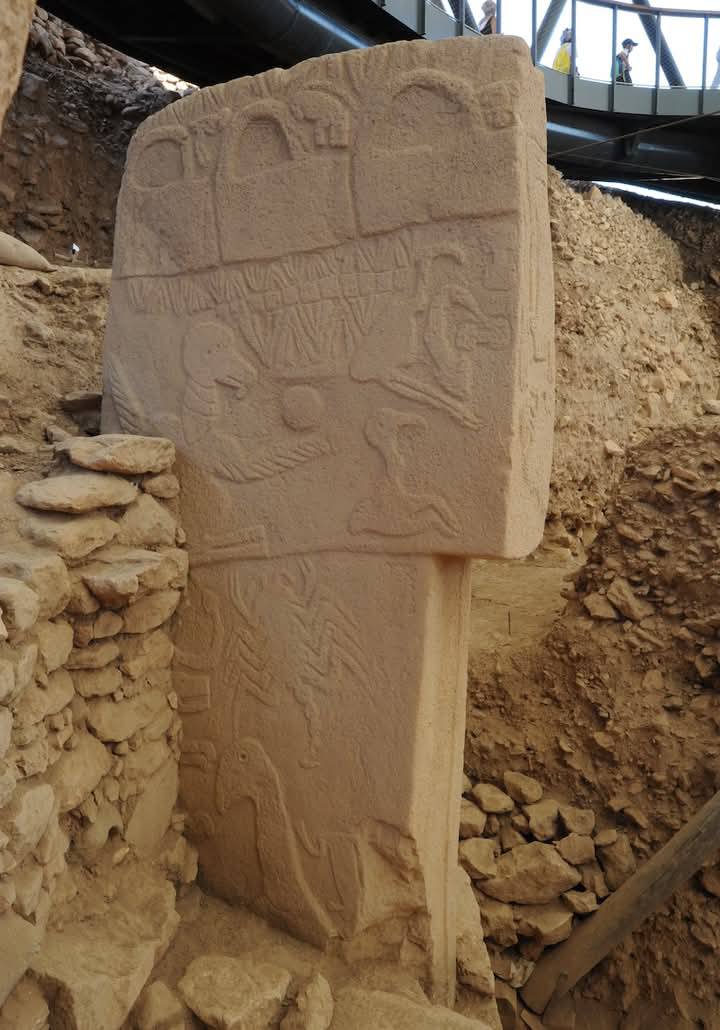
Göbekli Tepe consists of a series of large, interconnected stone circles, some of which are surrounded by smaller, smaller circles. The central pillars are made of limestone and are ornately decorated with carvings of animals such as snakes, scorpions, wild boars, and vultures. These carvings are not just artistic expressions but may hold symbolic meanings related to the religious or ceremonial practices of the people who built the site.
The sheer scale of the site is astounding. The central pillars can stand as high as 5 meters and weigh several tons, suggesting a level of engineering and organization that was far more advanced than what one would expect from a group of hunter-gatherers. Excavations have revealed that only about 10% of the site has been uncovered, which means that much of the monument remains hidden, leaving many mysteries yet to be discovered.
Hunter-Gatherers and Monumental Architecture: An Unlikely Pair?
What makes Göbekli Tepe even more puzzling is the fact that it was built during a time when humans were still largely hunter-gatherers, living in temporary shelters or caves. During this period, there were no known agricultural practices, no permanent settlements, and no complex tools that would be expected for large-scale construction projects. Yet, somehow, these early humans were able to create an incredibly complex and large monument.
This challenges the traditional view that only settled agricultural societies, with surplus resources and permanent labor forces, could have built such structures. The fact that Göbekli Tepe was constructed by nomadic peoples, who lived in small groups and moved with the seasons, suggests that there may have been social or spiritual factors at play that drove the creation of this monument. It raises the question: How did these hunter-gatherers possess the knowledge, organization, and skills to construct such an elaborate site?
Theories Behind the Monument’s Creation
There are several theories about why Göbekli Tepe was built and who could have constructed it. One possibility is that the monument served as a religious or ceremonial center. Some archaeologists believe that the people who built Göbekli Tepe may have used the site for ritualistic purposes, such as ceremonies honoring the animals depicted on the pillars or as a gathering place for spiritual worship. The carvings and the positioning of the pillars suggest that there may have been astronomical significance as well.
Göbekli Tepe’s alignment with celestial bodies and constellations raises the possibility that the site was designed as a form of astronomical observatory. Some researchers have pointed out that the arrangement of pillars may correspond to the positions of the stars, particularly during key events such as the solstices and equinoxes. This would indicate that the builders of Göbekli Tepe had a sophisticated understanding of astronomy long before the rise of established civilizations in Mesopotamia, Egypt, or the Americas.
The Mysterious Influence Behind Göbekli Tepe’s Construction
One of the most intriguing aspects of Göbekli Tepe is the possibility that its builders were influenced by a lost or unknown civilization. Some researchers have speculated that the knowledge to build such a monument may have come from more advanced societies that existed long before recorded history. Could these early builders have received knowledge from distant cultures, or could they have been part of an unknown civilization?
There are numerous myths, stories, and legends of lost ancient civilizations that possessed advanced technologies and knowledge, such as the fabled Atlantis or the mysterious builders of the pyramids in Egypt. While there is no concrete evidence to suggest that such civilizations existed, the discovery of Göbekli Tepe has fueled speculation that human history may be far older and more complex than previously thought.
Another possibility is that the builders of Göbekli Tepe may have shared knowledge with other ancient cultures. While the monument is located in Turkey, it is not inconceivable that early human societies in different parts of the world could have communicated and shared ideas through migration, trade, or other means. For instance, some theories have suggested that the ancient civilizations of Egypt, Mesopotamia, or even the Mayans might have had contact with early human groups in Anatolia, exchanging knowledge of architecture, astronomy, and mathematics.
The Astronomical and Environmental Significance
Göbekli Tepe’s alignment with the stars and celestial bodies is not the only fascinating aspect of its design. Researchers have also discovered that the monument may have been created in a location that was particularly rich in natural resources. The area surrounding the site is abundant with wildlife and suitable for hunting, which could have been a key factor in its selection as a place for gathering and ceremonies.
In addition, the site’s positioning relative to the surrounding landscape is noteworthy. The people who built Göbekli Tepe had an acute awareness of their environment, selecting a site that was not only suitable for construction but also aligned with certain natural features, such as the movement of celestial bodies and the landscape’s topography. This suggests that the builders of the site had a deep understanding of their surroundings and how to work with them, rather than against them.
Conclusion: The Mystery and Legacy of Göbekli Tepe
Göbekli Tepe continues to challenge our understanding of ancient human history. The monument’s scale, complexity, and the fact that it was built by hunter-gatherers has forced historians and archaeologists to rethink what is possible in the prehistoric world. The theories about its purpose, origins, and connections to other ancient civilizations are still being debated, and much of the site remains unexplored.
As further excavations take place and new technologies allow for deeper analysis, more answers may come to light. For now, Göbekli Tepe stands as a testament to the ingenuity and mystery of early humans, challenging our perceptions of the past and offering a glimpse into a time long forgotten.