



HMS Eagle was the fourth British aircraft carrier to enter service, after the Furious, Argus and Hermes, and a compromise. Taking a massive dreadnought to carry 25 planes would seems ludicrous to us today, but there were little options at the time, but scrapping the ship entirely, instead of taking advantage of an hole in the naval disarmament treaty of 1922. A dreadnought, even devoid of its main battery, was still a serious proposition as a warship, at a time aviation was seen merely as an auxiliary for the fleet, mainly used for spotting and possibly “harassing” small ships. Before the experiments of Mitchell, the idea of sinking a battleship with planes was not taken seriously by any admiralties.
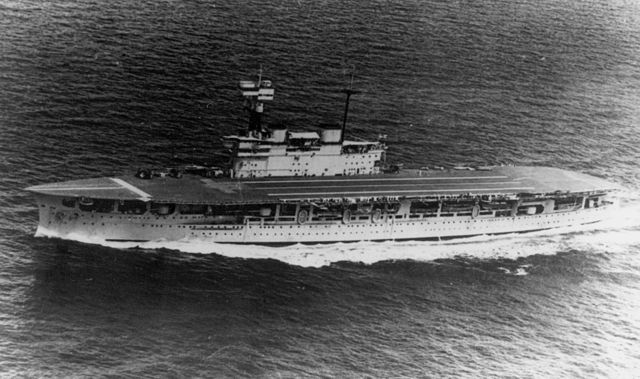
So we need to see the HMS Eagle in the context of the time, almost as an hybrid that needed to fight for itself in case of close combat, something provided by its 6-in barbette guns and strong armor. As a result, like most early conversions, in particular from battleships, the Eagle was not a satisfying solution, being too cramped to bring a potent air group, and too slow to follow modern battlelines with 30 knots ships. In WW2 nevertheless, she operated in many places from 1939 to 1942: Indian Ocean, Western and Eastern Mediterranean, even thesouth Atlantic from the West African coast and the East African campaign. Her air groups claimed more than a dozen of ships, most of the military, badly damaging many others, including during the famous raid at Tarento. She was sunk in 1942 during the battle of Malta after delivering a hundred of Spitfires, sea Hurricanes and other planes to the besieged Island.
The Chilean Battleship turned Carrier
The Eagle was the result of those ships called upon at the top of the battleship era and in a climate of naval rivalry, caught up by the war, resulting of an amazing twist of fate afterwards. In 1910, Chile was the last of the three great naval rivals of South America to embark on the dreadnought race, after Brazil (with the Minas Gerais class) and Argentina with the Rivadavia class. One reason ws to wait for the budget, the other was to study both designs and answer with a superior one. Instead of sticking with the 12-in caliber, the Chilean admiralty, always very close to the Royal Navy chose to embrace the new caliber in development, 14-in (356 mm) for their Almirante Latorre class.
Long story short, both battleships were ordered on 29 July 1912 to British yards, and the second, called Almirante Cochrane, was laid down 20 February 1913 at Vickers Armstrong Whitworth yards. In August 1914, work had advanced well, but stalled completely. She was just month away to be launched, but decision was taken to requisition her sister, Almirante Latorre, to be completed instead and renamed HMS Canada. She would do a brillant career in the Royal Navy, including the battle of Jutland. After the war, she would be delivered back to Chile and stay active under this flag until the 1950s.
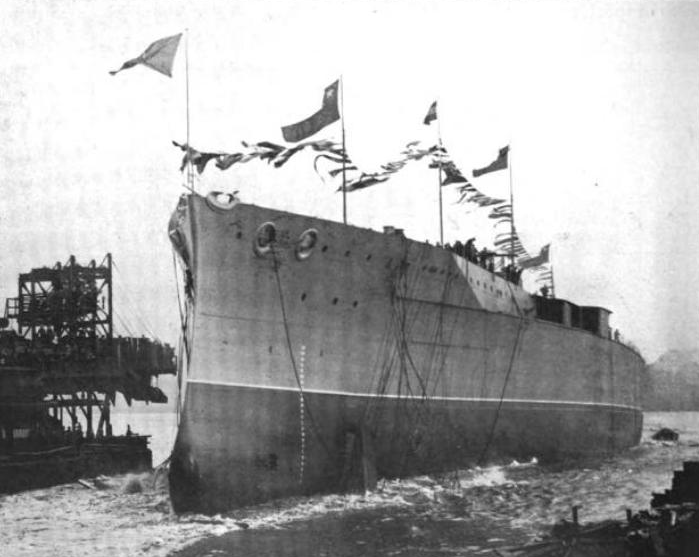
Launch of the Latorre, 1915
Meanwhile Almirante Cochrane was left as she was, her hull complete but missing her side armour and still not ready to be launched. Materials and personal has been requisitioned for other more urgent completion and would stay busy in maintenance and other constructions for the years to come. By the fall of 1917, the transformation of HMS Furious and various experiments with British seaplane and aircraft carriers conducted the admiralty to be more open to other quick conversion proposals.
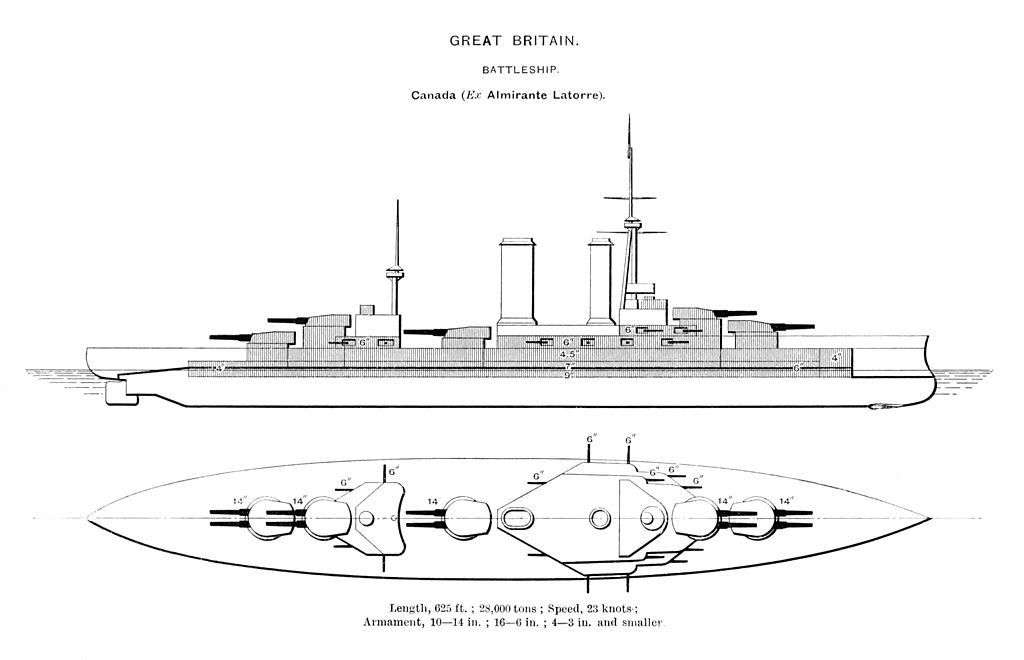
Brassey’s design 1915. Impressive, contrary to the previous Brazilian and Argentinian ships she was considered a “super dreadnought”, faster and better armed.
Director of Naval Construction immediately thought the Cochrane, still officially the property of Chile, would do a good platform for conversion, as she was large, roomy and advanced enough. He delivered a proposal to the admiralty, and an outline design was ready on 8 February 1918. The admiralty was indeed interested to test the innovative design and 20 days later, on 28 February 1918, the request to the government to purchase the hull from the Chileans has been accepted, as well as the conversion. The Cochrane passed under the supervision of the Royal Navy, unnamed and noght in commission at this point. After many revisions and delays, completion would be effective on 20 February 1924, six years later.
Design specifics of the conversion
The first design proposal of late 1917 by the Director of Naval Construction was indeed quite singular and striking: She would have been the first and only carrier fitted with two islands, one either side of the continuous flight deck. Both islands, 110 feet (33.5 m) long would have comprised two funnels and a tripod mast, and were staggered to confuse submarine captains and ships spotters over the ship’s orientation. Both islands were connected with heavy bracing and the bridge mounted above, leaving 20 feet (6.1 m) of clearance above the flight deck. This intermediary space as defined was 68-foot (20.7 m) wide, with the aircraft lifted by the two elevators and assembled before taking off from there.
In addition as seaplanes were still important, a crane was fitted at the aft end of each island to operate these. To feed this air group, 15,000 imperial gallons (68,000 l; 18,000 US gal) were carried inside individual 2-imp. gallon tins stowed on the forecastle deck and under 1-in (25 mm) of armour plate protection. Two ready-use tanks near the islands were installed for quick refuelling of the planes. Armament was of course reduced to side sponsons, with guns under masks instead of barbettes, nine of the original 6-in guns plus four 4-in AA guns between the islands. The powerplant was left unchanged, but with increased quantities of fuel oil, coal still carried but also increased to 1,750 long tons (1,780 t) and 3,200 long tons (3,300 t) respectively.
In March 1918 however, there has been enough experience with turbulence and smoke on Furious from the pilots to decide to scrap the port Island. The ship would be more conventional, and the Island made slightly larger.
Trials on HMS Furious and pilots hearing went into reports, feeding the design staff on the Eagle, which recognised planes dangerously to turn to port when recovering from an aborted landing. This resulted in eliminating the port island altogether in April 1918. To cope with just one left, the remaining starboard island was made longer, at 130 feet (39.6 m) but it as also reduced in width by 15 feet (4.6 m). This minified air turbulence.

Prow of the HMS Eagle in the 1920s – Src: wrecksite.org
The island design was revised to include a more substantial bridge, the two truncated funnels and and enlarged single tripod mast which carried the fire-control directors. Admiral David Beatty, then Grand Fleet commander, insisted for the main armament to be increased to twelve 6-inch guns, notably one on deck, close to the island. He also insisted for eighteen torpedo tubesto be mounted in three triple fixed mounts per side. The idea was to prevent night German light cruisers attacks. At the same time, AA armament was limited to a single 4-inch gun placed on the island, between the funnels, a choice that radically reduced its arc. But David Beatty, in advance on the era on this point, believed the carrier’s own fighters could do the job of defending the vessel against other planes. The revised blueprints were approved in June 1918. The design was later altered for protection: The 4.5-inch (114 mm) armour of the upper belt was lowered at waterline level. The barbettes for the former 14-inch guns were completely eliminated.
Launching and delays
HMS Eagle was eventually launched on 8 June 1918 without much fanfare. She was towed downriver, to the shipbuilder yard for fitting-out. This started ten days after, after all preparations has been made. This started by re-routing boiler uptakes. Next the 1.5-inch (38 mm) upper deck was modify to be used as the floor of the hangar deck. A new superstructure was erected above, running all the way but stopping short of the stern and prow. The flight deck which was built above had a 1-in thickness (25 mm). The thickness was more for better stiffness of the ship rather than protection per se. By November 1918, the war ended, and HMS Eagle was still nine months from completion.
As priorities changed, construction immediately slowed down to almost a halt, pending a decision of the admiralty, linked to the Government’s own decision about her fate. Indeed, before requisition she had been paid by the Chilean Government (but refunded afterwards). As the war ended, so was the requisition and the ship should potentially return to her original owner. Construction of HMS Eagle was therefore completed suspended on 21 October 1919, when Chile made known by its ambassador the will of the Government to repurchase the ship.
This was assorted to the will to converted her back to her initial state, as a battleship. Politicians were not well aware of the technical consequences of this choice. Indeed soon, the yards evaluated the cost of such back conversion to £2.5 million, whereas the purchase as estimated to £1.5 million. This was of course too steep, and the Chileans retracted, after securing the return of HMS Canada as Almirante Latorre, still individually superior to the Rivadvia and Minas Gerais.
The ball was back to the Admiralty which decided to retain the ship and resume conversion. Soon, with adequate material and manpower, completion was nearly done and flying trials started. For the first time, the Royal Navy experimented with a ship with a proper island, and the trials results were eagerly awaited to proceed with other designs. Meanwhile the HMS Hermes, also with an island of a similar type, was in completion.
1919-20 Trials

HMS Eagle – original sketches conversion overview
Eventually, on 11 November 1919, after machinery trials were successful, the admiralty approved the ship. Armstrong Whitworth rushed completion to be paid, plating over the openings for the undelivered elevators (cancelled as not in conformity with the specifications), completed the rear funnel, plated over the forward funnel uptakes and removed the torpedo tubes, which could have been an issue for stability. She sailed to the Royal dockyard, Portsmouth for her last modifications and start her first official sea and air trials on 20 April 1920. She performed those sea trials which just two of her boilers, converted oi-burning only.
Afterwards, the first air trials started, under Captain Wilmot Nicholson’s command (former Furious’s captain) and RAF Group Captain Charles Samson. The longitudinal arresting gear already tested in HMS Argus was further tested in a modified form. Bythat time, its purpose was solely to prevent the landing aircraft from veering off to one side, falling off. Indeed planes of that generation were light enough to stop without aid, just by aiming at a good headwind. This arresting gear was about 170 feet (51.8 m) long. The first trials showed it was installed too far forward for comfort. It was therefore moved further back and lengthened. The final version was 320 feet (97.5 m) long.
on 10 May, taxiing trials started, with Sopwith Camel fighters. They were joined by a Parnall Panther reconnaissance aircraft. These tests were realized with the ship anchored. Flights were performed to test winds currents around the ship, from all directions, headings and altitudes. What worried all was the behaviour of planes close to the tall island. The first on-board landing was performed on 1 June 1920.
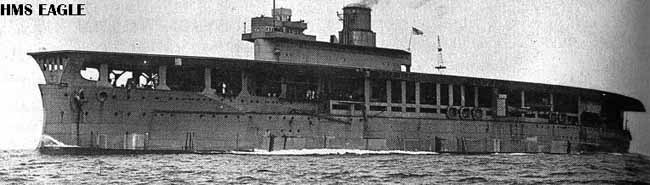
HMS Eagle in 1920 during her first trials – Src: Hazegray.org
Afterwards, HMS Eagle tested the Bristol F2B fighter, Sopwith Cuckoo (torpedo bomber), and De Havilland DH.9 bomber. Apart the Cuckoo, none was navalized. It was not required at that time.
Tests were mostly successful. They were only 12 minor accidents in 143 landings, including in adverse weather. Reports shown however that the planes own landing gear needed shock absorbers to handle the impact, moreover on a pitching deck and harder angle.
Group Captain Samson for the first time recognise the need to “navalize” aircraft. He preferred the elimination of the island altogether, which was of course opposed by Nicholson and the admiralty, as it was needed to serve the onboard armament and command and control in general. However the captain recoignised the size and shape of the island were not optimal. He recommended a full fuel oil conversion, due to black smoke issues hampering pilot’s vision, and stressed the removal of the 6-inch guns. They were to be traded for extra anti-aircraft guns, and elimination of the tripod mast needed for fire control. In this, he was not followed by the admiralty however. Thus, the HMS Eagle came out as a compromise.
HMS Eagle final design
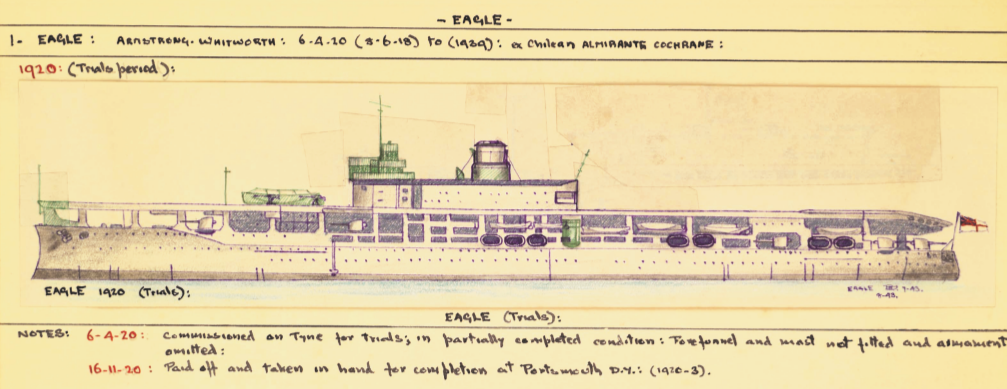
HMS Eagle, modifications 1923-29 – drawing by Perkins. His art book of the RN, recoignition plates, now part of the British Warship Recognition – Volume II: Armoured Ships 1860-1895, Monitors and Aviation Ships. SRC
1921-24 reconstruction
HMS Eagle active service as a test ship ended on 16 November 1920. However she was not taken in hands for modifications, on a completely revised design, before 24 March 1921. This took place at the Portsmouth NyD.
The Admiralty choose to retain some suggestions from Nicholson, but scrap others. The island, first of, was heavily modified. In between, a mockup scale model was tested in a wind tunnel at the National Physical Laboratory.
The admiralty did not flinched over the 6-inch guns, which were retained. The forward edge of the flight deck was faired into bow, as the results of the wind testings. It allowed to smooth out air currents over the bow. Extra 4-inch AA guns were mounted on and around the island as suggested. New elevators were orders, while the forward one was shifted at the forward end of the hangar. To improve ASW protection also, anti-torpedo bulges were added. They ran 6 feet (1.8 m) deep. Petrol storage was modified, from tins to a single 8,100-imperial-gallon (37,000 l) tank. Thus, fuel capacity was increased to 3,000 long tons (3,000 t) and with the bulges added, filled with additional petrol, up to 3,750 long tons (3,810 t), with 500 long tons acting as ballast. This was mandatory to offset the weight of the island on starboard.
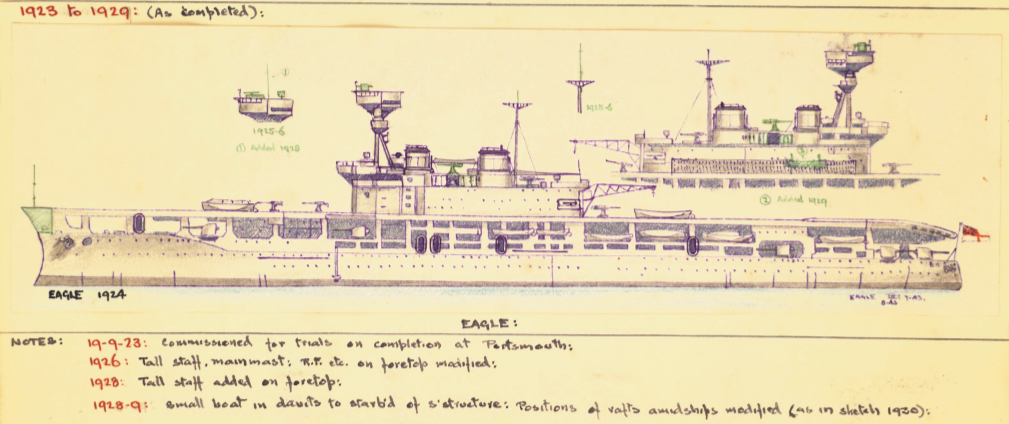
HMS Eagle, modifications 1923-29 – same source as above.
As completed in February 1924, HMS Eagle measured 667 feet 6 inches (203.5 m) overall, for 115 feet (35.1 m) in width (waterline) 26 feet 8 inches (8.1 m) of draft deeply loaded. Displacement was lower of course than the original battleship design, but still at 21,850 long tons (22,200 t) standard load.
The flight deck was 652 feet (198.7 m) long, the hangar below 400 feet (121.9 m) long. Its height was around 20 feet 6 inches (6.2 m). The forward elevator was 46 by 47 feet (14.0 m × 14.3 m), and the aft one 46 by 33 feet (14.0 m × 10.1 m). The arresting gear was further lengthened to 328 feet (100.0 m) long. To serve boats and recover planes was planed a large crane, with 60-foot (18.3 m) or traverse, right behind the island as initially planned in 1928.
Powerplant
Each of the ship’s four sets of Brown-Curtis geared steam turbines drove one 3-bladed propeller.[17] They were powered by 32 Yarrow small-tube boilers. During her sea trials on 9–10 September 1923, the turbines produced 52,100 shaft horsepower (38,900 kW) and gave Eagle a speed of 24.37 knots (45.13 km/h; 28.04 mph), but this caused leaks in the turbine joints and she was limited to a maximum of 50,000 shaft horsepower (37,000 kW) in service. She had a range of 4,800 nautical miles (8,900 km; 5,500 mi) at 16 knots (30 km/h; 18 mph).[18]
Protection
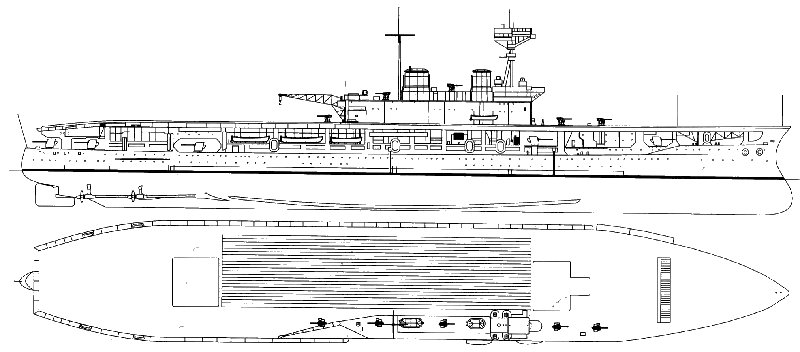
Blueprint of HMS Eagle in 1924 as completed
The protection was no longer to battleship standard, but nevertheless, in addition to ASW ballasts, which stored oil and were used to compensate for the island weight offset, the waterline belt was 4.5 in (114 mm) in thickness, and the main protective deck: 1–1.5 in (25–38 mm), the latter figure over the magazines and engine rooms. With a hangar, this means a shell had more levels to cross. Bulkheads were not forgotten and were 4 in (102 mm) thick. Hangar protection included four steel shutter fire curtains to isolate any fires in the hangar.
Armament
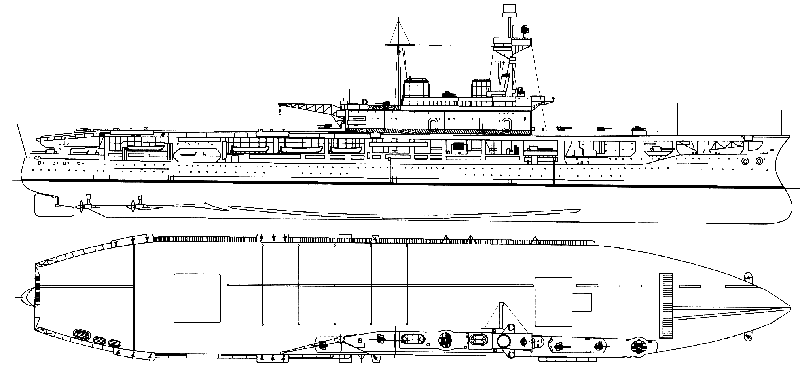
Blueprint of HMS Eagle in 1942
The final armament of the Eagle still comprised nine 6-inch (152 mm) guns, completed by five 4-inch (102 mm) Mk V anti-aircraft guns. The former were the standard-issue BL Mk XVII 6-inch gun. Three were posted at the stern, one in the axis and the two others in échelon behind, and the six others went along the broadsides in sponsons. Each was supplied with 200 rounds and was protected by a standard-issue light cruiser gun shield, cast and rounded.
The 4-inch (102 mm) Mk V AA guns were another staple of British light artillery, with a lineage going back from 1914 up to 1945. They were developed to provided a higher rate of fire than the BL 4 inch Mk VII. At first these were used only for anti-shipping role, and inaugurated by the Arethusa class cruisers, but soon a high-angle mount was tested, and fitted, to procure the gun a anti-aircraft role. In that guise, the Mk V had a practical ceiling of 28,750 ft (8,800 m). Muzzle velocity was 2,350 ft/s for the 31 lb (14.1 kg) fixed QF HE round, with promixity fuse in WW2. The gun elevation was 80° but loading was limited to 62°, which slowed down the rate of fire.
Aviation
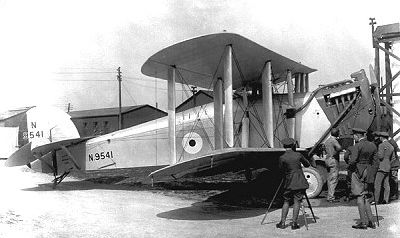
Blackburn Dart, of the 1920s air group, No. 460 Flight.
HMS Eagle aircraft capacity was 25 to 30 planes, depending on their size. In 1939 the crew comprised 41 officers and 750 men, while the air group added 160-200 more personal.
HMS Eagle air group was rather small but comprised a classic trio at first in 1924: Fairey Flycatchers fighters, Blackburn Blackburn (reconnaissance), Supermarine Seagull flying boats (for recce, arty spotting and liaison) and Blackburn Dart torpedo bombers.
From 1925, the Seagull were retired and replaced by land-based Fairey IIIDs from January 1925. Later that year, she carried Avro Bison spotters.
From 1934, the air group would comprise 9 Hawker Osprey fighters and 12 Fairey IIIFs, later replaced by the Blackburn Baffin. In 1937 they were all replaced by a single type air group, nine Fairey Swordfish torpedo bombers and nine more Swordfish of two squadrons. In 1939-40 she carried Gloster Sea Gladiators in crates to be disembarked, but there is no evidence she flew some. She was still equipped only with Swordfish TBs. However in early 1941 she did carried nine Fairey Fulmars, five Sea Gladiators and six Swordfish. In 1942 she would carry for Malta 17 Spitfires and six Fairey Albacore, but retained four Sea Hurricanes, which replaced the obsolete sea gladiators. In addition to those, for her last mission to Malta she carried a total of 31 Spitfires. Later, when she was struck by a submarine, she carried 16 Sea Hurricanes (Sqn 801 & 813) plus four reserve aircraft.