



Last of their kinds and advanced semi-dreadnoughts
The Nelson class was infortunate as the last pre-dreadnoughts Battleships built by Great Britain. They were launched in June and September 1906, while HMS Dreadnought was completed (she was commissioned in December 1906), but started in May 1905 (October 1905), and still, were commissioned one solid year after, in June and December 1908, showing one one hand, the urge of Admiral Jackie Fisher to push his project forward, and the doubts in the admiralty with their own pre-dreadnoughts.
This “parallel project” could be seen as the admiralty’s guarantee to have two new battleships if HMS Dreadnought did not delivered all its promises. This also doomed them in a sense, making them irrelevant to take part in the Grand fleet after a few years, facing the Kaiserliches Marine, but still, they were part of the Channel Fleet when the First World War began in August 1914. They were only transferred to the Mediterranean Sea in early 1915 to participate in the Dardanelles Campaign, and stayed there (Aegean Squadron 1916, then occupation of Cantontinople in 1918). Sold in 1920 for Nelson, this made her career just spanning twelve years. Agamemnon was turned into a taret ship and managed to survive until 1927.
Design Development (1901-1905)
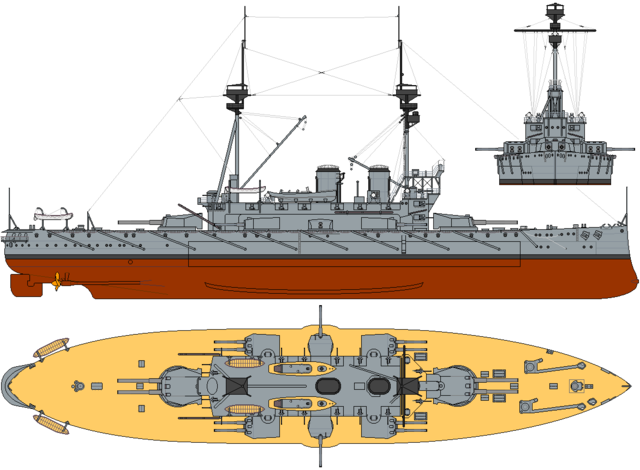
2-view color profile – CC
Following the pioneering naval gunnery developments by Captain Percy Scott in the early 1900s, reports were written, and examined with great interest by the admiralty:
-Expected battle ranges of 6,000 yards (5,500 m): This was enough to force the spotters waiting for the shells to arrive before applying corrections.
-Shell splashes from smaller weapons tended to obscure splashes from the bigger guns.
-Either smaller-calibre guns would have to hold their fire, losing their faster rpm advantage.
-Longer-range torpedoes expected in service, discouraging closing ranges (and thus secondary fire).
-In conclusion of all this, more heavy guns and uniform calibre were needed.
Philip Watts (Director of Naval Construction in early 1902) and Vice-Admiral William May (3rd Naval Lord, Controller of the Navy) conducted studies shown in addition that despite their high rate of fire the 6-inch (152 mm) had still an impact way smaller than 12-inch (305 mm). Greater damage at greater range was a force multiplier. A Battleship had a real chance to obliterate it’s opponent’s smaller guns before they could even open fire, but thicker armour was required in response.
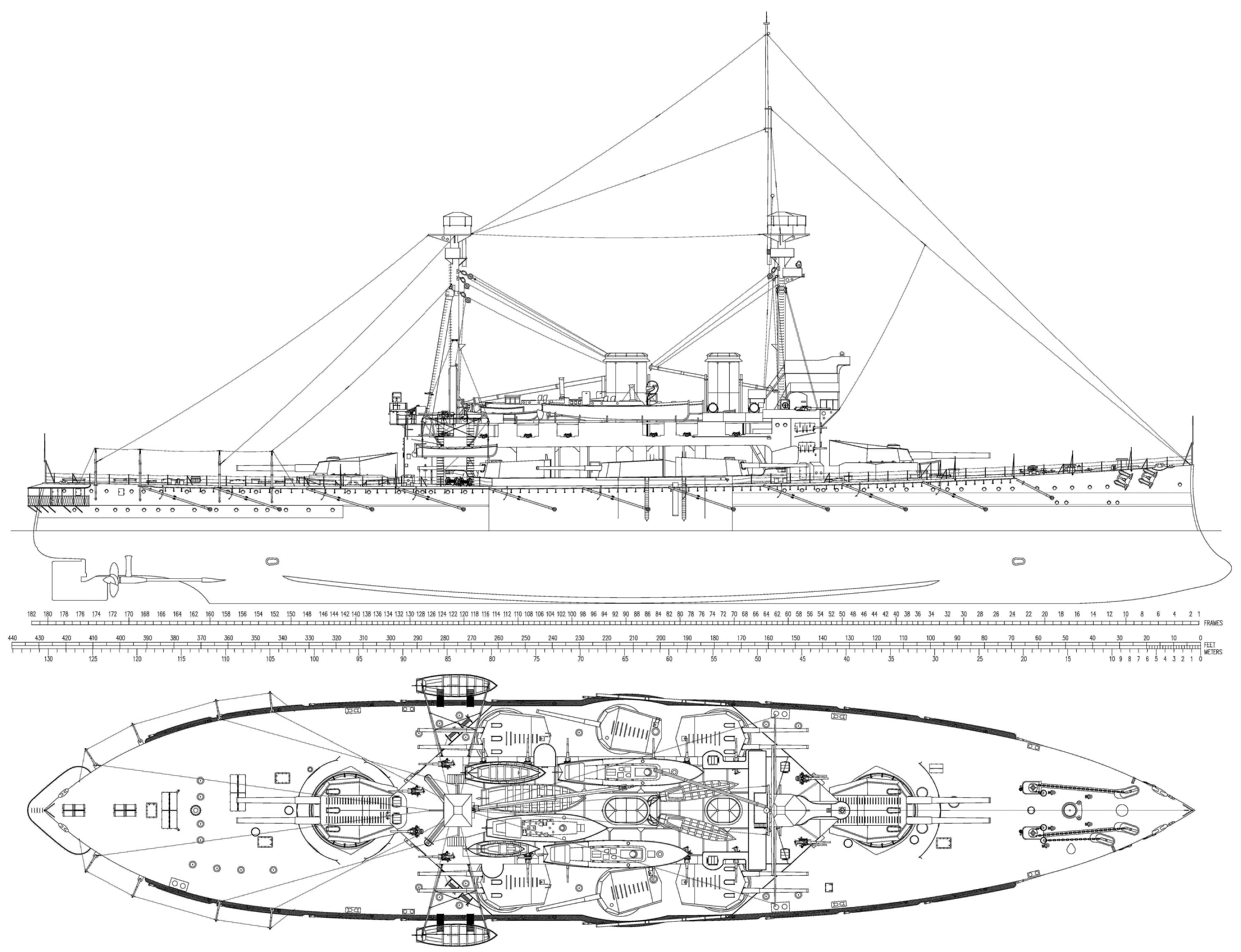
HD Illustration
The Board of Admiralty in its 1903–1904 Naval Programme wanted no more than 14,000 long tons (14,000 t) battleships designs, like the earlier Duncan class to use its drydocks at Chatham, Portsmouth and Devonport (they were were enlarged anyway), which severely constrained the new design. Preliminary design work for the Nelson class started in mid-1902. A displacement and dimensions close to the preceding King Edward VII class was required. A conference in November to discuss the way forward was held, as there were still doubts in the admiralty about their configuration, between the studies seen above and Fisher’s own ideas. Participants agreed in the end to increase armour to a 12 inches, and displacement to 16,500 long tons and eliminate the mixed three-calibre gun configuration of the King Edward VIIs (which proved unpopular in the end). It was chosen, based on the small displacement, a mix of 12-inch and 9.2-inch (234 mm) guns; Director Philip Watts meanwhile proposed a “Cuniberti-style” all-10-inch (254 mm) guns project, which was ruled out.
The Admiralty approved the new 16,350-long-ton design, on the base she was armed with four 12-inch and twelve 9.2-inch guns, a seemingly much better arrangement than the previous KE VII, on 6 August 1903. In October however it was revoked as the new ship could not be docked at Chatham. Too late to revise the design in time according to the 1903–1904 timetable, the Admiralty instead ordered three extra King Edward VII-class vessels. Philip Watts refined the design in between to to have her entering the Chatham docks, and this implied first, dropping two of the 9.2-inch guns, down to ten. As it was, the nex design was eventually approved on 10 February 1904. A planned third was cancelled due to the repurchase of the Swiftsure-class battleships.
Hull construction
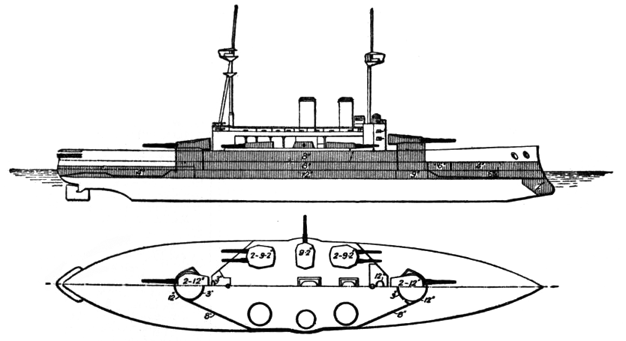
The Lord Nelson-class measured 443 feet 6 inches (135.2 m), which was shorter than the KE VII class (435 feets or 138.3 m), for a greater beam ar 79 feet 6 inches (24.2 m) versus 75 feets or 22.9m, and larger deeply loaded draught figure of 30 feet (9.1 m) versus 25 ft 8in (7.82 m). They displaced a bit less standard at 15,358 long tons (15,604 t), but were heavier when fully loaded, at 17,820 long tons (18,106 t) – versus 17,500.
The Lord Nelson had a metacentric height of 5.27 feet (1.6 m) deeply load and proved to be good seaboats and steady platforms with predictable roll, excellent agility and helm response. Of course they bled speed when steered hard over, about 60% at full speed, but this hardly was a surprise. Their crew comprised 749–756 men in peacetime, and up to 800 men in wartime. They carried six main service boats, including two picket steamboats stored on the main battery roof.
Design wise, they were less “symetrical” ship than previous classes, with a slightly higher freeboard for better seekeeping. Their two funels were close together and of different lenght, and closer to the bridge and foremast.
The lack of casemate guns in the hull was another sure way to identify them. The central superstructure was tall, with a narrow utility base level, cutout to allow the side large turrets to swing around. Above was the battery deck, with all their 3-in guns placed high enough to possess a good range. They had two masts, the aft being a tripod, and two booms to handle the service boats. Seven projectors for night fighting also including two smaller ones for morse communication.
Yard Model of Nelson
They had two small ovale conning towers fore and aft. There were two command brigde, one enclosed in the bridge with four portholes and enclosed between the supports for the open bridge above. This was the “weather bridge”. The open bridge was located just above, overhanging by at least two meters. Above it was located an extra flying bridge with a signals device. Before WWI the open bridge was enclosed in a small structure. Also customary also there the classic “officer’s galley” at the poop.
Powerplant
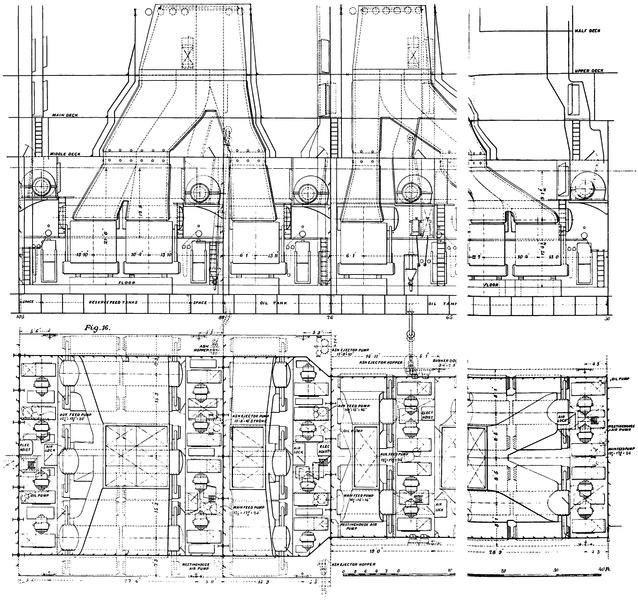
In this field, although they still had the same VTE engines, the Nelson class innovated: Their four-cylinder inverted vertical triple-expansion steam engines were nothing new. They drove four-bladed, 15-foot (4.6 m) propeller screws and steam came from fifteen water-tube boilers working at 275 psi (1,896 kPa; 19 kgf/cm2). Their exhausts were trunked into two funnels amidships.
This powerplant was rated for 16,750 indicated horsepower (12,490 kW), and a designed speed of 18 knots (33 km/h; 21 mph). On trials, they delivered more, reaching 18.5–18.7 knots (34.3–34.6 km/h; 21.3–21.5 mph). But the novertly was that they were the first fitted with built-in fuel oil sprayers in the boilers to increase burn rate, and it was done in a systematic way, with large quantities of fuel oil. So it was “mixed” in a sense.
They had onboard 2,170–2,193 long tons (2,205–2,228 t) of coal in peacetime (in wartime extra compartments were filled to the brim, doubling this figure) plus 1,048–1,090 long tons (1,065–1,107 t) of fuel oil. The latter was stored in tanks in their double bottom. With a cruising speed of 10 knot their normal range was 5,390 nautical miles (9,980 km; 6,200 mi) on coal alone, but 9,180 nmi (17,000 km; 10,560 mi) with both and more potentially in wartime.
Armament
The main artillery was the same as before, two twin main turrets with 12-in guns, but of a new model. The real game changer was their secondary armament composed or turreted 9.2 in guns. Very ambitious at the start, it was to comprise three twin turrets, but due to Chatham dockyards limitations at the time, the designer reduced this by given them central turrets with a single gun instead. Both wings turrets were still twin. The other big point was the total absence of casemate guns, as they were reported useless in conclusions of recent reports.
Thirdly, athough there was debate to adopt a single light gun caliber, 3-in, those who wanted extra defence against light vessels won and obtained two calibers. So in a sense, the Nelson class were still not even “semi-monocaliber”, certainly not as radical as HMS Dreanought. The complete alimination of casemate 6-in guns was resisted by some members in the staff that still feared torpedo and destroyer attacks, obtaining the guarantee of better performances for the new 3-in guns and still a score of lighter, faster-firing 3-pdr (47 mm or 1.9 in).
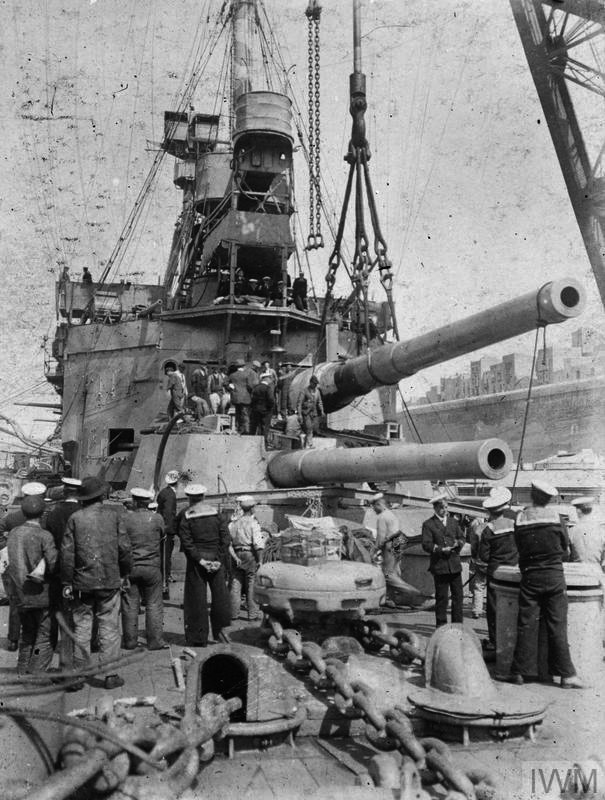
HMS Agamemnon’s 12-inch gun replacement at Malta, 1915
For accuracy, the Nelsons had two main military masts, one being a pole forward, with three tops, one fitted with a single projector (six more located on the battery roof), a signal top, and above, like for the aft mast, the main spotting top, covered and fitted with telemeters and long range optics. The aft mast was tripod to compensate for the boom’s load. A smaller boom was fitted to the foward mast as well.
Main: 2×2 12-in Mark X
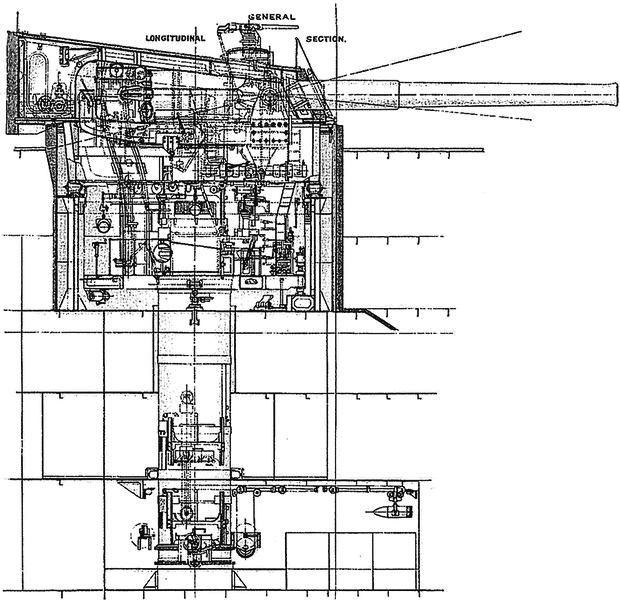
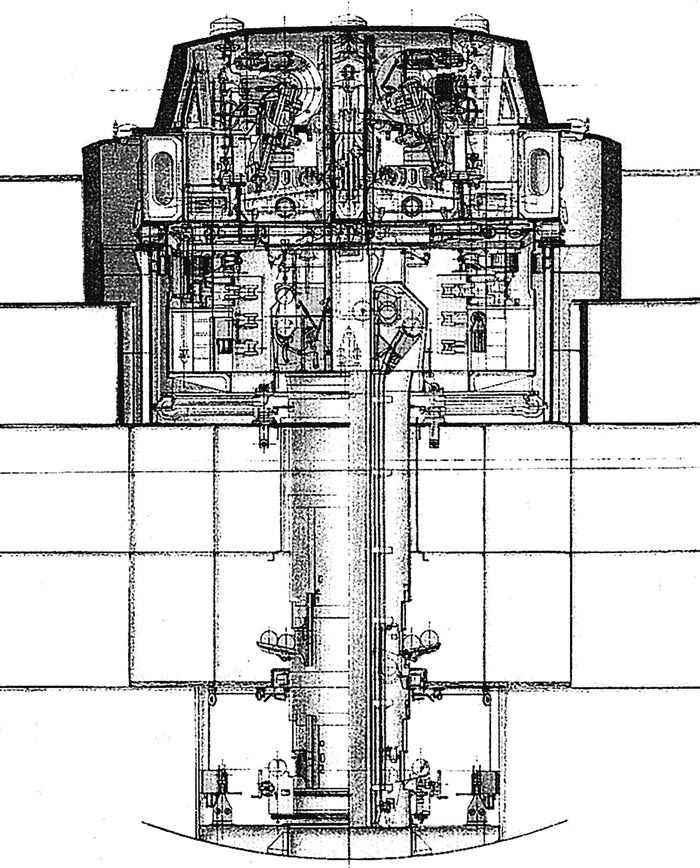
These 45-calibre breech-loading (BL) 12-inch Mark X guns had a maximum elevation of +13.5° for a 16,450 yards (15,042 m) range, fired 850-pound (386 kg) shell at 2,746 ft/s (837 m/s) and two rounds a minute (1.5 for other sources). They carried 80 shells per gun.
Secondary: 4×2, 2×1 9.2 in Mark XI
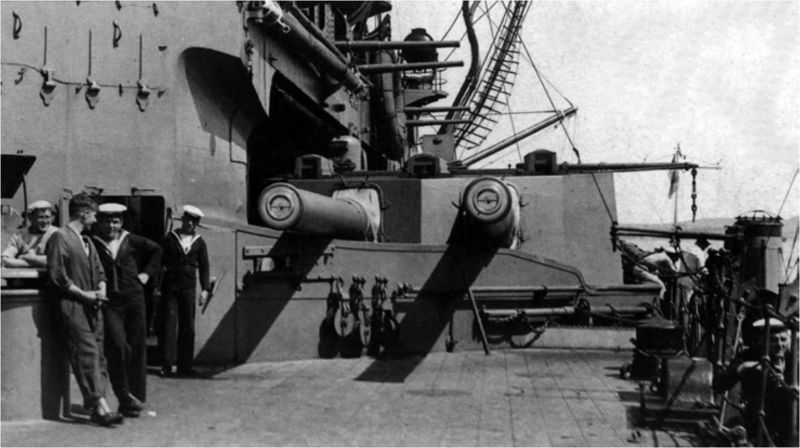 Secondary guns
Ten 50-calibre BL 9.2-inch Mk XI guns mounted in four twin-gun turrets at the corners of the superstructure and two single-gun turrets amidships. An elevation of +15° gave them a range of 16,200 yards (14,800 m). They fired a 380-pound (172 kg) shell at 2,875 ft/s (876 m/s) and max rpm of four a minute, twice as fast as their main arrillery, which was the point. They very similar range made their ideal range at around 15,000 yards.
Tertiary: 24x 3-in+12x 3pdr
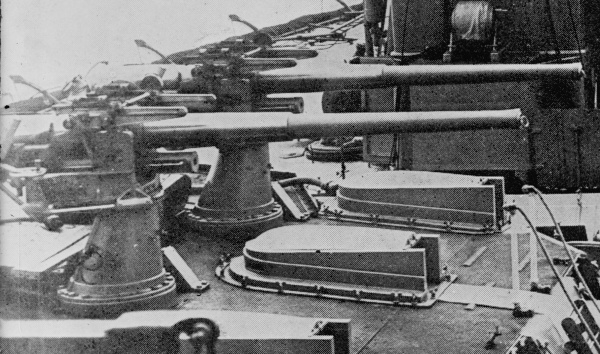
QF-12 pdr 18 cwt Guns (hms dreadnought)
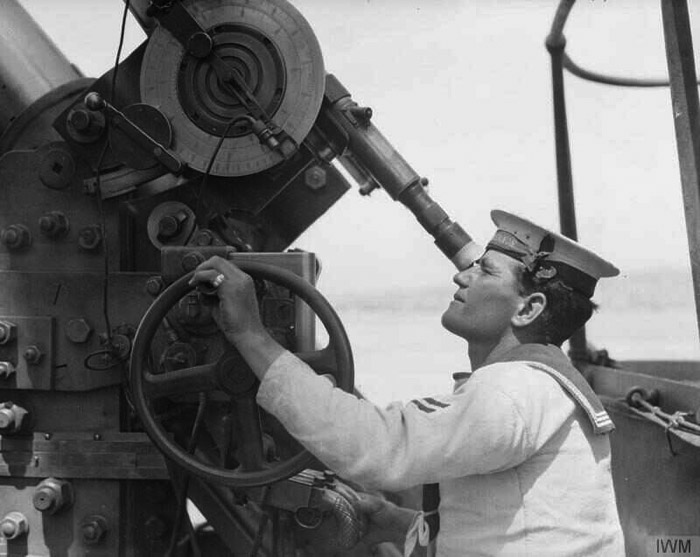
HMS_Agamemnon_12-pdr_gun_crew_aiming-Salonika_1916_IWM
-The twenty-four 3-in or 12-pdr were the main light defense against Destroyers. It was theorized that the relatively high rate of fire of the 9.2 in guns should be enough to repel destroyers at long range, dealt with at closer range by the numerous light guns, starting with the Vickers-Armstrong QF 12-pounder 18 cwt (76 mm) naval guns just introduced in 1906. They became widespread on Britsh dreadnoughts afterwards, often placed on the turret’s roofs. These guns fired a 12.5 lb (5.66 kg) at 2,600 ft/s (790 m/s) with a rate of fire of 20 rd/min, up to 9,300 yards (8,500 m) at +20° elevation. They were all located in a semi-covered battery deck (open above them), seven on each broadside, four in the forward bridge structure in casemates, two aft.
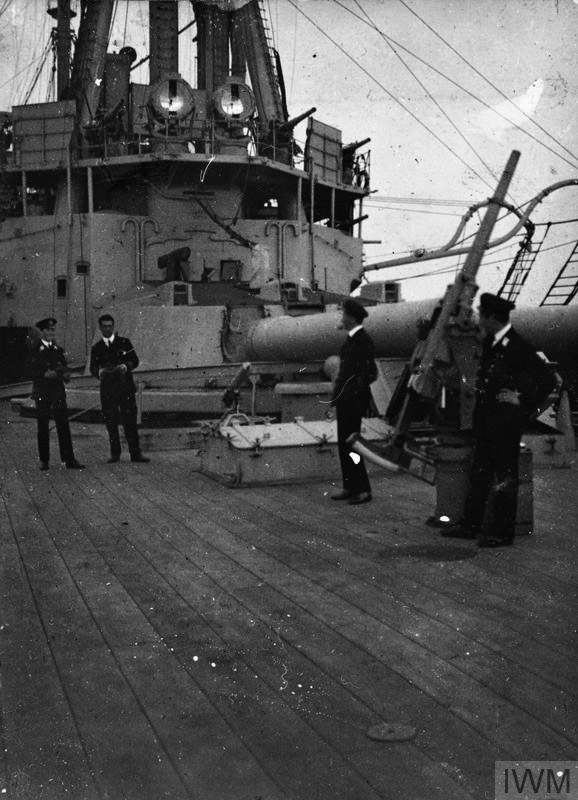
Agamemnons’s 3-pounder AA gun in WWI
-The twelve QF 3-pdr Hotchkiss (47 mm) were a much older ordnance, a “classic one” shared by all pre-dreadnoughts or the Royal Navy and widespread in cruisers as well. They fired a much smaller HE round, but at 30 rpm, 571 m/s (1,870 ft/s) and max range of 5.9 km (3.7 mi) or even 4.5 km (2.8 mi) on the late mount, allowing a +80° elevation for AA fire. These were by default the AA guns on board and for maximal arc of fire, were placed on the battery roof fore and aft.
Torpedoes: 5x 18-in
Like all previous pre-dreadnoughts and HMS Dreadnought herself, the Nelson class had the mandatory 18-inch (450 mm) torpedo tubes. They were five of them, submerged, two on each broadside aft of the citadel, and one in the stern, with 23 torpedoes in storage. They were likely of the Mark VI type (1904), capable of 28.5 knots (52.8 km/h; 32.8 mph) on 4,000 yd (3,700 m) or much faster setting at 41 knots over 1,000 yd (910 m).
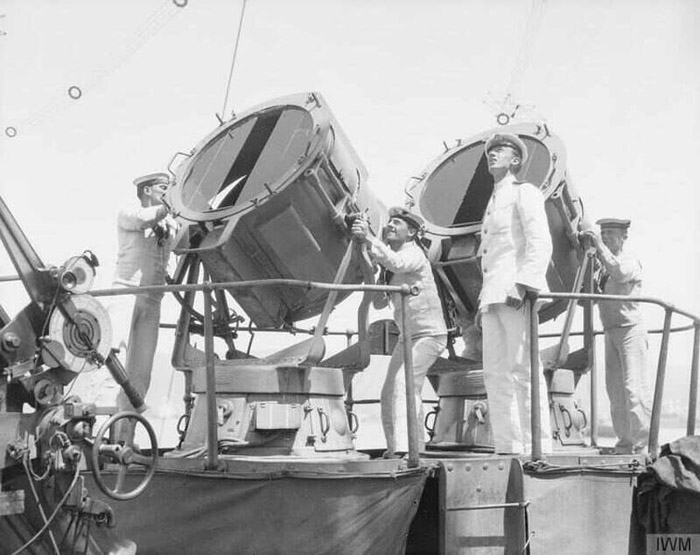
HMS Agamemnon’s projectors
Armor protection
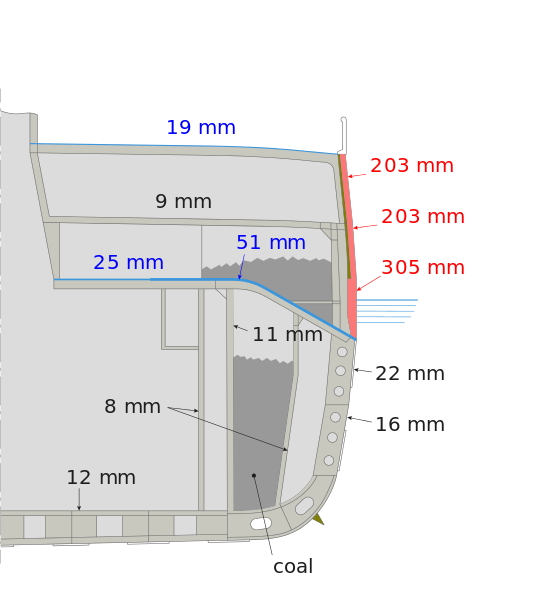
The Lord Nelsons’ scheme still was in line with the previous King Edward VII class, albeit thicker but with thinner deck armour as a result of reports. Krupp cemented armour (KCA) for vertical armour.
Naval historian R. A. Burt later pinted out their waterline belt could be submerged deeply load, and the thin barbette armour below the upper deck as critical weak points, exposing their magazines to plunging fire at long range. If committed at Jutland they could have well met the same fate as the ill-fated Beatty’s Battlecruisers.
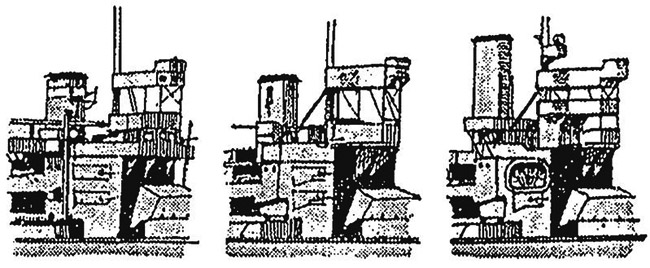
Various bridge configurations of the class
Details of the scheme

- Waterline main belt (7 ft high): 12-in, down to 6 in lower edge.
- WL belt 190 feet (57.9 m) long amidships, but from the rear of the forward barbette
- Aft belt 4 inches (102 mm) to stern
- Forward belt 9 inches (229 mm) and 6 in the bow.
- Strake downwards, ram bow 2-inch (51 mm)
- Middle strake 8-inch (203 mm) to the bow (4-6 in in)
- Bulkhead aft and fwd 8-inch.
- Upper strake 8 inches thick, oblique bulkheads on side armour
- Main gun turret 12 in fwd, roofs 3-4-in
- Main gun barbettes 12 in external faces
- Lower main barbette (below deck) 8 in (aft barbette 12 in)
- Main Barbettes inner faces 3-4 in fwd, 3 in aft
- 9.2-in gun turret 8-in faces, 7 in sides, 2-in roof
- 9.2 in gun turrets barbettes 6-in
- Ammunition hoists tubes 2-inch
- Citadel upper strake 0.75 inches (19 mm)
- Main armored deck fwd citadel to bow 1.5 inches (38 mm)
- Middle armored deck (citadel floor) 1 inch (25 mm), 2 in slopes
- Lower armored deck 4 in sloped upwards
- Lower deck fwd citadel 1 in, 2 in aft (3 in slope to steering gear)
- Forward conning tower 12 in, 3-in roof
- Aft conning tower 3-in.
The Nelson’s lifts
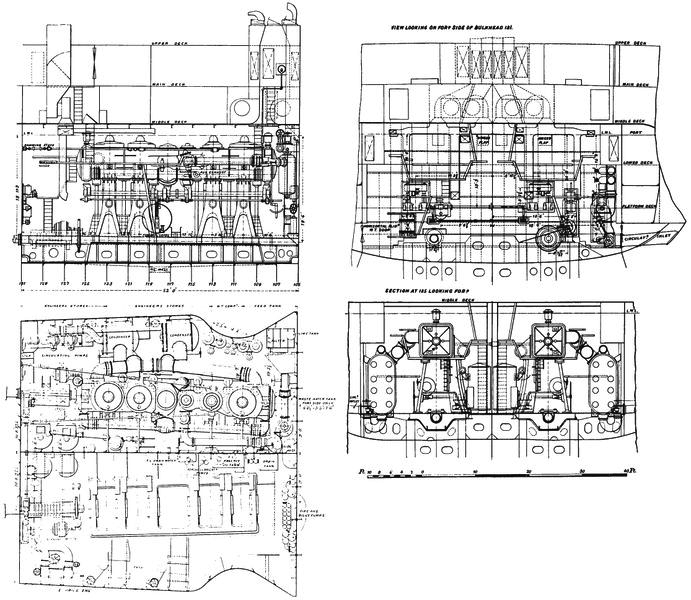
For ASW protection, the Lord Nelson class innovated, as they were fitted with unpierced watertight bulkheads, for all main compartments. Lifts were just introduced onboard Liners (like the famous “Olympic class”) and were all the rage. Some in the design team though this would be a good idea. Access was therefore possible using lifts only, not hatches or doors. In service this feature proved unpopular, for it was very unpractical especially in the engine and boiler rooms, raising concens about a single lift to save all men in case of rapid flooding. The Lord Nelson class was therefore the first and last Battleship in the RN to use personal lifts. It was abandoned for all following battleships.
Modifications
Modifications were minor:
-In 1909 aleady, 3-pounders were cut out ot just four in Agamemnon, two on Lord Nelson.
-In 1910–1911, a rangefinder was installed on the forward turret’s roof on both sister ships, plus another on the spotting top of Agamemnon.
-In 1912, Lord Nelson’s spotting top was modified to receive the same rangefinder.
-In 1913–1914 Lord Nelson received an additional rangefinder to the bridge.
-In 1914-15, remaining 3-por were removed, plus rooftop and bridge rangefinders.
-In 1915, two 12-pounders were removed and replaed by two 3-pdr AA Hotchkiss guns
-In 1916–1917, four 12-pdr were removed in Agamemnon, two on Lord Nelson.
-In 1918, two more removed from Lord Nelson’s aft superstructure.
In 1919, the Admiralty led by Beatty wanted a dedicated radio-controlle target ship, and chosed for it HMS Agamemnon, the most modern of any British pre-dreadnoughts. The challenge was to create a radio-controlled target for realistic gunnery drills, for 15-inch (380 mm) shells on armour plates. Test however performed at 25,230 yards (23,070 m) had the plates of another vessel completely destroyed, confirming the admiralty the same fate awaited any of its early dreadnoughts.
To avoid sinking her, next no above 6-inch tests were made. Agamemnon was modified with a wireless equipment, disarmed, internal openings plated over, internal equipment removed and 1,000 long tons (1,016 t) of ballast added low in the ship. She was even tested by having her listed. Displacement in 1921 when complated was 14,185 long tons, with a metacentric height of 8.56 feet (2.6 m). See below her career for more.
General assessment: Near-Dreadnoughts ?
In this “the admiratly vs. Fisher” hypothetical match, without the insight of today’s naval warfare evolution, and on paper, it was not certain that HMS Dreadnought was that superior to a Nelson class:
The main difference with the previous King Edward VII was the “near-monocaliber” configuration of the Nelsons, which was revolutionary: The 6-in guns were dropped entirely for the first time and the main armament was much more powerful, and “near-monocaliber”: Originally with, in addition to the two main twin turrets fore and aft, six twin with 9.2 in guns, in the wings.
The interesting point here is the comparison between the two calibers: The new generation 12-in Mk.X range was 22,860 m (25,000 yd, max), compared with the 9.2 in 9.2″/50 (23.4 cm) Mark XI guns which was 14,630 m (16,000 yards) max. The rest of the armament, like HMS Dreadnought, only comprised small 3-in (76 mm) guns. This was the closest to the dreadnought type, and in thuth, the class could have been “near-dreadnoughts” rather than “semi-dreadnoughts”.
The difference of caliber meant water plumes were close between the 12 and 9.2 in, but still distinguishable unlike heavier guns such as the 10-in caliber (254 mm), adopted by the Japanese on their Kashima class. The weight and size of the 9.2 in and their superior rate of fire was also one reason. At 6,000-16,000 yards was the true ideal “envelope” in which the Nelson class would shine: HMS Dreadnought’s could fire a broadside of eight 12-in guns out of ten, while the Nelsons could fire nine (ten originally), with a better rate of fire, of 5 rpm on paper, versus 1.5 for the 12-in, meaning at the top edge of thir envelope the Nelsons could trade at least two volleys to one for Fisher’s ship, but this was linked to accuracy. And HMS Dreadnought was much faster and could stay out of range at will, using its reserve of four knots (21 knots versus 18), quite valuable in calm weather.
Overall, the Nelsons was a brave and potent “readguard action” of the pre-dreadnoughts, certainly the most edgy transitional, most advanced of all comparable types around the world. If range was to fall close enough for them, they could be deadly indeed against any dreadnought. Unfortunately the war decided otherwise and they were deployed against two small naval powers practically brought to impotence: The Austro-Hungarian and Turkish Ottoman fleets. Their only “duels” were against immobile mud-and-stone forts. Their potential was thus never verified and would stay on paper, left to historians to debate with (or in video games).
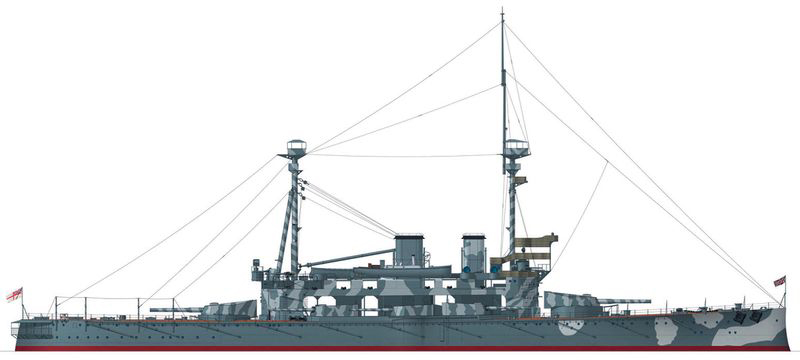
Depiction of HMS Agamemnon in 1915 with her incomplete port camouflage (wikimedia cc RU)
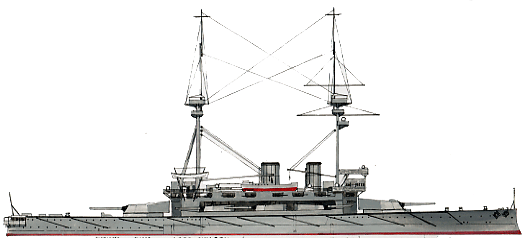
Author’s old illustration
⚙ Nelson class specifications |
|
| Dimensions | 135,2 x 24,2 x 9,1 m (443 x 79 x 30 ft) |
| Displacement | 15,358t – 17,820t FL |
| Crew | 750-800 peace/wartime |
| Propulsion | 2 shaft 4 cycl. TE engines, 15 WT boilers, 16.750 ihp |
| Speed | 18 knots top speed (33 kph, 21 mph) |
| Range | 9180 nmi@ 10 knots |
| Armament | 2×2 12-in, 10x 9.2 in, 24x 12-pdr, 12x 3-pdr, 5x 18-in TTs |
| Armor | Belt 8-12 in, Decks 1–4 in, Barbettes: 3–12 in, Main turrets 12 in, Secondary 7–8 in, CT 12 in, Bulkheads 8 in |