



“It’s a real sharing experience, to be in the dark waiting for the light,” says Clare Tuffy, manager of Brú na Bóinne Visitor Centre in the Boyne Valley of Ireland.
In 2016, nearly 33,000 people applied by lottery for entry to the Newgrange passage tomb on the mornings surrounding the winter solstice.
Only 60 were chosen.
On the days between December 18 and 23, in a spectacular feat of Stone Age engineering, a dawn sunbeam strikes through the “roofbox” opening above the tomb’s entrance, then creeps along the 19-meter passageway, to where a hushed group of visitors stand waiting in the blackness of the innermost chamber.
For around 17 minutes – weather permitting – the chamber is flooded with light.
“There are very few experiences you can share across five millennia, with your ancestors,” Tuffy tells CNN Travel. “5,000 years ago, people were waiting in the exact same spot, for the same event.”
Ireland’s Ancient East
Hailed by UNESCO as “Europe’s largest and most important concentration of prehistoric megalithic art,” the World Heritage Site of Brú na Bóinne lies less than an hour’s drive north of Dublin, in the heart of what the country’s tourism board has dubbed Ireland’s Ancient East.
Here, three large burial mounds – Newgrange, Knowth and Dowth – and around 40 satellite passage graves lie in the rich, green hills of County Meath.
The valley is as fertile now as when the monuments were built using tools of stone, bone and wood by a farming community in 3,200 BCE, some 500 years before the great pyramids of Giza.
Newgrange is the most famous.
This grass-covered, quartz-ringed hump, some 86 meters across and 13.5 meters high, covers an acre of land. Its smooth exterior belies the mysterious hidden chambers within; only a fraction are open to the public.
Eternal house of the dead
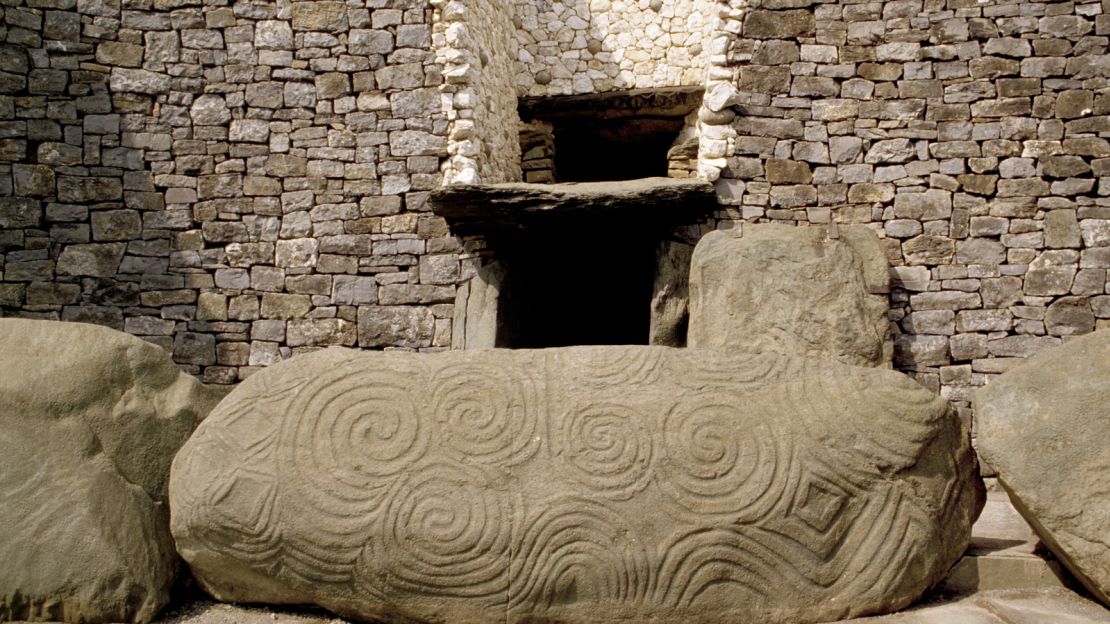
The solar aligned roofbox above the entrance is unique to Newgrange. Brian Lynch/Tourism Ireland
These communal passage tombs proliferated across western Europe in the Neolithic era, linking the ancient communities with immortality.
“Their own houses would be very simple, ephemeral things of wood and clay, so for the dead they built houses that would last forever,” Tuffy says.
Examples today include Gavrinis in France, Maeshowe in Scotland and Bryn Celli Ddu in Wales.
“As they got more and more sophisticated, they included the solar alignments,” says Tuffy. They grew in scope also. In their day, they would most likely have been the largest monuments in the world. But there’s a reason UNESCO says that the passage grave is “brought to its finest expression” in the Boyne Valley.
“About 12% of passage tombs have a significant solar alignment,” explains Tuffy. “But Newgrange is unique in that it is the only one that has a special opening to allow the sun to enter.”
Temple, tomb and town center
“We think for the people who built it, it was far more than just a tomb,” explains Tuffy. The monuments had social, economic, religious and funerary functions.
“It would have been a place where people gathered, it would have been a place where the ancestors were honored. It is a symbol of the people’s wealth, and it is a place probably where they interceded between the living and the dead.”
Many of the 97 boulders – or “kerbstones” – that ring Newgrange are decorated with obscure carvings of spirals, circles, zigzags and triangles, which may have astronomical as well as religious significance.
in his 2012 book, “Newgrange, Monument to Immortality,” Irish journalist Anthony Murphy argues that the Newgrange and Knowth were enormous calendars used by the Neolithic farmers to measure years, leap years and more.
After the Stone Age
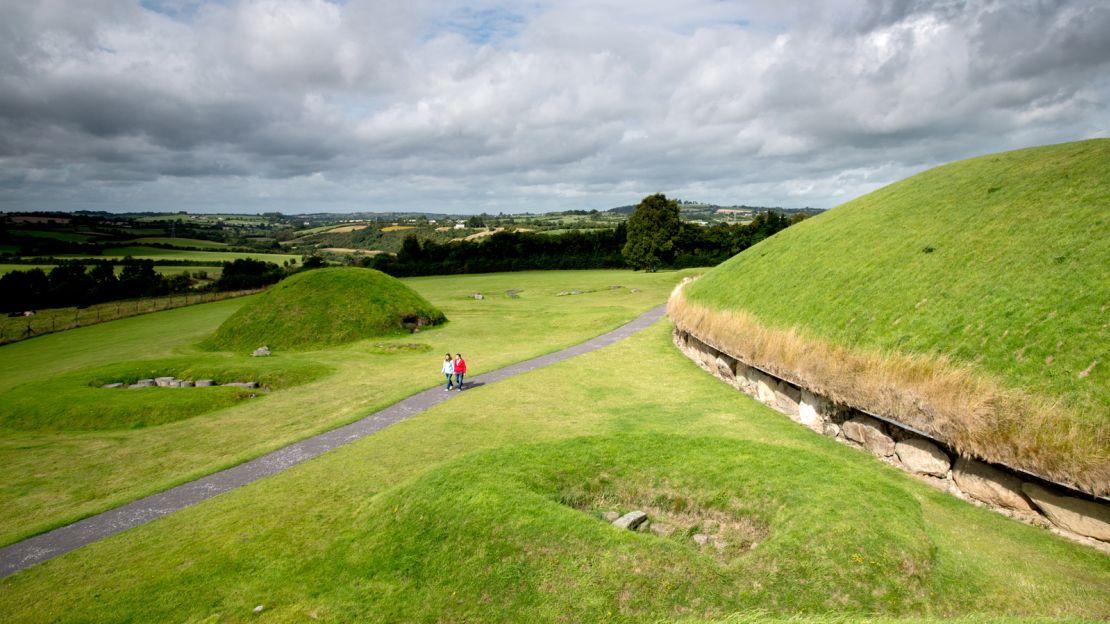
Newgrange is better known, but Knowth has more layers of history to explore. Tony Pleavin/Tourism Ireland
“Eventually the building was such a drain on the resources of the community that they stopped building them,” says Tuffy. “New ideas came to Ireland with bronze. We began to see shiny gold metal, and we all wanted to be buried in individual graves, and be buried with the good stuff. So the whole tradition changed. The monuments then were abandoned, but still honored.”
Newgrange was sealed after its original use had come to an end.
It remained so until the passage and chamber were rediscovered in 1699 by one of William of Orange’s men, nine years after the Dutch Protestant William of Orange’s forces defeated those of King James II of England at the history-defining Battle of the Boyne.
The white quartz exterior was added in the 1970s.
While the artifacts unearthed in the Newgrange group are purely prehistoric, there are “far more layers of activity” at the Knowth group of 30 monuments, says Tuffy, which has features dating from the Neolithic period to the Middle Ages.
The Hill of Tara archaeological complex, ancient seat of the High Kings of Ireland and used from the Neolithic period to the 12th century, is a short distance away beside the River Boyne and can be combined with a day trip to Brú na Bóinne.