



The Sd.Kfz. 161. Panzerkampfwagen IV (PzKpfw IV) Ausf F2. The German answer to powerfulls Matildas, T-34’s and the heavy KV-1.
History:

The Panzer IV was the most widely manufactured German tank of the Second World War, with some 8,500 built. The Panzer IV was used as the base for many other fighting vehicles, including the Sturmgeschütz IV assault gun, Jagdpanzer IV tank destroyer, the Wirbelwind self-propelled anti-aircraft gun, and the Brummbär self-propelled gun.


The Panzer IV was the most widely exported tank in German service, with around 300 sold to Finland, Romania, Spain and Bulgaria. After the war, Syria procured Panzer IVs from France and Czechoslovakia, which saw combat in the 1967 Six-Day War.

Circa 8,553 Panzer IVs of all versions were built during World War II, with only the StuG III assault-gun/tank destroyer’s 10,086 vehicle production run exceeding the Panzer IV’s total among Axis armored forces.

The Panzer IV was the brainchild of the German general and innovative armored warfare theorist Heinz Guderian. In concept, it was intended to be a support tank for use against enemy anti-tank guns and fortifications. Ideally, each tank battalion in a panzer division was to have three medium companies of Panzer IIIs and one heavy company of Panzer IVs.

On 11 January 1934, the German army wrote the specifications for a “medium tractor”, and issued them to a number of defense companies. To support the Panzer III, which would be armed with a 37mm anti-tank gun, the new vehicle would have a short-barreled, howitzer-like 75mm as its main gun, and was allotted a weight limit of 24 tonnes (26.46 short tons). Development was carried out under the name Begleitwagen (“accompanying vehicle”), or BW, to disguise its actual purpose, given that Germany was still theoretically bound by the Treaty of Versailles ban on tanks. MAN, Krupp, and Rheinmetall-Borsig each developed prototypes, with Krupp’s being selected for further development.
The chassis had originally been designed with a six-wheeled Schachtellaufwerk interleaved-roadwheel suspension (as German half-tracks had already adopted), but the German Army amended this to a torsion bar system. Permitting greater vertical deflection of the roadwheels, this was intended to improve performance and crew comfort both on- and off-road. However, due to the urgent requirement for the new tank, neither proposal was adopted, and Krupp instead equipped it with a simple leaf spring double-bogie suspension, with eight rubber-rimmed roadwheels per side.
The prototype required a crew of five men; the hull contained the engine bay to the rear, with the driver and radio operator, who doubled as the hull machine gunner, seated at the front-left and front-right, respectively. In the turret, the tank commander sat beneath his roof hatch, while the gunner was situated to the left of the gun breech and the loader to the right. The turret was offset 66.5 mm to the left of the chassis center line, while the engine was moved 152.4 mm to the right. This allowed the torque shaft to clear the rotary base junction, which provided electrical power to turn the turret, while connecting to the transmission box mounted in the hull between the driver and radio operator. Due to the asymmetric layout, the right side of the tank contained the bulk of its stowage volume, which was taken up by ready-use ammunition lockers.


After assembling 40 Ausf. Cs, starting with chassis number 80341, the engine was replaced with the improved HL 120TRM. The last of the 140 Ausf. Cs was produced in August 1939, and production changed to the Ausf. D; this variant, of which 248 vehicles were produced, reintroduced the hull machine gun and changed the turret’s internal gun mantlet to a 35 mm thick external mantlet. Again, protection was upgraded, this time by increasing side armor to 20 mm. As the German invasion of Poland in September 1939 came to an end, it was decided to scale up production of the Panzer IV, which was adopted for general use on 27 September 1939 as the Sonderkraftfahrzeug 161 (Sd.Kfz. 161).

 |
| Matilda I infantry tank |
 |
| Matilda II infantry tank |

Older model Panzer IV tanks were retrofitted with these features when returned to the manufacturer for servicing. 206 Ausf. Es were produced between October 1940 and April 1941.

In April 1941, production of the Panzer IV Ausf. F started. It featured 50mm single-plate armor on the turret and hull, as opposed to the appliqué armor added to the Ausf. E, and a further increase in side armor to 30 mm (1.18 in). The main engine exhaust muffler was shortened and a compact auxiliary generator muffler was mounted to its left. The weight of the vehicle was now 22.3 tonnes (24.6 short tons), which required a corresponding modification of track width from 380 to 400 mm to reduce ground pressure. The wider tracks also facilitated the fitting of track shoe “ice sprags” (grousers), and the rear idler wheel and front sprocket were modified. The designation Ausf. F was changed in the meantime to Ausf. F1, after the distinct new model, the Ausf. F2, appeared. A total of 471 Ausf. F (later temporarily called F1) tanks were produced from April 1941 to March 1942.

 |
| Pak 38 L/60 5,0 cm in the winter |
The first prototype was to be delivered by 15 November 1941. Within months, the shock of encountering the Soviet T-34 medium and KV-1 heavy tanks necessitated a new, much more powerful tank gun. In November 1941, the decision to up-gun the Panzer IV to the 50 mm gun was dropped, and instead Krupp was contracted in a joint development to modify Rheinmetall’s pending 75 mm anti-tank gun design, later known as 7.5 cm Pak 40 L/46.
 |
| Pak 40 L/46 7,5 cm in rest… |

The tank increased in weight to 23.6 tonnes (26.0 short tons). Differences between the Ausf. F1 and the Ausf. F2 were mainly associated with the change in armament, including an altered gun mantlet, internal travel lock for the main weapon, new gun cradle, new Turmzielfernrohr 5f optic for the L/43 weapon, modified ammunition stowage, and discontinuing of the Nebelkerzenabwurfvorrichtung (rear hull) in favor of turret mounted Nebelwurfgeraet. Three months after beginning production, the Panzer IV Ausf. F2 was renamed Ausf. G.
 |
| Nebelkerzenabwurfvorrichtung (smoke grenade rack) |

 |
| Panzer IV Ausf G with schurzen – very late. Kursk July 1943 Notice the commander’s cupola hatch |
The double hatch for the commander’s cupola was replaced by a single round hatch from very late model Ausf. G. and the cupola was up-armored from 50mm to 95mm . In April 1943, the KwK 40 L/43 was replaced by the longer 75mm KwK 40 L/48 gun, with a redesigned multi-baffle muzzle brake with improved recoil efficiency. The longer L/48 resulted in the introduction of the Turmzielfernrohr 5f/1 optic.
The next version, the Ausf. H, began production in June 1943 and received the designation Sd. Kfz. 161/2. The integrity of the glacis armor was improved by manufacturing it as a single 80mm plate. A reinforced final drive with higher gear ratios was introduced. To prevent adhesion of magnetic anti-tank mines, which the Germans feared would be used in large numbers by the Allies, Zimmerit paste was added to all the vertical surfaces of the tank’s armor. The turret roof was reinforced from 10mm to 16mm and 25mm segments. The vehicle’s side and turret were further protected by the addition of 5mm hull skirts and 8mm turret skirts.

This resulted in the elimination of the vision ports located on the hull side, as the skirts obstructed their view. During the Ausf. H’s production run, its rubber-tired return rollers were replaced with cast steel, a lighter cast front sprocket and rear idler wheel gradually replaced the previous components, the hull was fitted with triangular supports for the easily damaged side skirts, the Nebelwurfgeraet was discontinued, and a mount in the turret roof, designed for the Nahverteidigungswaffe (smoke bomb discharger), was plugged by a circular armored plate due to initial production shortages of this weapon.

Despite addressing the mobility problems introduced by the previous model, the final production version of the Panzer IV, the Ausf. J, was considered a retrograde from the Ausf. H. Born of necessity, to replace heavy losses, it was greatly simplified to speed production. The electric generator that powered the tank’s turret traverse was removed, so the turret had to be rotated manually. The turret traversing mechanism was modified and fitted with a second gear which made hand-operation easier when the vehicle was on sloping terrain.

On reasonably level ground, hand operation at 4 seconds to traverse to 12.5° and 29.5 seconds to traverse to 120° was achieved. The resulting space was later used for the installation of an auxiliary 200 liters fuel tank; road range was thereby increased to 320 km. The remaining pistol and vision ports on the turret side hatches were removed, and the engine’s radiator housing was simplified by changing the slanted sides to straight sides. Three sockets with screw threads for mounting a 2-ton jib boom crane were welded on the turret roof while the hull roof was thickened from 11mm to 16mm.
In addition, the cylindrical muffler was replaced by two flame-suppressing mufflers. On June 1944 Wa Prüf 6 had decided that because bomb damage at Panzerfirma Krupp in Essen had seriously jeopardized tank production, all plates which should have been face-hardened for the Panzer IV were instead made with rolled homogeneous armour plate. By late 1944, Zimmerit was no longer being applied to German armored vehicles, and the Panzer IV’s side-skirts had been replaced by wire mesh, while the gunner’s forward vision port in the turret front was eliminated and the number of return rollers was reduced from four to three to further speed-up production.

In a bid to augment the Panzer IV’s firepower, an attempt was made to mate a Schmalturm turret -carrying the longer 75mm L/70 tank gun from the developing Panther Ausf. F tank design, and partly developed by Rheinmetall from early 1944 onwards – to a Panzer IV hull. This failed and confirmed that the chassis had reached the limit of its adaptability in both weight and available volume.
Romania received approximately 120 Panzer IV tanks of different models throughout the entire war. To arm Bulgaria, Germany supplied 46 or 91 Panzer IVs, and offered Italy 12 tanks to form the nucleus of a new armored division. These were used to train Italian crews while the Italian dictator Benito Mussolini was deposed, but were retaken by Germany during its occupation of Italy in mid-1943. The Spanish government petitioned for 100 Panzer IVs in March 1943, but only 20 were ever delivered, by December.
 |
| Spanish Panzer IV Ausf. H Base militar El Goloso – Brigada Acorazada “Guadarrama” XII Museo de Medios Acorazados |
Finland bought 30, but only received 15 in 1944, and the same year a second batch of 62 or 72 was sent to Hungary (although 20 of these were diverted to replace German losses). In total, 297 Panzer IVs of all models were delivered to Germany’s allies.
 |
| Finnish Panzer IV Ausf. J – Finnish Tank Museum (Panssarimuseo) Parola |
 |
| Panzer IV Ausf A. Tank number 433 Invasion, of Poland – 1939 |
Although the Polish Army possessed less than 200 tanks capable of penetrating the German light tanks, Polish anti-tank guns proved more of a threat, reinforcing German faith in the value of the close-support Panzer IV.
 |
| Pzkpfw 35(t) leading three Pzkpfw IVs and behind them a line of Pzkpfw II 6th Panzer Division – France, 1940 |
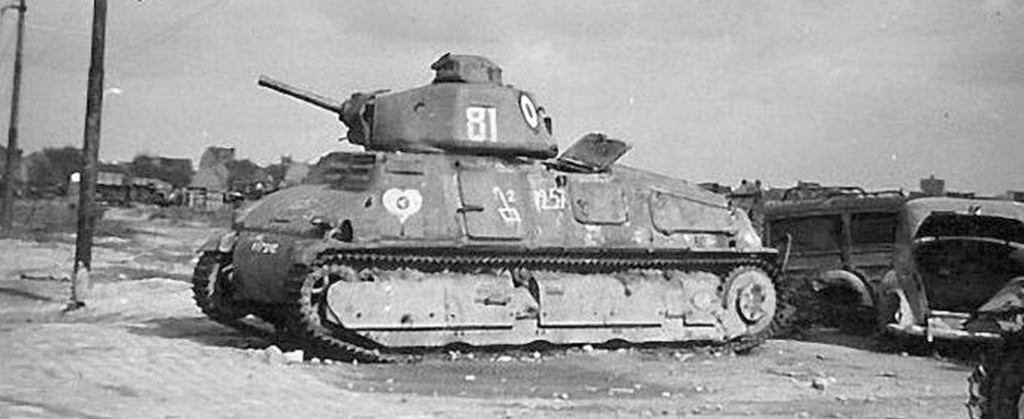
Through the use of tactical radios and superior tactics, the Germans were able to outmaneuver and defeat French and British armor. However, Panzer IVs armed with the KwK 37 L/24 75mm gun found it difficult to engage French tanks such as Somua S35 and Char B1. The Somua S35 had a maximum armor thickness of 55mm while the KwK 37 L/24 could only penetrate 43mm at a range of 700 m. The British Matilda II was also heavily armored, with at least 70mm of steel on the front and turret, and a minimum of 65 mm on the sides, but were few in number.
 |
| Somua S-35 |
 |
| Char B1 bis VERCORS in parade, liberation of France- 1944. |
Although the Panzer IV was deployed to north Africa ith the German Afrika Korps, until the longer gun variant began production, the tank was outperformed by the Panzer III with respect to armor penetration. Both the Panzer III and IV had difficulty in penetrating the British Matilda II’s thick armor, while the Matilda’s 40-mm QF 2 pounder gun could knock out either German tank; its major disadvantage was its low speed. By August 1942, Rommel had only received 27 Panzer IV Ausf. F2s, armed with the L/43 gun, which he deployed to spearhead his armored offensives. The longer gun could penetrate all American and British tanks in theater at ranges of up to 1,500 m, by that time the most heavily armored of which was the M3 Grant. Although more of these tanks arrived in North Africa between August and October 1942, their numbers were insignificant compared to the amount of matériel shipped to British forces.
 |
| M3 Grant |
 |
| German infantry advancing on a Panzer IV Ausf F2 during fighting for the Kerch Peninsula Russian front – May 1942 |
At the time, the Panzers IV Ausf F2 were the only German tanks that could defeat T-34 or KV-1 with sheer firepower. They played a crucial role in the events that unfolded between June 1942 and March 1943, and the Panzer IV became the mainstay of the German panzer divisions.
 |
| PzKpfw IV Ausf. F2 belonging to the 12th Panzer Division Volkhov’s pocket, Northern Russia – Autumn 1942. |
Although in service by late September 1942, the Tiger I was not yet numerous enough to make an impact and suffered from serious teething problems, while the Panther was not delivered to German units in the Soviet Union until May 1943. The extent of German reliance on the Panzer IV during this period is reflected by their losses; 502 were destroyed on the Eastern Front in 1942.
 |
| PzKpfw IV Ausf F2 Volkhov Front – Russia – Spring – 1942 |
 |
| PzKpfw IV Ausf F2 and PzKpfw III at Kursk. |
Throughout 1943, the German army lost 2,352 Panzer IVs on the Eastern Front; some divisions were reduced to 12 – 18 tanks by the end of the year. In 1944, a further 2,643 Panzer IVs were destroyed, and such losses were becoming increasingly difficult to replace. Nevertheless, due to a shortage of replacement Panther tanks, the Panzer IV continued to form the core of Germany’s armored divisions, including elite units such as the II SS Panzer Corps, through 1944.
 |
| PzKpfw IV – ‘612’ – .tank captured at 27th Armoured Brigade workshops Normandy – 3 July 1944. |
 |
| They paid the highest price … PzKpfw IV Ausf G (late) and a german soldier Kursk – Russsian front – 1943. |
 |
| Even in 1944 the veterans PzKpfw IV Ausf B still fought in front line… 21st Panzer Division- 8th Company of the 22nd Regiment Normandy, France – June 1944. |
Regular upgrades to the Panzer IV had helped to maintain its reputation as a formidable opponent. The bocage countryside in Normandy favored defense, and German tanks and anti-tank guns inflicted very heavy casualties on Allied armor during the Normandy campaign, despite the overwhelming Allied air superiority. German counter-attacks were blunted in the face of Allied artillery, infantry-held anti-tank weapons, tank destroyers and anti-tank guns, as well as the ubiquitous fighter bomber aircraft.
 |
| An american soldier preparing a destroyed PzKpfw IV Ausf J from 2nd Waffen-SS Panzer Division to be towed out of the road. Notice four hits: 2 in in front glacis and 2 in the gun mantlet. |
The rugged terrain caused the side-skirt armor used to predetonate shaped charge anti-tank weapons, such as the British PIAT, to be pulled away. German tankers in all theaters were “frustrated by the way these skirts were easily torn off when going through dense brush”.
 |
| 30th Infantry Division M4 Sherman passes 2 German Panzer IV Ausf H St. Lo – Normandy 1944 Two battle horses face to face… |
 |
| Sherman Firefly IC Hybrid |
A second British tank equipped with the 17pdr gun, the Cruiser Mk VIII Challenger, could not participate in the initial landings having to wait for port facilities to be ready to land.
 |
| Cruiser Challenger |
It was not until July 1944 that American Shermans, fitted with the 76mm M1 tank gun, achieved a parity in firepower with the Panzer IV.
 |
| Sherman Medium M4A1 with 76mm gun |
During the winter of 1944-45, the Panzer IV was one of the most widely used tanks in the Ardennes offensive, where further heavy losses – as often due to fuel shortages as to enemy action – impaired major German armored operations in the West thereafter.
 |
| K.O. PzKpfw IV and M36 Jackson in the Battle of the Bulge – Ardennes, 1944. |
The Panzer IVs that took part were survivors of the battles in France between June and September 1944, with around 260 additional Panzer IV Ausf. Js issued as reinforcements.
 |
| Turret and hull of PzKpfw IV in “Krali Marko Line” |
 |
| Spanish PzKpfw IV in the field… |
 |
| Rumanian PzKpfw IV at “Muzeul Militar Nationat”, Bucharest. |
 |
| Syrian PzKpfw IV Ausf H captured by Israelis Six Days War Latrun Israeli Museum |
These were used to shell Israeli settlements below the Golan Heights, and were fired upon in 1965 during the Water War by Israeli Centurion tanks. Syria received 17 Panzer IVs from Spain; these saw combat during the Six-Day War in 1967.
 |
| PzKpfwn IV – Etimesgut Tank Muzeum Ankara – Turkey |
Captured Panzer IVs in service
 |
| Pzkpfw IV Ausf F1 – 79th Separate Training Tank Battalion. Crimean Front, April 1942. This captured vehicle initially belonged to the 22nd Panzer Division. |
Sometimes, captured tanks were used in different temporary units or as single tanks. While captured Tigers and Panthers were only permitted to be used until they broke down, the simplicity of the Panzer IV and the large number of captured parts allowed for repair and continued use.
 |
| Panther-equipped tank company under command of Gds.Lt. Sotnikov vic Praga (Warsaw’s suburb). Poland, Aug. 1944 |


Variants:
 |
| Jagdpanzer IV |
 |
| Sturmgeschütz IV |
Cheaper and faster to construct than tanks, but with the disadvantage of a very limited gun traverse, around 1,980 Jagdpanzer IVs and 1,140 Sturmgeschütz IVs were produced. Another tank destroyer, the Panzer IV/70, used the same basic 75mm L/70 gun that was mounted on the Panther.
 |
| Panzer IV/70 |
 |
| Panzerbefehlswagen IV Ausf J |
 |
| Panzerbeobachtungswagen IV artillery observation tank |
This, too, received new radio equipment and an electrical generator, installed in the left rear corner of the fighting compartment. Panzerbeobachtungswagens worked in cooperation with Wespe and Hummel self-propelled artillery batteries.
The Tauchpanzer IV was developed in 1940 for the proposed invasion of Great Britain (Operation Sea Lion – Unternehmen Seelöwe). Tauchpanzer IV were converted in the same way as for the amphibious version of the Panzer III.Total production: 42 converted Panzer IV Ausf D.
 |
| Tauchpanzer IV Ausf D with fuel trailer |
 |
| Sturmpanzer IV SPG 150mm “Brummbar” |
Furthermore, a 105mm artillery gun was mounted in an experimental demountable turret on a Panzer IV chassis. This variant was called the Heuschrecke (“Grasshopper”). Another 105 mm artillery/anti-tank prototype was the 10.5 cm K (gp.Sfl.) nicknamed Dicker Max.
 |
| Heuschrecke IVb (“Grasshopper”) |
 |
| Pz. SFL IVA Dicker Max 105mm |
 |
| Flakpanzer IV Möbelwagen 37mm AA gun |
In late 1944 a new Flakpanzer, the Wirbelwind (“Whirlwind”), was designed, with enough armor to protect the gun’s crew and a rotating turret, armed with the quadruple 20mm Flakvierling anti-aircraft cannon system; at least 100 were manufactured.
 |
| Flakpanzer IV Wirbelwind 20mm Flakvierling |
Sixty-five similar vehicles were built, named Ostwind (“East wind”), but with a single 37mm anti-aircraft cannon instead. This vehicle was designed to replace the Wirbelwind.
 |
| Flakpanzer IV Ostwind 37mm Flak |
The final model was the Flakpanzer IV Kugelblitz, of which only five pilot vehicles were built. This vehicle featured an enclosed turret armed with twin 30mm Rheinmetall-Borsig MK 103 aircraft autocannon.
 |
| Flakpanzer IV Kugelblitz 30mm |
 |
| Hummel SPG 150mm |
 |
| Nashorn SPG 88mm AT |
 |
| Bergepanzer IV ARV |
The conversion involved removing the turret and adding a wooden plank cover with an access hatch over the turret ring and the addition of a 2-ton jib crane and rigid towing bars.
- Ausf.A, 1/BW (Sd.Kfz.161)
- 35 produced by Krupp-Gruson, between November 1937 and June 1938.

- Ausf.B, 2/BW
- 42 produced by Krupp-Gruson, from May to October 1938.

- Ausf.C, 3/BW
- 140 produced by Krupp-Gruson, from October 1938 to August 1939.

- Ausf.D, 4/BW + 5/BW
- 200 + 48 produced by Krupp-Gruson, from October 1939 to October 1940.

- Ausf.E, 6/BW
- 206 produced by Krupp-Gruson, from October 1940 to April 1941.

- Ausf.F, 7/BW
- 471 produced by Krupp-Gruson, Vomag and Nibelungenwerke from April 1941 to March 1942.

- Ausf.F2, 7/BW (Sd.Kfz.161/1)
- Temporary designation for Ausf F chassis built with long 7.5cm KwK40 L/43 main gun, later renamed into Auf. G and 8/BW.

- Ausf.G, 8/BW
- 1,927 produced by Krupp-Gruson, Vomag and Nibelungenwerke from March 1942 to June 1943.

- Ausf.H, 9/BW (Sd.Kfz.161/2)
- ~2,324 produced by Krupp-Gruson, Vomag and Nibelungenwerke from June 1943 to February 1944.

- Ausf.J, 10/BW
- ~3,160 produced by Vomag Nibelungenwerke from February 1944 to April 1945.


| Panzerkampfwagen IV Ausf F2 – SdKfz 161/1 | |
|---|---|
| Type | Medium tank |
| Place of origin | Nazi Germany |
| Service history | |
| In service | 1939–1945 (Nazi Germany) 1954–1967 (Syria) |
| Used by | Nazi Germany Romania Turkey Hungary Bulgaria Italy Finland Spain Croatia Syria |
| Wars | World War II, 1948 Arab–Israeli War, Six-Day War |
| Production history | |
| Designer | Krupp |
| Designed | 1936 |
| Manufacturer | Krupp, Vomag, Nibelungenwerk |
| Unit cost | ≈103,462 Reichsmark |
| Produced | 1936–1945 |
| No. built | ≈8,553 of all variants |
| Variants | StuG IV, Jagdpanzer IV, Wirbelwind, Brummbär, Nashorn |
| Specifications – Pz IV Ausf F2, 1942 | |
| Weight | 23,6 metric tons |
| Length | 6.630mm |
| Width | 2.880mm |
| Height | 2.680mm |
| Crew | 5 (commander, gunner, loader, driver, radio operator/bow machine-gunner) |
|
|
|
| Armor | Hull front: 50mm Hull side (upper and lower): 30mm Hull rear (upper and lower):20mm Hull roof and floor: 10mm Turret front: 50mm Turret side and rear: 30mm Turret roof: 10mm |
|
Main
armament |
7.5 cm KwK 40 L/43 main gun (87 rounds) |
|
Secondary
armament |
2 × 7.92mm MG 34 machine guns (3.150 rounds) |
| Engine | Maybach HL 120 TRM 12-cylinder gasoline engine 300 PS (296 hp, 220 kW) |
| Power/weight | 11.2 (HP/metric tons) |
| Transmission | (Synchromesh ZF SSG 77) 6 forward and 1 reverse ratios |
| Suspension | Leaf spring |
| Fuel capacity | 470 liter (3 tanks) |
|
Operational range
|
200 km |
| Speed | 42 Km/h |