



In August 24, AD 79 the ancient Roman city of Pompeii and surrounding wealthy villas like Herculaneum, Boscoreale, and Stabaie was buried in Mount Vesuvius’ volcanic ash and eventually forgotten. Many fled, but some stayed in their villas as their roofs fell onto them due to the raining pebbles and boulders.
Pompeii
Did you know?
The city of Pompeii was covered in ash and rocks from pebbles to huge boulders because of Mount Vesuvius.


The luxurious city of Pompeii has been largely preserved thanks to lack of moisture and air. So when the Spanish engineer Rocque Joaquin de Alcubierre in 1748 found the ancient city while making an aqueduct, the city was still intact. The first excavations were near the city baths.
The House of the Tragic Poet
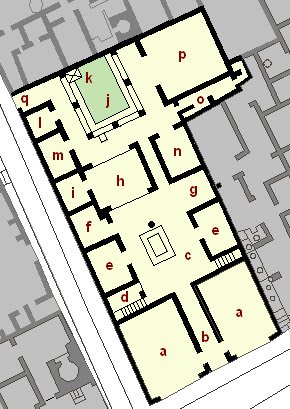
This is the layout of a small, Pompeian domus or house. House of the Tragic Poet was excavated in 1824 and found near the Forum Baths. The large singled room shops (a) were managed by the owner of the house. Each shop has a narrow door opening to the fauces (b), the entrance corridor, decorated in fourth style (see bottom right). The fauces leads to the atrium (c). It has an impluvium (see the top right) in the center lined with marble. On the southwest side is the porter’s room (d) and on the other two sides are the bedrooms or cubiculae also decorated in the fourth style (e). Next to the bedroom is a storeroom (f) and the opposite is a alcove or an ala. The master bedroom or the tablinum (h) is typically at the end of an atrium. The west side opens into another bedroom (i) and the north opens to a open courtyard or peristyle. In the center of the peristyle, is a small garden against a temple style shrine or lararium with a small marble statue of a satyr bearing fruit (k). There are three further bedrooms (l, m, and q) and kitchen and latrine or bathroom (o). The dining room or triclinium (p) is also decorated in the fourth style.
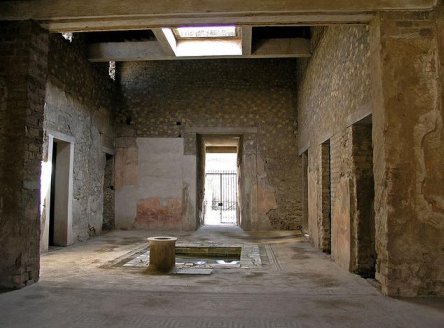
An impluvium is a sunken part of the atrium, designed to collect water. At the front is a pluteal, an enclosure around a well.
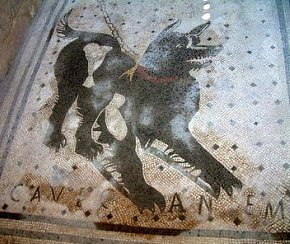
The fauces is decorated with yellow panels separated by red. This simple decoration is known as the fourth style. It has a black and white mosaic floor with the well known mosaic of a dog on a chain with the warning cave canem, ‘beware of the dog’.
Did you know?
The atrium of the house, unlike most other houses in Pompeii, was richly decorated with six large frescoes showing scenes from the Illiad.
The Frescoes
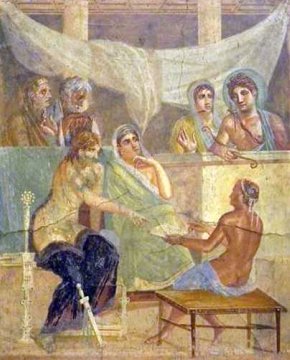
The tablinum contained another fresco on its east wall. This fresco, depicting the delivery to Admetus of the oracle which declared he must die unless someone volunteered to die in his place, was mistaken to be a poet reciting his verses. They thought that the figure with the papyrus in the fresco must have been a tragic poet. Thus, the name of the house was born.
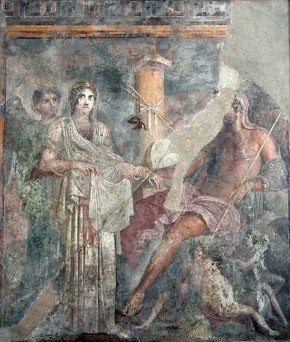
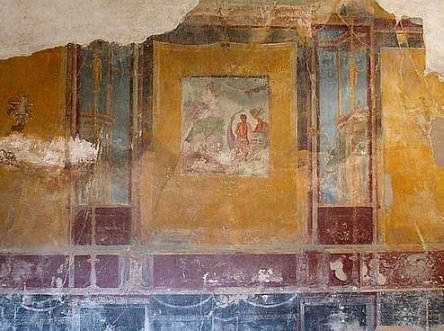
There were two frescoes framing the entrance on the south wall of the atrium. The fresco to the left of the entrance was of the Nuptials of Zeus and Hera on Mount Ida (see above) where Hypnos presents Hera to the seated Zeus. The Judgment of Paris was possibly on the right but it is now lost.
Only fragments remain on the west wall of the atrium. One of the pictures may have been of Thetis and Achilles, but there are not enough remains of the fresco to identify it certainly.
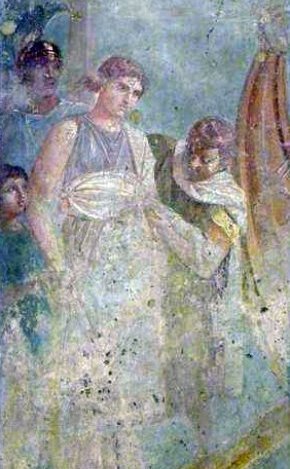
The frescoes on the east wall were found much better. The first one shows Helen boarding a ship to return to Troy. Only half of the fresco has survived, but it is thought that the missing portion showed Troy already seated on board.
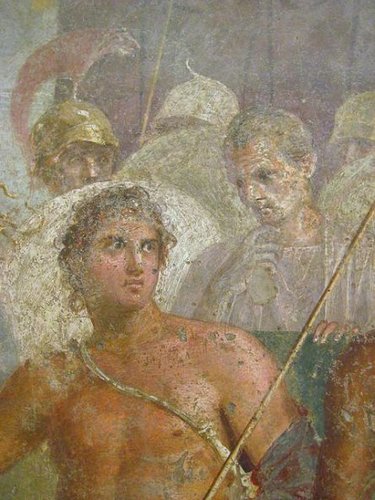
The second fresco on the east wall depicts the delivery of Breseis to the messenger of Agamemnon. Achilles, who is seated, is comforted by his faithful companion Phoenix before ordering Patroclus to hand over Breseis.
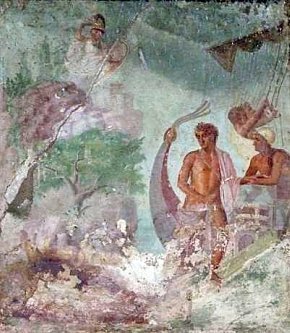
On the rear wall of the peristyle was a fresco called the Sacrifice of Iphigenia, where Iphigenia was to be sacrifices to Artemis in order that a departure from Aulis might be allowed to the Greek fleet assembled for the expedition against Troy.