



For a young Royal Canadian Air Force pilot, flying the Canadair Sabre Mk6 and tangling with other NATO fighters in the skies of Cold War Europe was something never to be forgotten
On a cold and windy day in mid-March 1960, my wingman and I launch our Canadair Sabres for a radar check. Canada had an enormous radar site in Metz, France, with a 200-mile radius called Yellowjack. Our mission is to fly a straight line north for almost 200 miles and return to Grostenquin, our home with 2 (Fighter) Wing, in eastern France. The radar site would calibrate the system using our identification friend or foe equipment. As we approach the overhead of RAF Jever in northern Germany we see two Hawker Hunters curving towards us. A great air battle ensues. My number two takes on his Hunter opposite number, and I fight the lead. Starting at 45,000ft, we twist and turn until just before we reach the undercast… at 20,000ft.
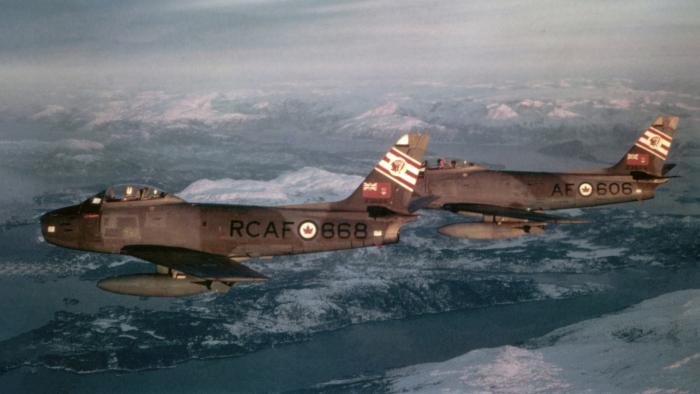
The two Hunters join up and dive into the soup. Since my wingman and I are getting low on fuel we also join up, contact Jever radar, and get vectored for a ground-controlled approach. It’s about 200ft cloudbase, half-a-mile visibility and raining. As we taxi to the designated parking bays and climb out, we are met by the two British pilots. Off to the mess for lunch and fighter pilot talk. The squadron commander greets us and, after introductions, says, “All right, chaps. What can we spot you from the bar — a gin?” “Many thanks, sir. However, we can’t drink on flying duty”. “Oh yes — Canadian rules. Then how about a beer?” What a fantastic life we lead.
I joined the Royal Canadian Air Force (RCAF) shortly after high school. I drove from Red Deer, Alberta south to Calgary to do the paperwork and two weeks later was on the train en route to London, Ontario, where the selection for pilot/navigator officer took place. I knew little of the chances of becoming an officer in the RCAF and even less the chance of getting selected for fighter pilot. Following a week of tests and interviews I was offered the position of pilot, which I readily accepted. Things then went quickly.
We were transferred to Centralia, Ontario for basic training, our initial flying taking place on Canadian-built Chipmunks. After that, I was back on the train for the five-day trip to Calgary and south to Clarsholm to convert to the yellow monster, the Harvard. The next summer, having mastered that machine, it was off to Winnipeg, Manitoba, and a bus north to Gimli, where we were to meet our first jet — the T-33. Summer transitioned into fall, then winter. My training finally complete, we awaited our assignments. I was bound for Chatham, New Brunswick, and the Sabre operational training unit. Now a commissioned officer, I was living among the instructors and was soon into school to learn to fly the best fighter of the day.
It was bitterly cold and windy and everything was covered in snow. My instructor pointed out a Sabre and instructed me to get in and taxi around for a while to get the feel of it. He stayed in the hangar. Next day he told me to get into a Sabre and go flying for an hour… again, to get the feel of it. I was 20 years old and now in my own F-86. One can’t describe the excitement of being in command of such a wonderful machine. Down the runway I went, scrambling to get the gear up before over-speeding it. It was a rocket-ship after the T-33. The next hour was tremendous. The aircraft would do anything asked of it. One didn’t feel to be inside an aeroplane. Sitting in the cockpit gave the impression of being out front of everything, just flying.

Landing gave me a great shock. After touchdown and slowing, I lowered the nose and it seemed to keep going down. Had I lost my nosewheel? Well, the Sabre taxies nose-low and my vast experience had not caught up with my present situation. When the nosewheel touched the snowy runway, I was relieved beyond imagination.
Soon after that we were told to climb as high as we could, put the nose down and go supersonic. What a fantastic suggestion — permission to do what we probably would have done anyhow. Come spring it was time for close formation, air-to-air cine practice and finally firing the guns. It was not easy to get good scores learning to fire accurately using the radar ranging gyro gunsight. Eventually we were graded as ‘satisfactory’ and progressed to air-to-ground. Everything moved fast. Close to the ground, put the fixed sight on the target, squeeze the trigger, pull up and not hit terra firma.
We were sent on a month of vacation before transfer to Europe. I was to be posted to 421 Squadron based at Grostenquin, part of No 1 Air Division. Transportation was by the Canadian version of the DC-4, the Canadair North Star, powered by four Merlin engines with straight pipes — incredibly noisy. It was a cargo aircraft and there were no seats, just fold-down canvas strips on one side. On that we went from Ottawa to Gander and Prestwick, where we transferred to an old C-47 to take us to France. Again, a freighter version.
Getting settled at my new base took a few days, but it was exciting meeting all the troops. Our squadron commander and flight commanders were all World War Two fighter pilots, most from the Spitfire. I was now in ‘B’ Flight and was to be trained by ‘Red’ Ashleigh, a Spitfire pilot and flight commander. My first trip in the newer Sabre Mk6 was a great surprise. Training at Chatham had been in the Mk5, much like the US Air Force’s F-86F, which had a little over 5,000lb of thrust. The Mk6 had a bit more than 7,000lb, making it the master of the sky in those days.
Formation was the main subject of our regular training there, both close and battle formation, transitioning into air fighting. Eventually I was sent up for a low-level nav trip with a senior pilot as chase. It was a great sightseeing jaunt, and over Verdun I made a rather sharp turn to look at some fortifications. The chase-plane lost me and told me to head for an American air base which had been decommissioned. I was to fly down the runway, where I’d be picked up and we’d proceed from there. I found an air base and flew down the runway, low and fast. “Do you see me?” “No, do it again”. I mentioned there were a lot of aircraft on this abandoned field and was told they were probably in storage. On my next low pass I called my chase pilot and told him some of the stored aircraft were moving. He suggested I keep going fast and low for a bit and head for home. Fortunately, I never heard from that base. Maybe I was going too quickly, or maybe they forgave me as I was a Canadian aircraft and friendly.

We departed for a three-week deployment to Sardinia, where the Italian base at Decimomannu was used for a gunnery camp. We usually flew two trips each day at 20,000ft. The towing aircraft was another Sabre and we’d fire on a flag well behind it. The tug would bring the flag back to base where it was dropped. After collection, it was hung up on a large plywood board and the coloured holes counted. Each aircraft had 200 rounds of colour-tipped bullets and two guns of the six were used for practice. The final day was the trophy shoot, where we had six guns and still 200 rounds. This made up the squadron’s score, and the eight RCAF Sabre squadrons in Europe — four in France and four in Germany — were very competitive.
Prior to the trophy shoot, a senior pilot would take off to fly west for some distance to verify that the weather would be good for the day. On one such trip our pilot spotted a large fleet of ships and thought he saw an aircraft carrier. A low pass down the deck didn’t go well with the US Navy, being caught unawares, and a call was duly put in to Metz, the RCAF headquarters in Europe. The pilot got a stern talking-to and that was that. Life went on.
Our role back at Grostenquin was as day fighters. For periods of three weeks we would launch in either two- or four-ship formations and call Yellowjack, our radar unit, for targets. Usually another four-aircraft section of Canadian Sabres would be engaged, us targeting them or them targeting us. As a wingman, one stayed in position for as long as possible, letting the lead know the situation to the rear. Usually, at some point, the wingman had either to get ‘shot down’ or evade and try to get behind the aggressor. Our ex-wartime pilots seemed to have a great advantage and the challenge was always to try to get film of them in an aerial fight.
On more than one occasion a section of USAF F-100 Super Sabres sought to join in. For the most part, we’d just back off a bit and let them slide through. They often were loaded with enormous drop tanks and really couldn’t turn with an ’86. However, they were still fighter pilots and wished they could get into the melee.
The fourth week was spent on Zulu alert. Eight aircraft, armed, sitting at the end of the runway with the pilots in the alert building, either on two-minute, five-minute or long stand-by. When the call came for the scramble we had two minutes to be airborne. On one occasion we were advised that someone had crossed the inner German border and off we went. The USAF also scrambled a lot of aircraft and, finally, Yellowjack advised us to return to base as there were now so many aeroplanes milling around they were not sure who the bad guy was, making it far too dangerous. Eventually the mysterious target returned to the eastern side of the frontier and that was the end of it.

Once, with a senior lead in a two-ship formation, during late 1958 we were sent after a large, unknown aircraft and intercepted it at 35,000ft. It was a new Pan Am Boeing 707 heading out of Frankfurt bound for New York City, and someone had not filed the proper flight plan. The lead went up quite close and I stayed back and above in a ‘threatening’ position. It was very interesting to be on a live scramble, though nothing came of it. Seven years later, as things turned out, I was a pilot for Pan Am.
Often we took part in NATO exercises where we were to intercept some other aircraft or formation, usually at altitude. Certain targets were not all that difficult to catch, but no way could we get anywhere near the British ‘V-bombers’. The Sabre couldn’t go high enough. Though I did manage once to climb up to 52,000ft, I was just hanging on and no threat to anything. When attacking the USAF’s B-66 Destroyers one could see the tail guns and 20mm weapons tracking us, obviously locked on with radar. There were limits to our use — however, at our optimum altitude we were seldom bested.
Most Tuesdays, one squadron would fly to the French air base at Laon. This was referred to as a Tuesday scrimmage, and resulted in the French Air Force intercepting us. We’d have a great air battle and land for lunch. It was a sought-after trip. Originally, the Mystère II represented easy pickings for the Sabre, but later they upgraded to the Mystère IVB, a much faster version with afterburner. They’d come into the fight high and fast, and we would turn away so no-one could get a ‘shot’. This was not really a lot of fun for us fighter pilots, whether Canadian or French. Eventually, they slowed up to engage and great battles were fought, but they still had their afterburners. And lunch was excellent.
I was an increasingly senior member of the unit, having become a section lead by the time we moved the squadron to a relief/emergency field to play at war. Life was quite good in these circumstances. One such base in Belgium was situated on a royal estate, and on a late-evening return the four aircraft had a herd of deer run across the runway as they were landing. Miraculously, none of them were hit, but it still came as a shock to the pilots.

I had taken a Sabre back to Grostenquin for some reason, and while returning to the relief field I spotted an F-102 Delta Dagger cruising along. They had just arrived in Germany and the USAF’s F-86F pilots had been off to school to learn their new machines. I went after the ’102 and soon had a nice picture in my gunsight. When I got back to base I told the troops the ’102 would be no threat — they were easy. Shortly after we returned to Grostenquin I again met up with a ’102, but it seemed the F-86F pilots were back and ready to even the score with the Sabre Mk6. There I hung almost vertical, canopy-to-canopy and running out of energy. He lit his afterburner, and as I fell away I knew the days of having our way were starting to be over. Yes, he’d had me and home I went, quite shaken.
Not all was work. If the squadron had more than 80 per cent serviceability, we could take either two- or four-ship formations away for weekends. Returning from a Copenhagen visit, my wingman and I were approaching the Hamburg area and were told to change frequency. Upon checking in with the new controller we were instructed to turn 90° left, or almost due east. I questioned the instructions and was assured this was correct as we were too far west of our course. I could see Hamburg ahead, so I instructed my number two to switch back to our previous frequency with Danish control. I was told no instructions had been given to us to change frequency, and he then gave us another frequency to contact Hamburg control. I advised the German controller what had just happened, and he said the East Germans often tried this to get NATO pilots to fly over their territory. This was the Cold War at its best — or worst.

During another NATO exercise I was leading my four-ship section in an attack on a group of RAF Javelins. I had one locked in my gunsight and was approaching quite fast. I popped the speed-brakes and my controls froze. My attack profile was still great and I feared I’d ram him. I hit the jet-wash of the twin engines and was flipped to the right, so I pushed in the speed-brake selector on top of the throttle. Had I regained control? I went back to Grostenquin and made a straight-in, not using speed-brakes. I landed a bit fast, but all was well. A young mechanic found a wire to the auxiliary hydraulic system in the speed-brake well was broken, and during use of the speed-brake the wire would separate. Closing the brakes with air speed pressure brought the two halves back together. My normal utility hydraulic system had failed and the warning light, for some reason, had not alerted me.
Two weeks later, during a dogfight on a very cold and windy day in early December 1960, my ailerons froze. I happened to be in level flight and was attempting a turn when nothing could move the stick left or right. I tried everything to get control back to no avail, so I advised Yellowjack. They vectored me over my base at 11,000ft for a ‘standard ejection profile’, which no-one had ever used. The ejection went smoothly, and there I was in my parachute watching my aircraft fly on, with my number three beside it. As I approached the landing field, I could see I was going to crash into some large power masts used to support high-tension electrical lines. I pulled very hard on what I felt was the appropriate riser and it looked good; however, as I let the riser go I started to swing quite badly. I landed on a downward swing with the wind pushing me and crashed into the frozen ground, causing an awful pain in my back. The result was four weeks on a plywood slab in the hospital with a compression fracture of some of the lower backbones.
1961 was now upon us and I’d convinced the doctor I was serviceable. Upon clearance, I was ready to join the squadron on a return to Sardinia for gunnery. Since I was a senior pilot I was given the last four-ship section, including two aircraft with questionable oxygen systems. I took us to a French base near Marseille, where we filled the oxygen tanks, and then went across the Mediterranean at 10,000ft to ‘Deci’. It was something different, and everyone enjoyed the trip. Our gunnery work was about the same as always, but this time I got the flight westbound to check the weather for the trophy shoot. No aircraft carriers could be seen — just as well.

The Canadian Sabre was the master of the skies during the late ’50s. The early ’60s introduced us to the advances of French and American manufacturers. We were becoming outclassed. I was fortunate to get another six months on the squadron, but things were changing. Aerial fighting was restricted and eventually halted, possibly for safety reasons.
But there was still fun to be had. On one occasion I took a four-aircraft formation to Cognac, a French training base, where one of the NATO students who’d been on my class on Harvards was instructing. We all enjoyed a great lunch and were asked if, after take-off, we could do a low flyby. We formed up in close battle formation and requested a low pass, whereupon the controller said we were cleared for 2,000ft. I responded that his radio was breaking up and I’d try to get better reception closer to the tower. We passed at tower level, two aircraft on each side, going extremely fast. I know the troops on the ground enjoyed it very much and, surprisingly, not a word came from air traffic.
Our role as day fighters was coming to an end. The MiG-17 was still a fair match, but the East Germans were now getting the MiG‑19. Everyone was faster and could go higher. And they all seemed to have missiles. It was time to go back to Canada. Some of the most exciting days of my life still rest up front in my memory, and I’m ever so grateful the Royal Canadian Air Force decided to send this young, small-town boy to such a wonderful place for those three splendid years.