



Going supersonic during a test flight and a number of deadly crashes were just some of the events that made development of the Handley Page Victor turbulent. Glenn Sands pays tribute to the men who designed and tested the crescent-winged wonder
A confidential memo was distributed around the Handley Page design team at Cricklewood on June 14, 1945. It was to be of vital importance to the future of that company, and it came from the man who gave the enterprise its name.
Sir Frederick Handley Page learned that English Electric had been contracted to build a twin-engined jet bomber. This became the exceptional Canberra. ‘HP’ concluded that a similar requirement would be needed to replace the Avro Lincoln within the next five to six years. Hence the memo, distributed to Godfrey Lee, Frank Radcliffe and Reginald Stafford, requesting they investigate the possibility of manufacturing two types of bomber.
One would be of 100,000lb all-up weight and powered by four Rolls-Royce AJ.65 (later to be the Avon and the Canberra’s powerplant) turbojets. The other would weigh in at 60,000lb and have two AJ.65s.

Handley Page indicated both designs should have wings swept back 40°. This was based on the company’s wartime experience testing the tailless HP.75 Manx test-bed of May 1943.
At that time, Godfrey Lee was chief aerodynamicist and responsible for future projects. He arranged a visit to Germany as part of an Allied technical intelligence mission and, while there, he spent a lot of time talking to engineers and aerodynamicists at the Volkeröde experimental establishment near Brunswick. German designers had gained a considerable amount of technical knowledge in the field of swept wings and Lee learned a great deal during his visit.
By mid 1946, the bomber design was developed into a formal proposal. This was deemed strong enough to warrant an approach to Stuart Scott-Hall, Handley Page’s Principal Director of Technical Development. Designated the HP.80, it was anticipated the new bomber would carry a 10,000lb weapon load over a range of 5,000 miles.

The concept was proposed to the RAF’s Director of Operations Requirements, Gp Capt Silyn-Roberts, who visited Cricklewood on July 19 to discuss the matter further, in view of the Air Staff’s emerging long-range bomber requirement – which Handley Page had foreseen.
There is little evidence to suggest Sir Frederick’s proposal had a direct impact on the Air Staff’s thinking. However, there can be little doubt his foresight enabled the company to co-operate with the Air Staff at a much higher level than other aircraft manufacturers in 1946 and over the following years.
Radical thinking
Godfrey Lee was aware his design was sound, and he clarified this to the RAF by stating: “No layout or design formula is the best for all specifications – HP.80 called for long range with an appreciable load, a high cruising Mach number and a high cruising altitude. The crescent wing is a compromise between the requirements for performance and for good [wing] tip stalling. It was for this reason that I started on a wing whose sweep varied with its span.”
Although Lee’s comments suggested the crescent wing was a ‘compromise’, it was a revolutionary concept when introduced. He was keen to emphasise that the design was not a direct result of his trip to Germany: “The one real concept we got out of the German visit was that sweep was a good thing.”

History, perhaps, allows Lee far more credit in the design of the Victor than is appropriate. Members of the Handley Page design staff have suggested that Sir Frederick might at least have guided them in the general direction of the crescent wing. Two others were to have a significant input to the resulting dramatic look of the bomber: chief designer Reginald Stafford and his assistant Charles Joy. Both men regarded their work on the Victor as their most demanding and ultimately satisfying role during their time with the company.
Educated at Kilburn Grammar School in north London, ‘Reggie’ Stafford studied aeronautical engineering at university, graduating with a diploma in 1926. He started as a technical assistant in the Handley Page aerodynamics department. Twenty years later, he had worked his way up to chief designer, just as design of the HP.80 was starting.
He was promoted again in 1953, this time to technical director. In this position, he oversaw completion of the B.2 variant of the Victor, and was responsible for many of the upgrades made to the fuselage. He continued to stay at the company, working on the Herald airliner before his retirement in the 1960s.

Charles Joy joined Handley Page in 1944, having trained at Coventry Technical College in Warwickshire, while working at Armstrong Whitworth Aircraft. Joy was promoted to assistant chief designer in 1947 and was by then working closely with Godfrey Lee on the HP.80 project.
Six years later, he was awarded the position of chief designer, with Lee as his deputy. Joy’s last work with the company was on the Jetstream twin turboprop before the firm collapsed in 1969.
Triumph and tragedy
Just a few weeks before Christmas 1950, Handley Page’s chief test pilot, Sqn Ldr Hedley George Hazelden DFC*, taxied the prototype HP.80, WB771, for the first time at Boscombe Down. By then, the design had adopted the Armstrong Siddeley Sapphire as its powerplant.
Hazelden had already spent a considerable amount of time learning to handle the Sapphires in the outboard nacelles of a modified Handley Page Hastings transport, as well as having flown a Sapphire-powered Canberra.

Born on June 7, 1915, at Sevenoaks, Kent, Hazelden won a scholarship to the prestigious Judd School at Tonbridge, before working in London as an insurance clerk. A keen pilot, he trained with the RAF Volunteer Reserve before the outbreak of World War Two. He joined the RAF in May 1939, completing his flying training on Avro Ansons at Redhill, Surrey.
He was posted to 44 Squadron at Waddington, which was equipped with HP Hampdens. In 1941, Hazelden underwent operational conversion training for the Avro Manchester at Finningley and was then posted to 83 Squadron at Scampton in Lincolnshire. He remained with the unit when it re-equipped with Lancasters and, in the spring of 1942, he flew in the first of Sir Arthur ‘Bomber’ Harris’ 1,000-bomber raids on Cologne. That summer, Hazelden was rested from frontline operations, to serve as an instructor on Vickers Wellingtons.
Following this, Hazelden was posted to the newly formed Empire Test Pilots’ School (ETPS) at Boscombe Down. Shortly before reporting to ETPS, he fell off his motorcycle and injured his leg. He then fell out of a Wellington after landing, injuring his elbow. So, wearing a sling and walking with a stick, he reported for the first ever test pilot course.

Graduating with honours, Hazelden was posted to the heavy aircraft squadron at the Aeroplane and Armament Experimental Establishment, also at Boscombe. There, he evaluated the handling characteristics of a Lancaster carrying the 22,000lb ‘Grand Slam’ bomb.
With the war in Europe over, Hazelden took command of the newly established Civil Aircraft Test Squadron and was charged with the task of establishing airworthiness standards of the first post-war airliners. Leaving the RAF in early 1947, aged 32, he was appointed chief test pilot at Handley Page where he prepared the Hastings to succeed the Avro York as the RAF’s long-range transport. After this, he tested the Hermes – a civilian version of the Hastings.
Then came his opportunity to test the type he is most associated with – the HP.80. Hazelden took the prototype, WB771, into the air for the first time on December 24, 1952, for a short 17-minute test flight from Boscombe Down.

Handley Page was also producing the Miles-designed Marathon airliner at Woodley, Berkshire. In July 1954, Hazelden was detailed to undertake a series of speed calibration flights in WB771 at Cranfield, Bedfordshire. On July 14, he was called away to Woodley, where a Japanese delegation was expecting a demonstration flight of a Marathon. Hazelden turned the Cranfield trials over to his deputy, Ronald ‘Taffy’ Ecclestone. With its flight-test crew of three, the prototype was making a series of low-level runs over the airfield when the entire tailplane detached and WB771 crashed in a ball of flame, killing all four on board.
Analysis showed fatigue around the bolts fixing the tailplane had caused the failure. A cure was quickly put into place in the second prototype, WB775, which took to the air on September 11.
Hazelden spent the following years flight-testing the Victor in preparation for its entry into operational service with the RAF in 1957. He also undertook the flight test programme on the Herald airliner.
Through the barrier
Following Hazelden’s retirement from Handley Page, to pursue a career with Autair as a Herald captain, Johnny Allam took over as chief test pilot with Philip ‘Spud’ Murphy as his deputy. These two airmen were to have an eventful time testing the Victor.
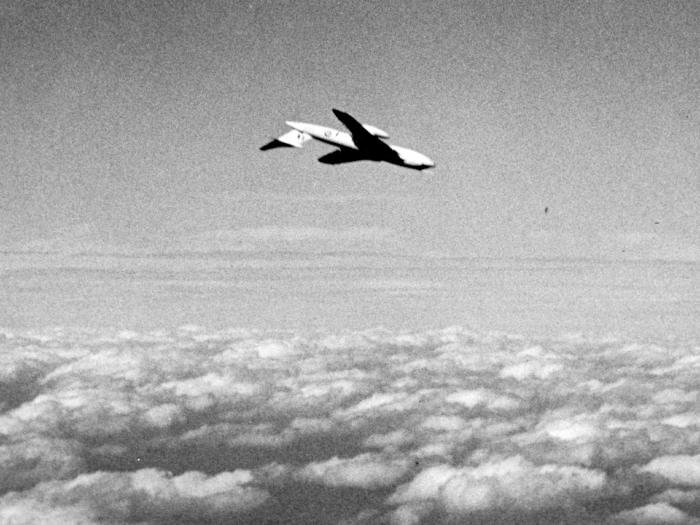
On June 1, 1957, with the initial production Victor B.1, XA917, on a test flight from Gaydon, Warwickshire, Allam put the aircraft into a shallow dive at 40,000ft and, while ‘inadvertently’ failing to keep an eye on the Mach meter, managed to clock up 675mph, which represented Mach 1.02. The double sonic bang was heard over a wide area.

At the time, the Victor was the largest aircraft to break the sound barrier. Sitting at the crew bench located behind the two pilots, and facing the tail, flight test observer Paul Langston had little sensation of what was going on. At that moment, he became the first man to break the sound barrier while facing backwards.
‘Spud’ Murphy later took a Rolls-Royce Conway-engined Victor B.2 to Mach 0.97, where he found the ailerons locked solid. The only way to recover was to slow down by using the elevators, but this carried the risk of putting the aircraft into a super stall.

On March 23, 1962, Murphy was to experience the traumas of flight testing. While flying B.2 XL159 on a sortie out of Boscombe Down, he was evaluating slow-speed handling. At 16,000ft, he set the aircraft up as though it were making a landing, but it developed a stable stall, leading very quickly to a flat spin. Despite intensive efforts to recover, there was no response and, at about 10,000ft, with the aircraft coming down at a terrifying speed, ‘Spud’ ordered the three ‘back-seaters’ to bale out.
On the Victor, the pilot and co-pilot had ejection seats, but not the rear crew. For them, exit was via the shrouded port-side crew door. When Murphy called for them to leave, it took repeated attempts before the air electronics operator, John Tank, managed to beat the slipstream and take to his parachute. By this stage, things were critical and Murphy and Boscombe Down test pilot Flt Lt J Waterton ejected.

The Victor spiralled into the ground, hitting a farmstead near Newark, Nottinghamshire, and killing the other two test crew, navigator Michael Evans and flight test observer Peter Elwood, instantly. Tragically, two women were also killed in the building flattened by the plummeting bomber: mother and daughter Annie and Cecily Gibson, the latter aged just 22.
There is often a high price to pay while creating an aircraft at the cutting edge of technology. The Victor did, of course, go on to great success, proving of vital importance during the Falklands conflict and even serving during the Gulf War – but its fame hadn’t come without cost.