



Abstract
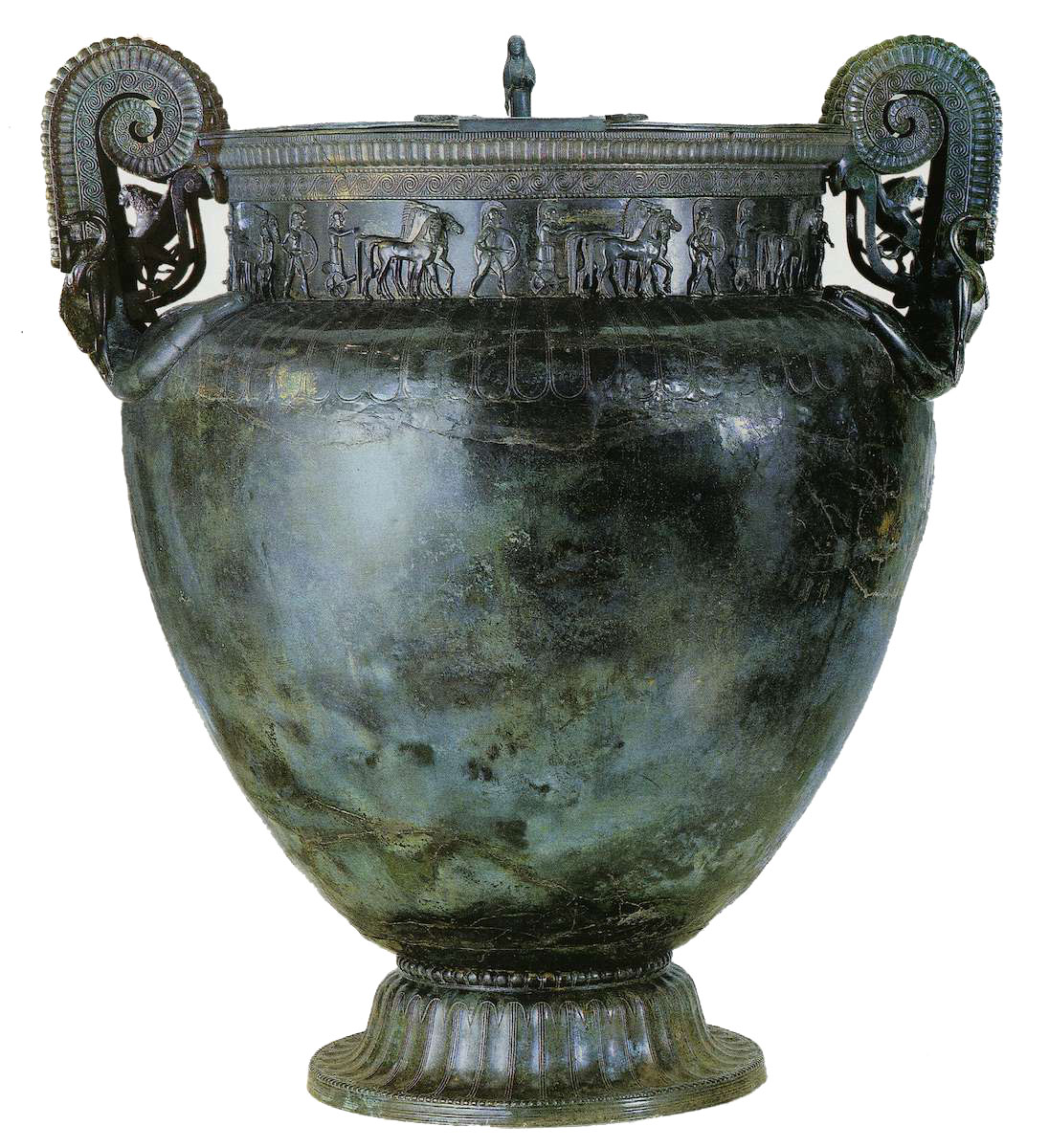
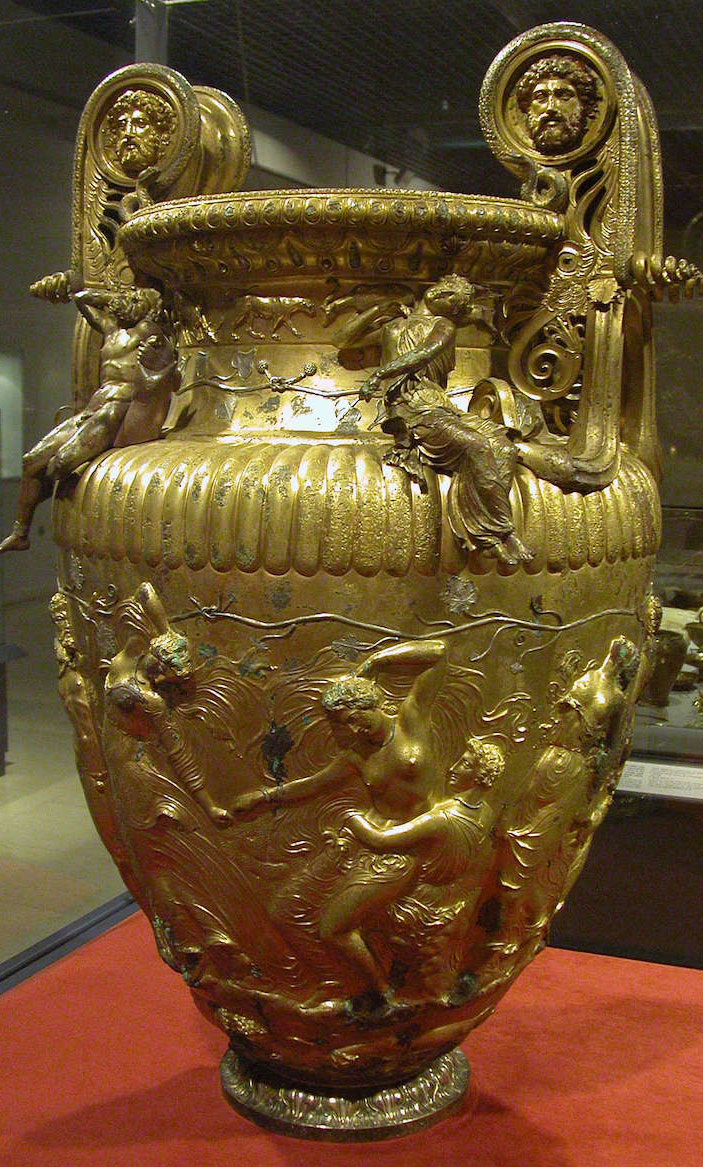
A simple observation provides the point of departure for this paper. The decorative schemes of two Greek bronze volute-kraters—the Archaic one found at Vix in Burgundy (fig. 26.1) and the Late Classical one from Derveni near Thessaloniki (fig. 26.2)—differ radically.Footnote1 The critical distinction lies in the prominent Dionysian frieze in high relief on the body of the latter. It is most unusual to find figural decoration at a large scale on the bodies of substantial Greek bronze vessels of the Archaic and Classical periods. The figural decoration on the body of the Derveni krater, too, was well outside the usual canon even at the time of manufacture, far removed from the generally austere appearance of Archaic and Classical bronze vessels, even when taking into account some important fifth-century developments in surface treatments, notably reeding. The restrained decoration of most Greek bronze vessels was a deliberate aesthetic choice, as suggested by comparison with contemporary pieces of armor: these are often much more elaborately embellished. Contemporary representations of these objects show that this difference is not simply a function of chance survival. This comparison inspires a generalizing rule: plain vessels, but elaborate armor. The contrast, I propose, goes back to the Homeric poems, which clearly articulate such a distinction. The underlying reasons for these profound differences, I will argue, may well have been economic.
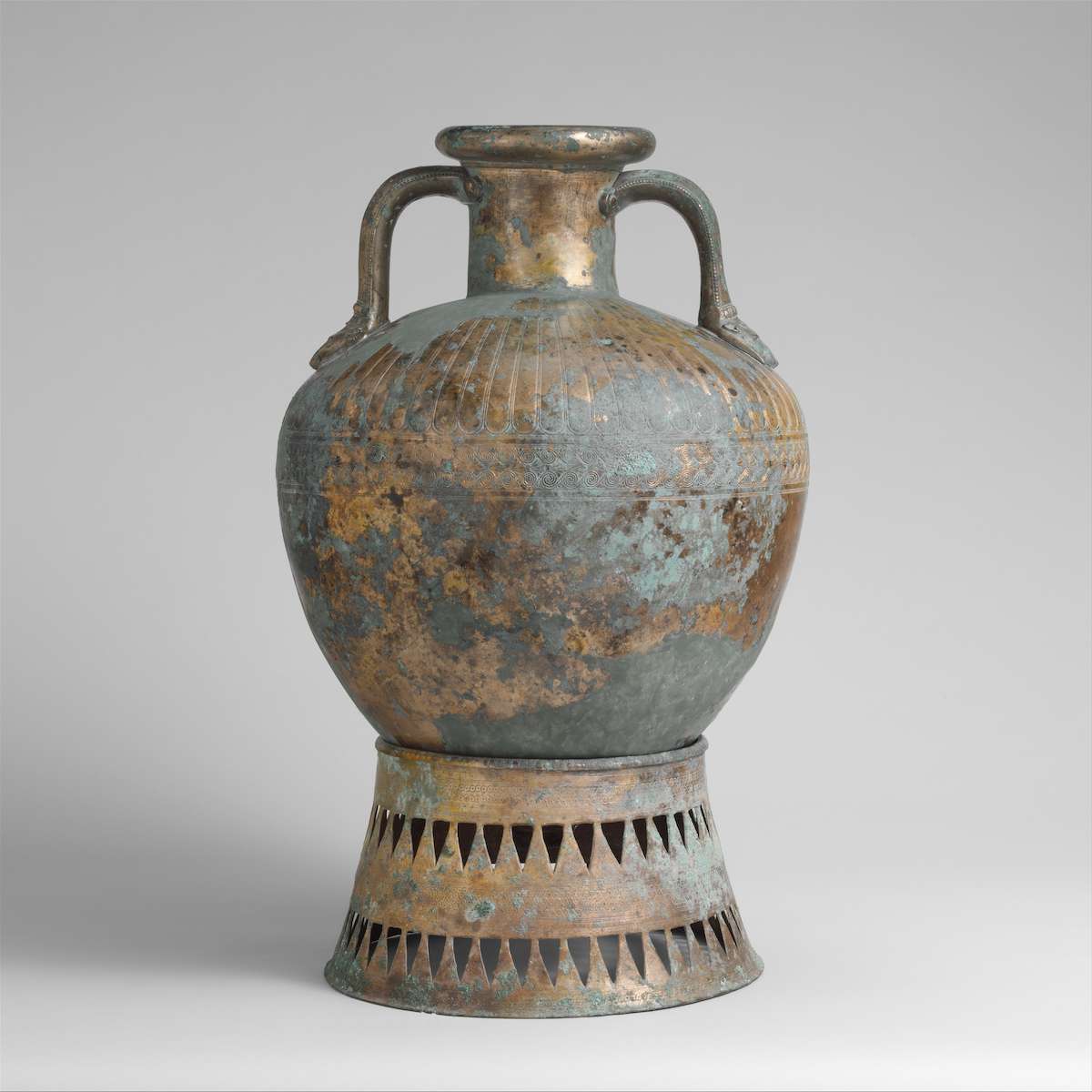
In stark contrast to the opulence of the Derveni krater, the surviving large Greek bronze vessels of the Archaic and Classical periods (kraters, amphorae, hydriai, and so forth) are, to a remarkable degree, homogeneous in the restraint of their decoration. Three archaeological contexts are especially illuminating: the series of graves of Balkan chieftains at Trebenischte; the so-called heroon at Paestum; and the finds at Pischane, Ukraine.Footnote2 Collectively, they account for over one hundred completely preserved bronze vessels. Leaving aside restricted pattern-work like shoulder tongues, every one of these vessels has a plain body. The decoration was confined primarily to the cast elements that served utilitarian functions—handles, feet, and bases—while on larger vases appliqués were sometimes also attached to the shoulder or neck. Well-known examples include the volute-krater from Trebenischte, now in Belgrade, and the hydria with a lion peering over the rim from Paestum.Footnote3 This general scheme of decoration is also familiar from other shapes, such as the oinochoe in Budapest whose handle is modeled in the form of an equestrian astride the spout; or the pointed amphora at the Metropolitan Museum in New York (fig. 26.3), whose body is relatively elaborately decorated with shoulder tongues above a guilloche band.Footnote4 Many more examples could easily be found, especially on hydriai.Footnote5
This subdued decoration on larger vessels should, I believe, be respected as the considered choice of Greek metalsmiths and their customers, rather than reflecting any technical limitation. The craftsmen who made the Vix and Derveni kraters, for example, could surely have made anything they chose. Walls of vessels with figural decoration in repoussé like the Derveni krater were prone to crack, thereby causing leaks; but, as Beryl Barr-Sharrar has discovered, that krater was lined after completion with a protective layer of beeswax and a film of clay.Footnote6 Furthermore, the concept of a double-walled vessel—the outer elaborately decorated, the inner a plain liner (familiar from small-scale Hellenistic and Roman silver cups)—is actually already present in the Archaic series of black- and red-figure psykter-amphorai and kraters that were made in Athens and Rhegium. These begin in the mid-sixth century with the Lydos amphora in London and continue until the Troilos Painter’s column krater of around 470 BC, now in New York.Footnote7 Earlier still is a series of Phoenician bowls with double walls, some of which found their ways into Greek contexts.Footnote8
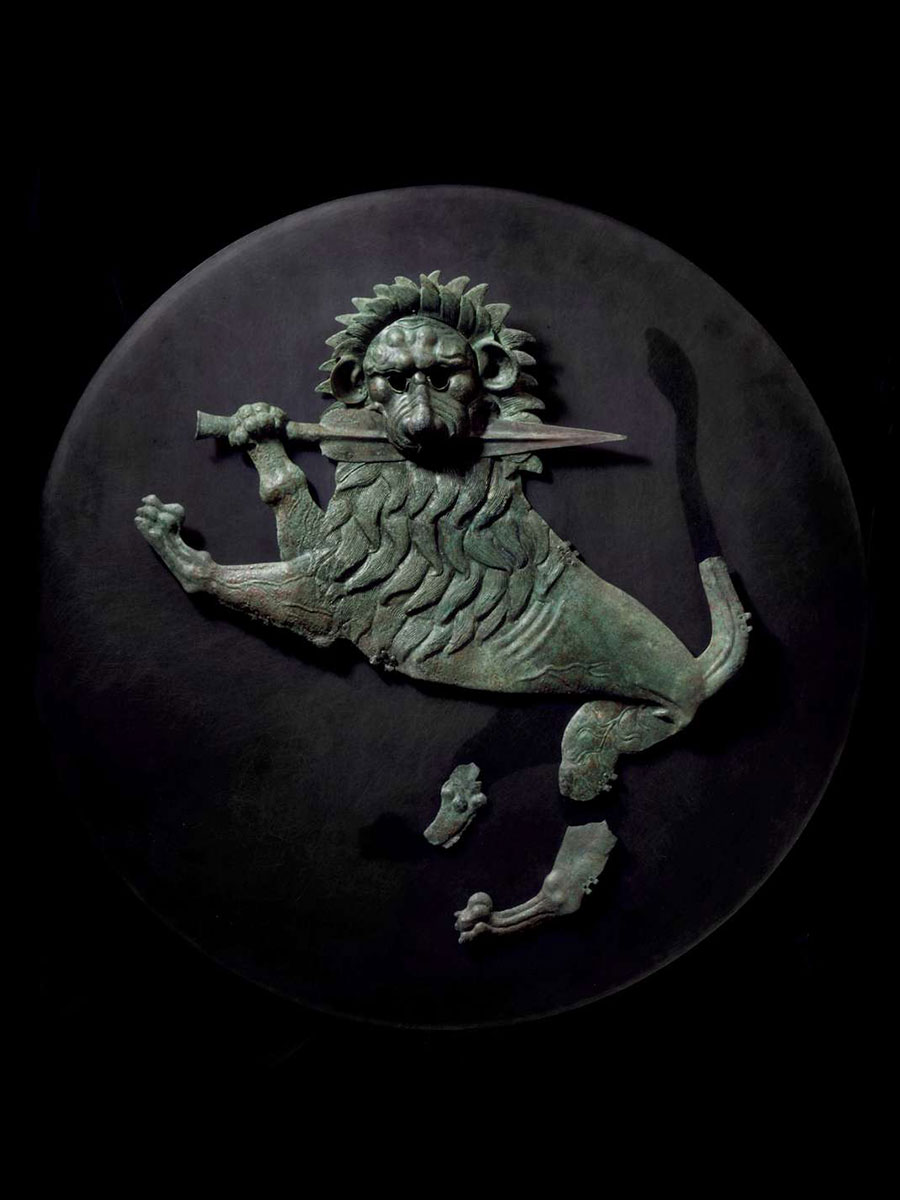
Furthermore, the practice of decorating large areas of metalwork, whether through engraving, casting, repoussé, or a combination of techniques, is familiar from contemporary Greek armor. The famous breastplate from Olympia, with Zeus and Apollo between deities, exemplifies engraved work.Footnote9 The magnificent shield devices document repoussé at a large scale: from the Archaic griffin suckling her young or the “composite Gorgon” from Olympia to a Late Classical rampant lion in Mougins (fig. 26.4).Footnote10 The shield bands offer a view into small-scale work using the same techniques; one in the J. Paul Getty Museum gives us the earliest of all signatures for metalsmiths, Aristodamos of Argos.Footnote11 Other pieces of armor, notably helmets and their cheekpieces but also greaves, sometimes reveal astonishing decorative metalwork.Footnote12 While a great deal of plain armor does of course survive, other examples were perhaps more for parade than for battle; the helmet in St. Louis (fig. 26.5),Footnote13 for example, was evidently made for a figure of elevated importance, the very same class of persons that commissioned the vessels.
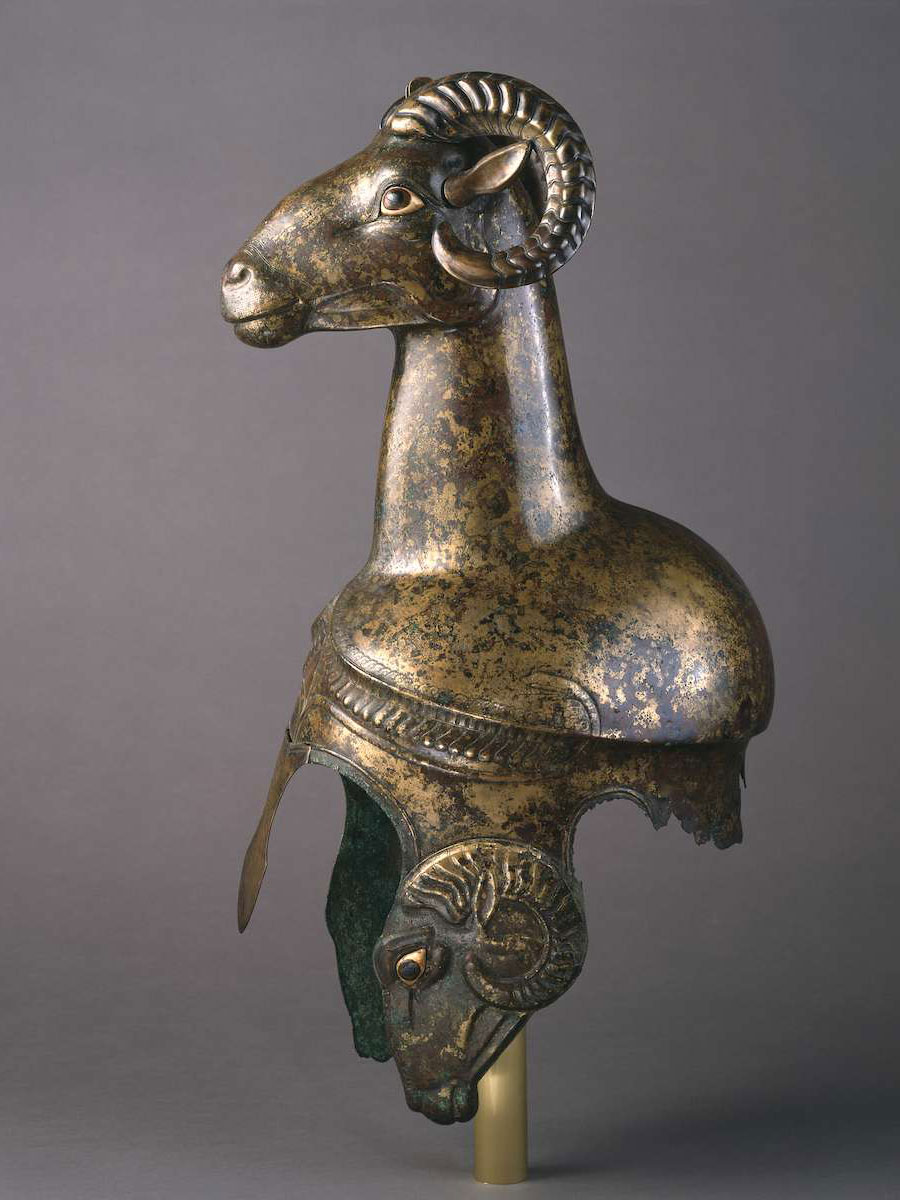
The restrained decoration accorded Archaic and Classical Greek bronze vessels stands in marked contrast not only to contemporary Greek armor but also to products of workshops outside Greece making similar vessels. The magnificent Orientalizing cauldrons from North Syria and elsewhere, with figures in high relief on the stands, were familiar enough in Greek sanctuaries.Footnote14 They were also popular in Etruria, where they engendered elaborate local responses, such as the tripod cauldron from the Barberini tomb in Palestrina.Footnote15 From Italy and central-northern Europe comes a series of bronze situlae whose walls are decorated all over with figural registers.Footnote16 These were surely known in Greece because their elite Italic and Celtic owners supplied Greek aristocrats with the thoroughbred horses from the Veneto, which are attested as early as Alkman.Footnote17
The objection may be raised that, because so few Greek bronze vessels survive, any observations concerning their appearance are largely speculative. To counter this objection, we turn to traditions of representations of these vessels in four different media: coins, gems, terracottas, and back- and red-figure vases. Of these four, two—coins and gems—are interrelated, while images on terracottas and black- and red-figure vases stand apart. All four types, however, suggest independently that metal vessels with major figural decoration were extremely uncommon. Furthermore, the ceramic dinoid krater in the J. Paul Getty Museum (fig. 26.6) demonstrates that surviving examples do indeed correspond closely with their representations.Footnote18 Just this sort of vessel is depicted on contemporary volute-krater fragments near the Pronomos and Talos Painters, now in Würzburg, while a neo-Attic marble version in a private collection evidently derives from the very same models (fig. 26.7).Footnote19
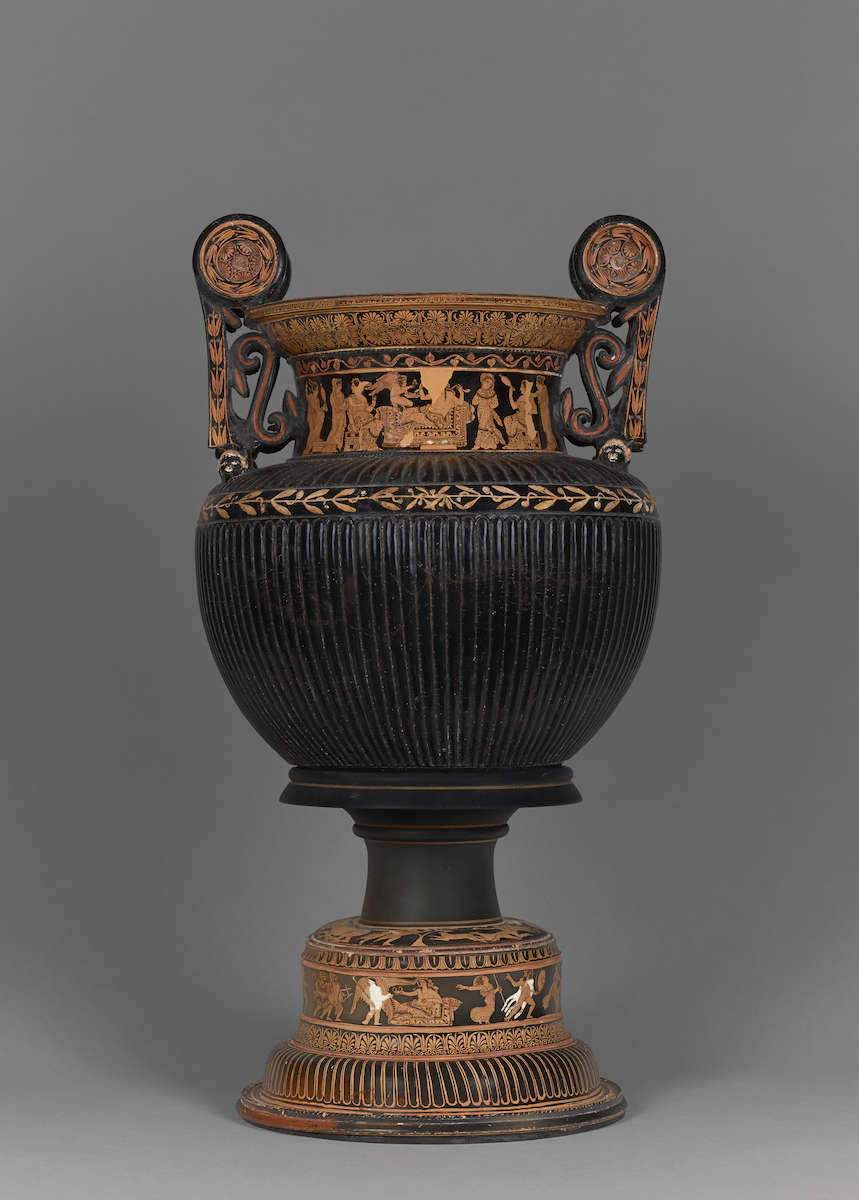
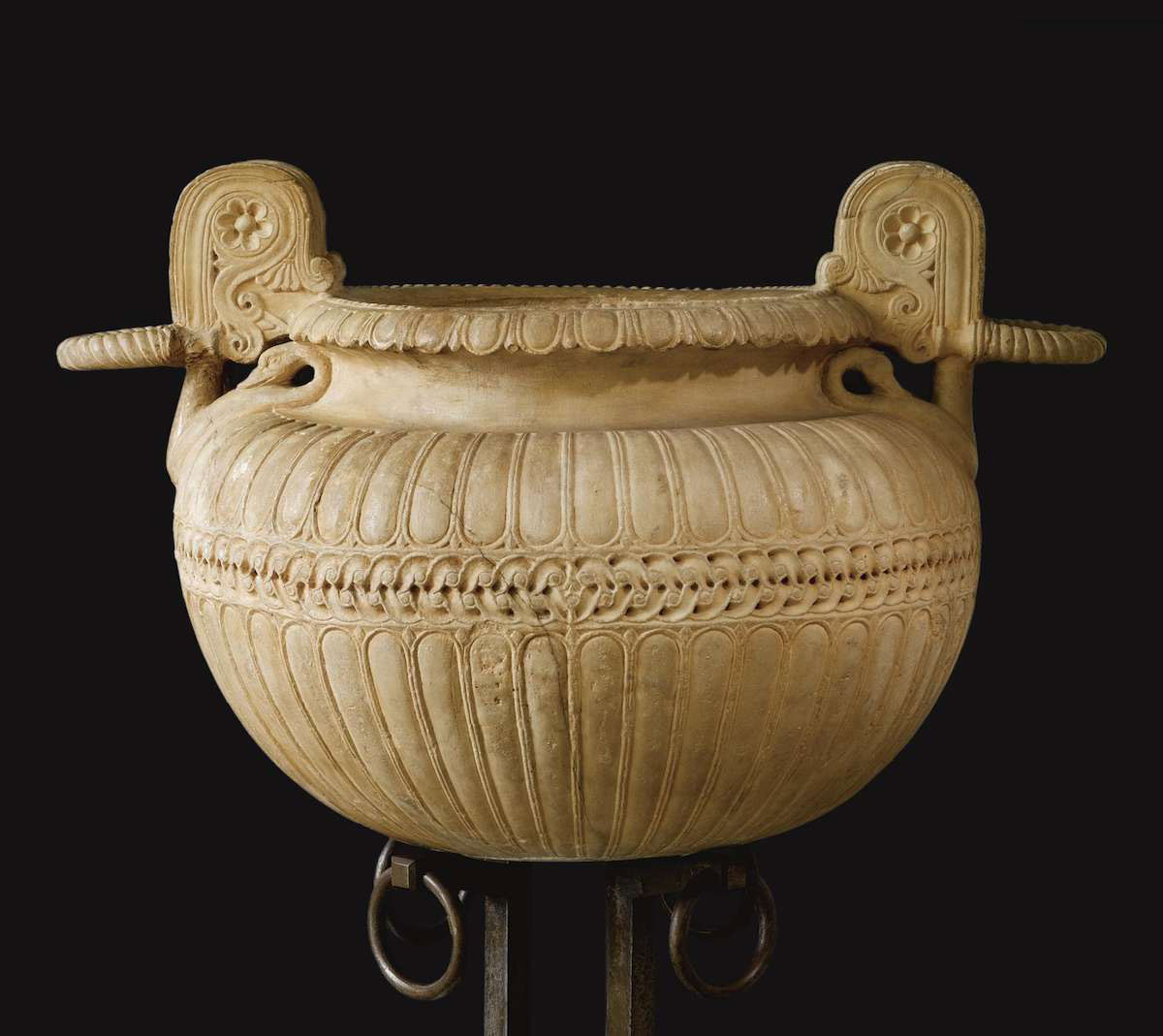
On coins and gems, scale alone does not explain why figural decoration on vessels is not shown: these same objects record minute details of ornate hoplite equipment, particularly in the wake of Pheidias’s chryselephantine Athena Parthenos.Footnote20 Perhaps the most detailed glyptic example is the rather later intaglio in Rome signed by Aspasios that conscientiously reproduces the helmet of the Parthenos, but similar detail occurs on an earlier carnelian cameo of Perseus of Macedon, now in Paris, in which a centauromachy decorates his helmet.Footnote21 On coins, helmets with elaborate figural decoration first appear on late fifth-century staters of Heraclea (continuing through the fourth century), and on gold twenty-litra coins of Camarina; and, through the fourth century, on staters of Thurium, distaters of Metapontum, and later didrachms of Hyele.Footnote22 Representations of shield devices are encountered on staters minted in late fourth-century Taranto (depicting Pegasos) and Opuntian Locris (griffin); and on didrachms in early third-century Epirus under Pyrrhus (Gorgoneion).Footnote23
This wealth of figurally decorated armor recorded on gems and coins contrasts markedly with contemporary representations of metal vessels in the same media. Archaic and Classical glyptic representations of kantharoi clearly depict metal rather than ceramic vessels, as we know from the treatment of the handles and also from the aristocratic clientele they were made for.Footnote24 Nevertheless, almost all of these vessels are represented as entirely plain. Just occasionally, as on the beaded rim of the kantharos held by a satyr and the krater that stands beside it on a famous scarab in London, some understated surface elaboration is suggested.Footnote25 An Archaic glyptic representation of a hydria with reeding or tongues on the shoulder, and a Classical version of a calyx-krater with reeded body are preserved; but not, to my knowledge, vessels with figural decoration.Footnote26
A similar picture emerges in numismatics. The amphorai on Archaic coins from Athens, Chios, Terone, and of unknown Macedonian mint are naturally plain, being “transport” amphorai.Footnote27 Yet so too are the many kantharoi depicted, most famously on early fifth-century staters of Naxos.Footnote28 As with the gems, the only decoration accorded to vessels on coins is reeding, as for example on the shoulders of volute-kraters on fourth-century hemidrachms minted in Lamia and staters minted in Thebes.Footnote29 As Barr-Sharrar has noted, these compare well with the shoulder tongues on the Derveni krater and those of an early Apulian volute-krater by the Painter of the Birth of Dionysos in Ruvo.Footnote30
Images on coins and gems, therefore, suggest that metal vessels were either plain or only partially decorated with pattern-work such as reeding. The terracotta plaques from Locri would tend to confirm this.Footnote31 Three types depict a variety of vessels together. On one, in which Persephone returns folded cloth to a chest, a plain lekythos and kantharos are shown hanging from pegs.Footnote32 A second type shows a table or cupboard on which stand four vessels: two plain alabastra, a plain pointed oinochoe, and a larger oinochoe with beaded rim, shoulder tongues, and tongues or rays at the foot.Footnote33 A third type, with two women, one enthroned, depicts two phialai and a hydria hanging from pegs, while the seated woman holds a deep bowl. The bodies of all are reeded or, for the phialai, articulated with lobes.Footnote34
Evidence for the appearance of major figural decoration on metal vessels from representations on vase paintings is more complex, but it, too, strongly suggests its rarity.Footnote35 Plentiful representations of vessels, sometimes washed in dilute glaze to approximate the appearance of polished metal, clearly depict these vases. The bail-handled amphora drawn in the tondo of a cup by Douris in New York (fig. 26.8) is clearly metal because the mechanism for the swinging handle is carefully drawn.Footnote36 The hydriai carried as part of the Ransom of Hektor on the Brygos Painter’s skyphos in Vienna furnishes another example.Footnote37 Like surviving examples, the ones drawn are plain.
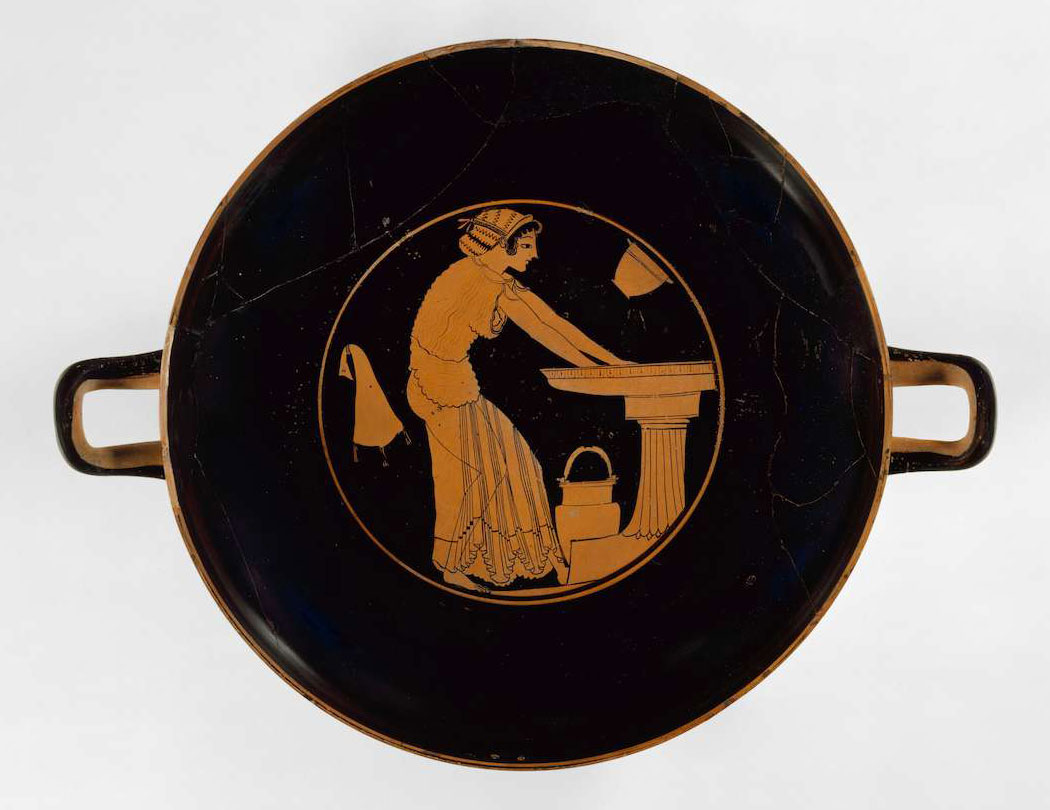
There is also, however, an important series of images of vases on vases that do bear figural decoration. These are essentially confined in the sixth and fifth centuries to Attic black- and red-figure vases, and proliferate during the fourth century in Apulia. Dirk Oenbrink has compiled a list of around forty Attic examples, a number that, by comparison with the representations of plain vases, is almost insignificant.Footnote38 Among many observations possible, two are pertinent. First, most such images appear in the late fifth and fourth centuries, a time when evidence exists for greater decorative elaboration on works of art in general. Second, while each example is unto itself, nevertheless several of them clearly reference ceramic rather than metal vases. Heading the list are the magnificent mid-sixth-century column-krater fragments in New York with the Return of Hephaistos, where maenads and satyrs fill two volute-kraters with wine.Footnote39 Mary Moore has rightly argued that the ivy on the handles, the rays at the base, and the animal fight on one of them that compares so well with other black-figure kraters, all suggest the artist had ceramic rather than metal vases in mind.
The practice of reeding for toreutic vessels must, by contrast, have been widespread. We have already encountered it on the shoulder tongues of the Derveni krater, and in representations of vessels on coins, gems, terracottas, and even vase paintings. The technique spread to black-glazed pottery during the second quarter of the fifth century.Footnote40 Although most common on small mugs, it is also found on larger vessels, especially hydriai but also on volute-kraters, not only black-glazed but also red-figure.Footnote41 The Parthenon inventories record a golden oinochoe in this technique.Footnote42 Brian Shefton rightly observed that the rising popularity of reeding may reflect emulation of Achaemenid metalwork,Footnote43 but the practice may also follow natural diversification of pattern-work accorded to that most sacred of shapes, the phiale, which can be traced back into the seventh century.Footnote44
The limited evidence for surviving vessels similarly conceived with major relief friezes, like the Derveni krater, begins with the famous fragment of a late fifth-century cast calyx-krater with maenads in Berlin published by Wolfgang Züchner.Footnote45 To this may be added a few cast statuettes of seated figures that may once have formed parts of kraters like that from Derveni, and an ancient plaster cast from something similar found at the Athenian Agora,Footnote46 with the important proviso that they may or may not have been quite as elaborate.Footnote47 Doubtless more common, being much smaller, were decorated situlae.Footnote48 Yet even here the preponderance of surviving examples suggests that, in general, only small areas of the body at the handles were decorated, whether with figures or simply with palmettes associated with handle attachments. Situlae with larger friezes wrapping around the (upper) body would appear to have been much less common.Footnote49 More recently, a spectacular bronze neck-amphora has come to light at Parion in the Troad. The body is decorated in relief with a Dionysian thiasos, while large plaques below the handles (their placement recalling hydriai) show Eros.Footnote50
A major source of late fifth- and fourth-century evidence must finally be acknowledged: the ceramic vases with figural decoration in relief spread over large surfaces of the body, made in Athenian workshops of the late fifth and fourth centuries. One such is the hydria by the Painter of the Wedding Procession depicting the struggle between Athena and Poseidon for Attica, familiar most recently from Beth Cohen’s marvelous exhibition at the Getty, The Colors of Clay.Footnote51 In light of the evidence for the rarity of what these ceramic versions appear to be emulating, perhaps we should think of them in terms that include elements of wishful fantasy as well as actual imitation.
This paper has argued for a conscious distinction between the generally restrained appearance of Archaic and Classical Greek bronze tableware and the exuberant decoration of contemporary armor. Symposiast and hoplite are, of course, one and the same person: a sort of ancient commonplace for Dr. Jekyll and Mr. Hyde. It remains to advance some explanation for this phenomenon. Elaborate armor, I suggest, would seem consciously to emulate the legendary examples starting with the most famous of all, the set made by Hephaistos at the request of Thetis for Achilles in the Iliad.Footnote52 Such literary descriptions continue via the Shield of Herakles described by Pseudo-Hesiod, to those Aeschylus bestowed upon the shield devices carried by the Seven who fought against Thebes.Footnote53 With these literary descriptions go both surviving examples and representations or derivations of others, not least the Pheidian Shield of Athena Parthenos, that are nothing less than spectacular.Footnote54 Taken together, they make it clear that the Homeric (heroic) vision for going into battle armed with glorious metalwork was very much alive in Archaic and Classical Greece.
In contrast to the epic taste for supremely elaborate armor, the Homeric vision for tableware is notably plain. Many vessels are mentioned in the two epics, but only one is described at any length, the Cup of Nestor.Footnote55 Of that cup’s decoration, we learn only that it was beautifully wrought, that it was set with golden nails (rivets), that it had four handles, and that around these handles were fashioned two doves of gold, feeding. In other words, the vessel had a plain body, the decoration was confined to the handles, or near them, and the parts were assembled with rivets. This is precisely the character of bronze vessels of the Archaic and Classical periods that we have seen.
Archaic and Classical bronze vessels circulated in an intellectual climate in which the act of conferring a highly polished surface to the metal was probably more prized than its elaboration: the very gleam of polished metal rendered it intrinsically godlike. In the end, however, it was perhaps not a simple aesthetic preference for plain bronze vessels that was the driving force among Greek bronzesmiths and their customers, nor yet a desire to distinguish the appearance of armor from that of tableware, but rather the forces of raw economic reality. As Demaratus is quoted as saying to Xerxes, it was poverty that was native to Greece: “τῇ Ἑλλάδι πενίη αἰει κοτε συντροφός ἐστι.”Footnote56 An Athenian inscription, concerned with commissioning cult statues of Athena and Hephaistos for the Hephaisteion in 421/420 BC, records the price of tin and copper as 230 and 35 drachmae per talent (a talent weighing 25.86 kg or 57 lb.).Footnote57 Put another way, a silver tetradrachm would purchase 448 grams of tin or 2,956 grams of copper. Very approximately, therefore, the cost of the raw materials—that is, the bullion value—of the Derveni krater, which weighs 40 kilograms (88 lb.) and contains 14.88 percent tin, would be 53.14 drachmae for the tin and 46 for the copper.Footnote58 To this must be added provision for silver elements like the wreaths (possibly as much as 40 drachmae?), for a total of more than 140 drachmae for the materials alone. A second inscription, recording accounts for the Erechtheum, indicates that craftsmen in Late Classical Athens were paid one drachma per day.Footnote59 The estimate reported by Barr-Sharrar that the Derveni krater “could well have taken five or six artisans, working together, more than eighteen months to produce,”Footnote60 implies potentially staggering costs for the actual workmanship, something conceivably in the order of 3,000 drachmae. Although this estimate to my mind is greatly exaggerated, it presupposes that the labor costs alone for the Derveni krater could have purchased sufficient silver to make three full-size hydriai of the types mentioned in the Parthenon inventories.Footnote61 Since these labor costs were completely unrecoverable in the frequent emergency situations that precipitated the melting down of metal plate, they must have struck many Greeks as an irresponsible and even profligate use of precious resources.
The impression that the sheer opulence of the Derveni krater is in some ways conceptually un-Greek may be refined by considering the findspots of the most elaborately decorated bronze vessels of the time. The Berlin krater with maenads was found in the northern Caucasus as part of the “Maikop Treasure.” The Athenian red-figure vases with relief were made largely for export to the Black Sea or Italy; the situlae for the most part come from northern Greece and Thrace, the new neck-amphora came from the Troad, while the Derveni krater itself was inscribed for one Aristouneios who came from Larisa. Common to these regions is a greater depth of wealth than one would find in Greece itself. In such places, the resources could be found to expend enormous, irrevocable sums on tableware for the purpose of display.