



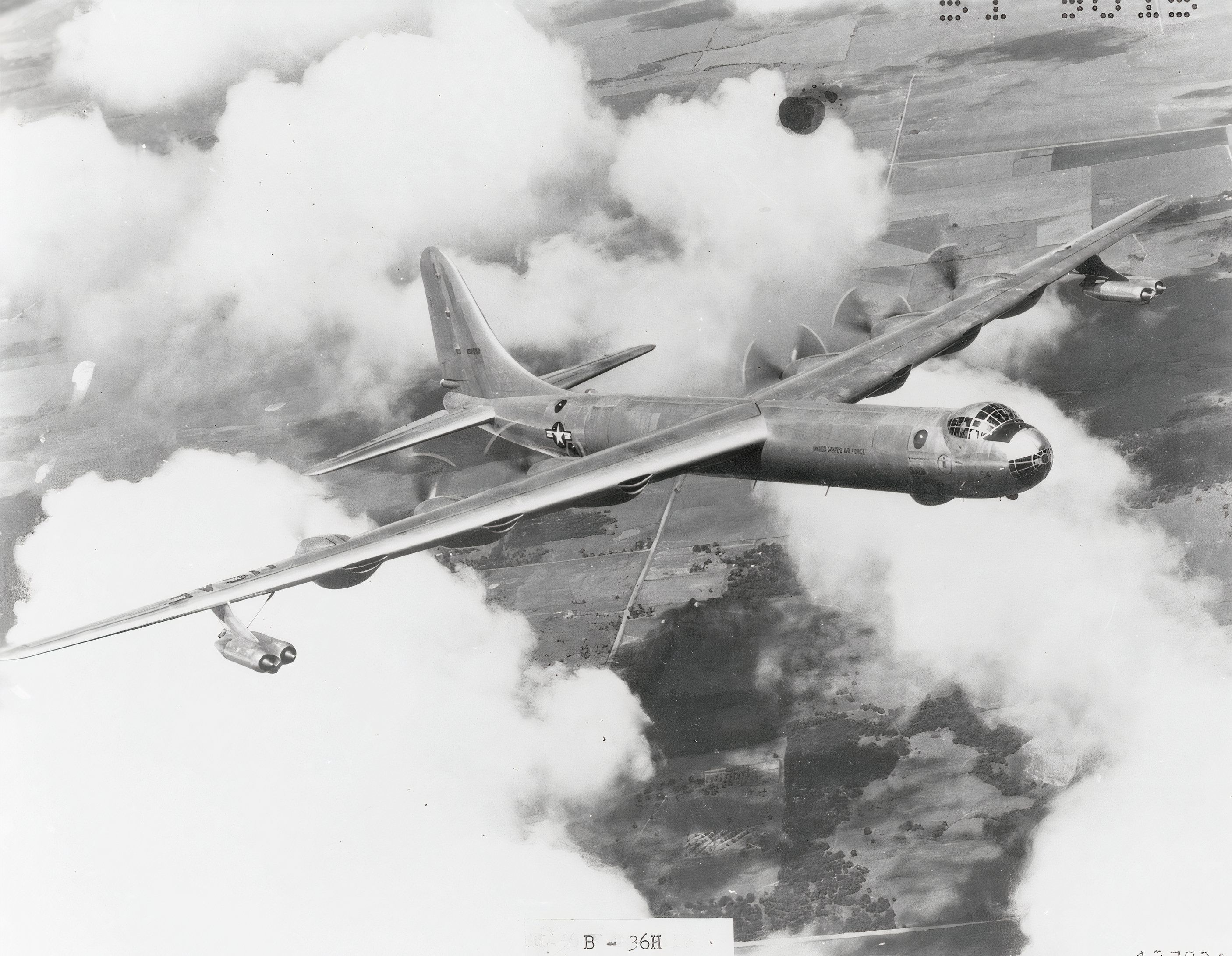
The B-36 was the largest combat aircraft ever designed and fielded by the United States Air Force . While it entered into service too late to be pressed into service during World War II, it none-the-less played an initial and important role during the outset of the Cold War.
Blitzkrieg and the potential need for an intercontinental bomber
The origins of the Convair B-36 strategic bomber were set prior to the official U.S. involvement in World War II. The year was 1940. At that point, U.S. military planners had their gaze fixed across the Atlantic on the European continent. This gaze was specifically focused on the massive success and combat prowess of the German military, which by that point had subsumed much of Europe.
If the German military could successfully conquer the island, any future forward basing options needed by the U.S. military to confront Germany would be off the table.
By July 16, 1940, Hitler issued Führer Directive No. 16, setting in motion the preparations for an invasion of England. At this same time, the Battle of Britain was underway with the purpose of destroying the Royal Air Force, bringing the English leadership to terms and demoralizing the population of Great Britain. If the German military could successfully conquer the island, any future forward-basing options needed by the U.S. military to confront Germany would be off the table.

It was against this backdrop, and by 1941, that U.S. military planners began looking into the possibility of a strategic bomber that could take off from air bases in the U.S., hit targets in Europe and return to its state-side bases.
The competition to build the first intercontinental bomber
For this reason, the U.S Army Air Corps (USAAC) announced a design competition for such a bomber on April 11, 1941, just eight months before the attack on Pearl Harbor. The USSAC requested an aircraft that had a maximum speed between 300 to 400 mph, a ceiling of 45,000 feet and a maximum range of 12,000 miles. Additionally, the USAAC desired the prospective bomber to be capable of operating from a 5,000 –foot runway.

Convair, based in San Diego won the contract. However, with a focus on the production and heavy use of the B-24 Liberator and B-29 Superfortress, coupled with the pace of the Pacific campaign, the B-36 never saw action in World War II. While this surely was disappointing to its project managers and engineers, the B-36 would still have a role to play in the post war period.
The Navy tried to scuttle the B-36 program!!! An anonymously written document, ostensibly without the knowledge of their superiors, detailed 55 serious accusations against the development of the B-36 and its proponents. The document was traced to the Office of the Secretary of the Navy and, finally, to Cedric R. Worth, an assistant to the Undersecretary of the Navy. Worth finally admitted that he had largely made up the accusations.
Europe was in ruins and the Soviets were on the move
Following the defeat of Hitler’s Third Reich, the Moscow was quick to consolidate its gains in East Europe. From north to south, the dividing line between east and West Europe was East Germany, Czechoslovakia, Hungary and Yugoslavia, this became known as the Iron Curtain. It appeared that the Soviet military would not stop but would continue, and their presence was palpable, and the fear was real.
According to Melvyn Leffler, an American professor and historian, “It was estimated during the winter of 1946-47 that the Soviets could mobilize six million troops in thirty days and twelve million in six months, providing sufficient manpower to overrun all important parts of Eurasia.”
The B-36 “Peacemaker” and Cold War deterrence
With its first flight on August 8, 1946, the B-36 was just in time for the Cold War, with a payload of 87,200 lb. and nuclear capable. With regard to the nuclear capability of the B-36, General Christopher S. Adams Jr. (USAF Ret.) and former B-36 and B-52 pilot, recalled that “some of the bomb bay systems were modified to carry the MK-17 thermonuclear bomb, the largest ever developed. It weighed 42,000 lbs. and measured 24½ feet in length.”
…with its deterrent capability, Russian military ambitions and possible campaign plans would have to take into account that any B-36 could theoretically launch a nuclear strike…
With regard to deterrence, and with a select number of the B-36 fleet modified to carry the Mk-19, the Russian military planners would have had to assume that the entire fleet had this capability, as they would not have know which planes were specifically retrofitted to carry the MK-19.
Thus, with its deterrent capability, Russian military ambitions and possible campaign plans would have to take into account that any B-36 could theoretically launch a nuclear strike or counterstrike on their military directly or military infrastructure (counterforce targets) or civilian targets (countervalue targets).
| Technical Notes | Numerical Data |
|---|---|
| Maximum speed | 435 mph |
| Cruising speed | 230 mph |
| Range | 10,000 miles |
| Ceiling | 45,700 ft |
| Wingspan | 230 ft. |
| Length | 162 ft. 1 in. |
| Height | 46 ft. 9 in. |
| Weight | 410,000 lbs. (loaded) |
Keeping the Soviet military leadership up at night and speaking to the B-36’s operational rage, General Adams stated, in 1949, a B-36 crew:
“set a long-distance record of 9,600 miles. The B-36 covered the distance in 43 hours, 37 minutes. Recalling these “feats” of aerial accomplishment brought the fond memory of a nonstop flight from Guam to Biggs AFB, Texas, my crew made in 1955. That trip took 34 hours, 40 minutes”.
What was it like to fly the “Beast”?
B-36 Crews affectionately called the B-36 the “Beast”, given its gargantuan size, and its record as the largest combat aircraft ever built. General Adams recalled that “engine start” would require 45 minutes before the scheduled takeoff time. About flying the B-36 he notes:
“Takeoffs in the B-36 were extremely pleasant and smooth. The power of the six pusher engines and the four jets provided all the thrust necessary to launch the airplane at any gross weight. For its size, it also handled extremely well in turns and during climb-out; its control pressures were exceptionally light. Likewise, both approach and landing were very straightforward and fun—under most conditions! Cross winds constituted the obvious exception, given the B-36’s wide wing spread and tall tail”.

“The B-36 couldn’t “sneak up” on anyone, it sounded like a flight of bass-throated bumblebees about to attack and projecting its noise miles ahead and behind.” – General Christopher S. Adams Jr.
From General Adams recollection, the pilots sat 70 feet forward of the main landing gear, giving them excellent visibility. While taxiing, it was a constant exercise to scan 180 degrees and at least 250 wide to ensure that the area was clear to safely move the “beast”.
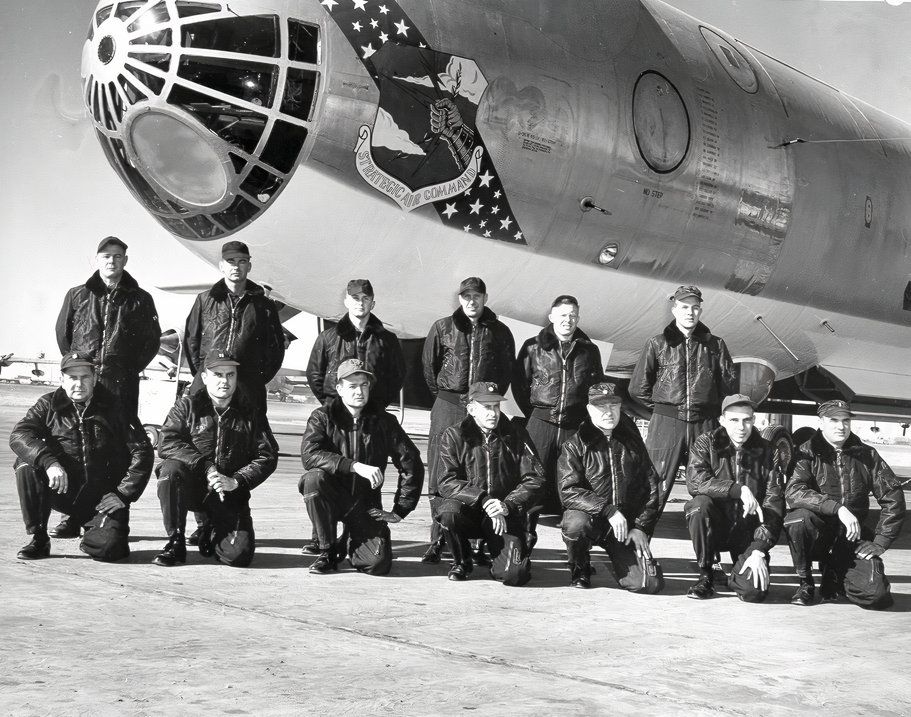
As for landing General Adams states that “the final approach was usually at about 125 MPH, with touchdown at 100 MPH for a smooth landing. Even with the cockpit “floating” at 40 feet above the ground at touchdown, visibility and control were excellent.”
That’s a wrap: The final details about the “Beast”
With its initial deployment in 1949 and its operational retirement in 1959, it had a short service life of just 10 years. A total of 358 B-36’s were manufactured, of this number, only four survived the scrapping process. The final flight of the B-36 was the model B-36J (No. 52-2220), it was flown from Davis-Monthan Air Force Base to the National Museum of the United States Air Force at Wright-Patterson Air Force Base, Ohio, on April 30, 1959.
While the B-36 project was given the infamous moniker of the “Billion Dollar Blunder”, due to issues surrounding the program’s initial testing, development and service costs, and the Navy was all too willing to rub that in.

Despite the issues, what the B-36 program did do, was deliver a long-range, ready-made, deterrent capability at the precise moment when U.S. military planners need one. Which happened to be just after the close of World War II, and the onset of the Cold War. With the B-36, the Air Force could deliver nuclear weapons deep into Soviet territory, at a height that anti-aircraft artillery could not touch.
…By 1959, the Navy was able to deploy its first ballistic missile submarine …and the first nuclear missile silos became operational..
What is more, the B-36 covered the ten-year gap between 1949 and 1959. During that time frame, the U.S. military did not have a complete nuclear triad (land, sea and air deployed nuclear weapons), infact, it only had one leg. By 1959, the Navy was able to deploy its first ballistic missile submarine (the USS George Washington: SSBN-598), and the first nuclear missile silos became operational (containing the Atlas nuclear missile). These assets completed the U.S. nuclear triad and filled out the U.S. military’s nuclear deterrence requirements.
While the B-36 had a relatively short service life, it did serve the great mission of deterrence at the beginning of the long and uncertain years of the Cold War.