



History:
The Sd.Kfz. 124 Wespe (German for “Wasp”), also known as Leichte Feldhaubitze 18/2 auf Fahrgestell Panzerkampfwagen II (Sf.) (“Light field howitzer 18 on Panzer II chassis (self-propelled)”), is a German self-propelled gun developed and used during the Second World War. It was based on a modified Panzer II chassis.
 |
| PzKpfw. II Ausf. F in The Tank Museum – Bovington |
During the Battle of France in 1940 it became apparent that the intermediate tank of the German forces, the Panzer II, was unsuitable as a main battle tank. Though mechanically sound, it was both under-gunned and under-armoured. The chassis, however, proved serviceable for providing mobility to the 10.5cm field howitzer. Existing chassis were converted to self-propelled artillery vehicles, such as the Marder II conversion providing mobility to the PaK 40/7.5 cm anti-tank gun.
 |
| Marder II 7.5 cm PaK.40/2 auf Fahrgestell Pz.Kpfw.II Ausf.A-F (Sf) – SdKfz131 Kubinka Museum |
The design for the Wespe was produced by Alkett, based on the Panzer II Ausf. F chassis. Alkett had earlier worked with Alfred Becker to convert captured French armoured vehicles into self-propelled artillery carriers. Among other modifications the Panzer II’s engine was moved forward and the chassis slightly lengthened to accommodate the rear-mounted 10.5 cm leFH 18 howitzer.


The superstructure was lightly armored, with 10 mm armor plate (enough to stop small arms fire) left open at the top and rear. The vehicles were produced by FAMO’s Ursus plant in Warsaw.
 |
| 10,5cm Leichte Feldhaubitze 18-2 auf Fahrgestell Panzerkampfwagen II Sf. Wespe Sd.Kfz.124 – Musée des Blindés – Saumur |
The Wespe was in production from February 1943 until June 1944, when Soviet forces approached the frontier.
 |
| A knocked out Wespe being inspected by a American soldier Normandy, France – 1944 |
 |
| Wespe Sdkfz124 of the 2nd Panzer Division France, Normandy, 1944. |
By that time, 676 had been produced. An additional 159 gun-less Wespe were produced to serve as mobile artillery ammunition carriers.
 |
| Munitionsschlepper Wespe in Eastern front – 1943. Notice the flat steel plate closing the opening of the gun. |
 |
| Wespes ammo carriers (Munitionsschlepper) with “standard” Wespes 10,5cm SPH Notice the truck ammo carrier in the background Eastern front – Spring, 1944. |
 |
| Wespes ammo carriers (Munitionsschlepper) with “standard” Wespes 10,5cm SPH Notice the truck ammo carrier leading the line Eastern front – Winter, 1943. |
 |
| Wespe ammunition carrier captured by Free French fighters France, Normandy, 30th August 1944 Notice the flat plate in the vehicle’s front casemate |
 |
| A Wespe ammo carrier with winter cammo bogged in the Russian road Eastern front – 1944. |
Combat history:
The Wespe first saw combat in 1943 on the Eastern Front. It proved very successful, and Hitler ordered all Panzer II chassis production be dedicated to the Wespe alone, at the expense of other projects, including the Marder II self-propelled anti-tank gun.
 |
| Wespe waiting for a new phase in artillery fire… Eastern Front – Winter 1943. |
 |
| A battery of 3 Wespes opening fire against the Russians, “fed” by an Opel Blitz ammo carrier. Kursk – July 1943 |
 |
| Wespe wearing full winter cammo, in the Eastern front – winter, 1943. |
 |
| A posed picture of an immaculate Wespe with his smiling full crew. Eastern front – Summer, 1943. |
The vehicles were allocated to the armored artillery battalions (Panzerartillerie Abteilungen) of Panzer divisions along with heavier Hummel self-propelled artillery. The Wespe brought greater mobility to the artillery formations of the panzer divisions.
 |
| Two wrecked German self-propelled guns (Wespe and Hummel) somewhere in Germany in March 1945, victims of the guns of the 1st Belorussian Front. |
 |
| An interesting pic showing Hummels and Wespes fighting togheter… East front – 1945 |
The Wespe proved relative reliability and poor performance, but sorely needed. Like contemporary self propelled guns such as the British Sexton 25pdr. SPG and U.S. M7 Priest 105mm SPG, had inadequate overhead gun crew protection. The Wespe was a considerably smaller target than either of these allied vehicles, but it also held less ammunition given it was based on a smaller chassis chosen based upon availability given limited production capacity for larger ones.
The main deficiences observed in the Wespe were:
- The engine was too weak. Therefore, the Wespe are to slow (only one-third of the convoy speed of a motorized towed artillery). Concentrated movement of a Batterie was not possible because of continuous mechanical failures. The Wespe moved individually.
- The Wespe final drives frequently broke down while attempting to steer through the tight curves in the mountains.
- Due to overtaxing caused by the terrain, damage continuously occurred to the brakes, brake linings, and their rivets. As an example, because of these problems, only 11 out of 18 Wespe were still operational in the 3.Panzer-Grenadier-Division although this division first came into action with these vehicles for only several weeks. In the 26.Panzer-Division only two out of twelve Wespe still remained operational after four weeks in action. Three Wespe had to be blown up by the troops after they broke down during a retreat. These losses due to mechanical breakdown are especially high when one compares them to only two losses occurring due to enemy action.
- The lack of room for carrying anything in addition to the crew and ammunition in the Wespe fighting compartment is bothersome. It isn’t possible to carry along the necessary baggage for the crew such as blankets, washing kits, ration pouches, and cooking utensils. To try to compensate for this limitation in the amount of ammunition, the ammo-carrier version was a constant company of the armed version.
 |
| Wespes howitzers move through a town in southern Russia. Notice the amount of stuff in the vehicle superstructures… |
In spite of several minor weaknesses, the Wespe have proven to be successful on the Eastern Front. The Wespe has proven to be an excellent weapon on the Eastern Front.
 |
| Battery of Wespe self-propelled howitzers supporting German forces during the Battle of Kursk Eastern front – Autumn, 1943. |
 |
| A battery of Wespes ready to fire at the enemy. Look at howitzers at maximum elevation. |
 |
| A Wespe from an unknown unit with the sprocket wheel oil seal in terrible condition … Eastern front – 1943. |
 |
| Wespe “43” of the Grossdeutschland Division. Ponyri – Kursk, July 1943 |
 |
| Wespe displaying a beautiful Panzer-gray camouflage with green stripes. Notice the cammo net laying in the howitzer barrel… Easern front – 1943. |
 |
| Hallo, Greta!! A Wespe with white stripes roaring by a russian road. Eastern front, winter. 1944. |
However, it has been established that this model of the self propelled gun is not suitable for employment in the mountainous terrain in the south and middle of Italy. The troops want their old towed batteries back.
 |
| Wespe 11 in howitzer maintenance in heavy mud conditions Italy, 1944. Notice the Famo Sd.Kfz 9 18t crane doing the job… |
 |
| Wespe of the 26. Panzer-Division under howitzer maintenance… Cisterna Italy 1944 Notice the M4A2 turned and burned on the side of the road… |
Specs:


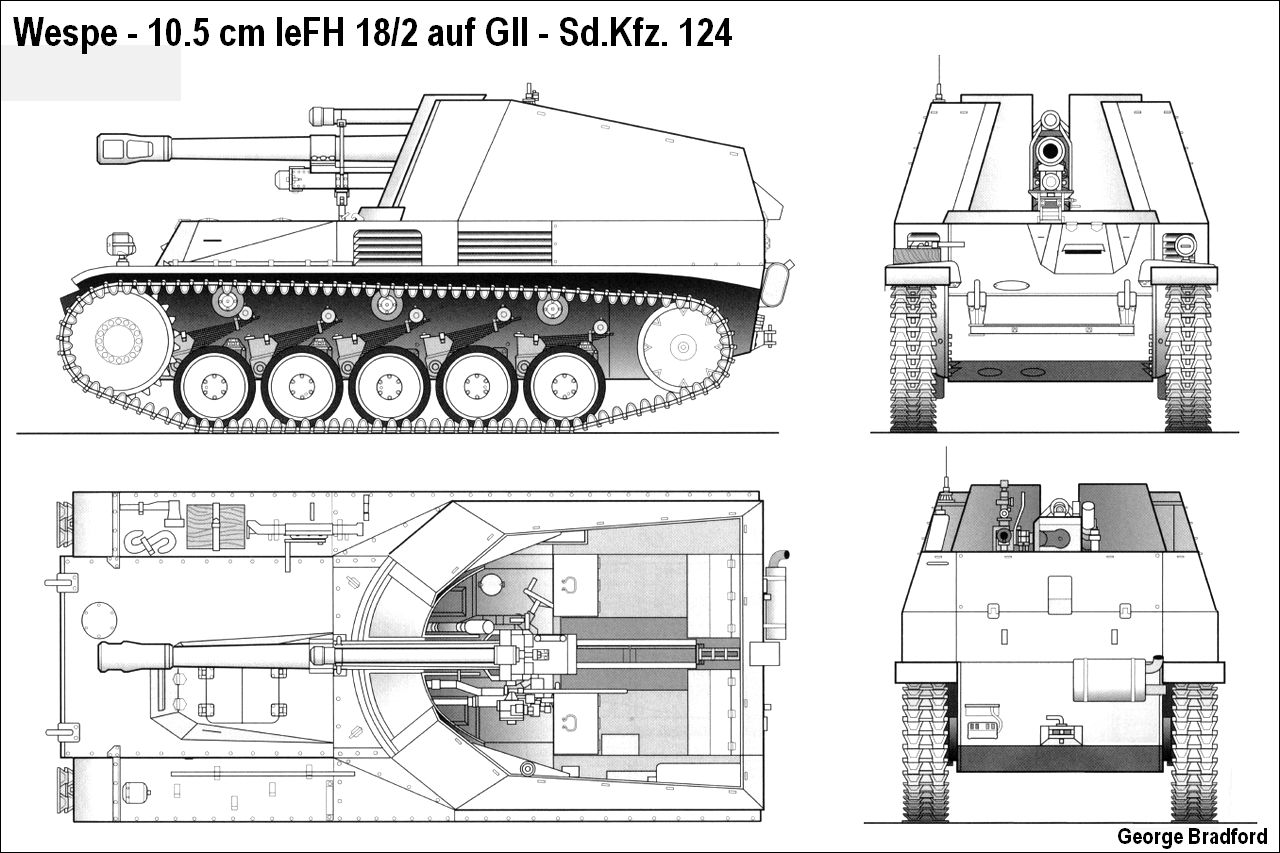


| Wespe – 10.5 cm leFH 18/2 auf GII – Sd.Kfz. 124 | |
|---|---|
| Type | Self-propelled artillery |
| Place of origin | Nazi Germany |
| Service history | |
| In service | 1943 – 1945 |
| Used by | Nazi Germany |
| Wars | World War II |
| Production history | |
| Designer | Alkett |
| Designed | 1942 |
| Manufacturer | Famo-Ursus |
| Produced | 1943 – 1944 |
| No. built | 676 (gun version) 159 (ammo carrier) |
| Variants | ammunition carrier |
| Specifications | |
| Mass | 11 tonnes |
| Length | 4.81 m |
| Width | 2.28 m |
| Height | 2.3 m |
| Crew | 5 (commander, driver, three gunners) |
|
|
|
| Armor | 5 – 30 mm |
|
Main armament
|
1x 10.5 cm leFH 18/2 L/28 with 40 rounds |
| Engine | 6-cyl petrol Maybach HL62 TR 140 PS (138 hp, 103 kW) |
| Power/weight | 12.7 PS/tonne |
| Suspension | leaf spring |
|
Operational range
|
220 km |
| Maximum speed | 40 km/h |