



The Avro Vulcan, Britain’s last home-produced bomber, was known for its incredible range and rapid speed due to strong aerodynamics, not just good esthetics. The pioneering delta wing design significantly enhanced the plane’s performance, allowing for a more efficient and stable airframe.
Additionally, the Vulcan contained state-of-the-art electronic equipment, including its radar systems, making it one of its era’s most advanced bombers. Such were its capabilities that it would even inspire the design of the famous Concorde jets.
The Delta wing design
For the Royal Air Force’s Avro Vulcan, the aircraft’s delta planform wing was vital to its performance. This design accomplished a number of significant effects:
- It was very aerodynamic to enhance speed
- It provided a lot of space for fuel tanks alongside four turbojet engines and landing gear.
- It allowed the Vulcan to take off and land without using flaps.

One should also note that the Vulcan’s long intake helped calm and focus the air incoming to the turbojets, preventing the risk of compressor stall.
Also, for maximum wing efficiency, Avro needed several wing designs. After prototype wings were found to be simplistic but also to have compressibility drag, the wing was redesigned to have a kinked and drooped leading edge developed by wind tunnels. The elimination of drag helped increase the speed of the Avro Vulcan to eventually 0.96 times the speed of sound.
Electrohydraulics for flight controls
Having electrical assistance for the pilot with a fighter-style control stick was essential for making the Avro Vulcan easy to handle. As Vintage Aircraft Echonoted in their April 20th, 2018 review, the Vulcan’s wing had four elevons on each wing.
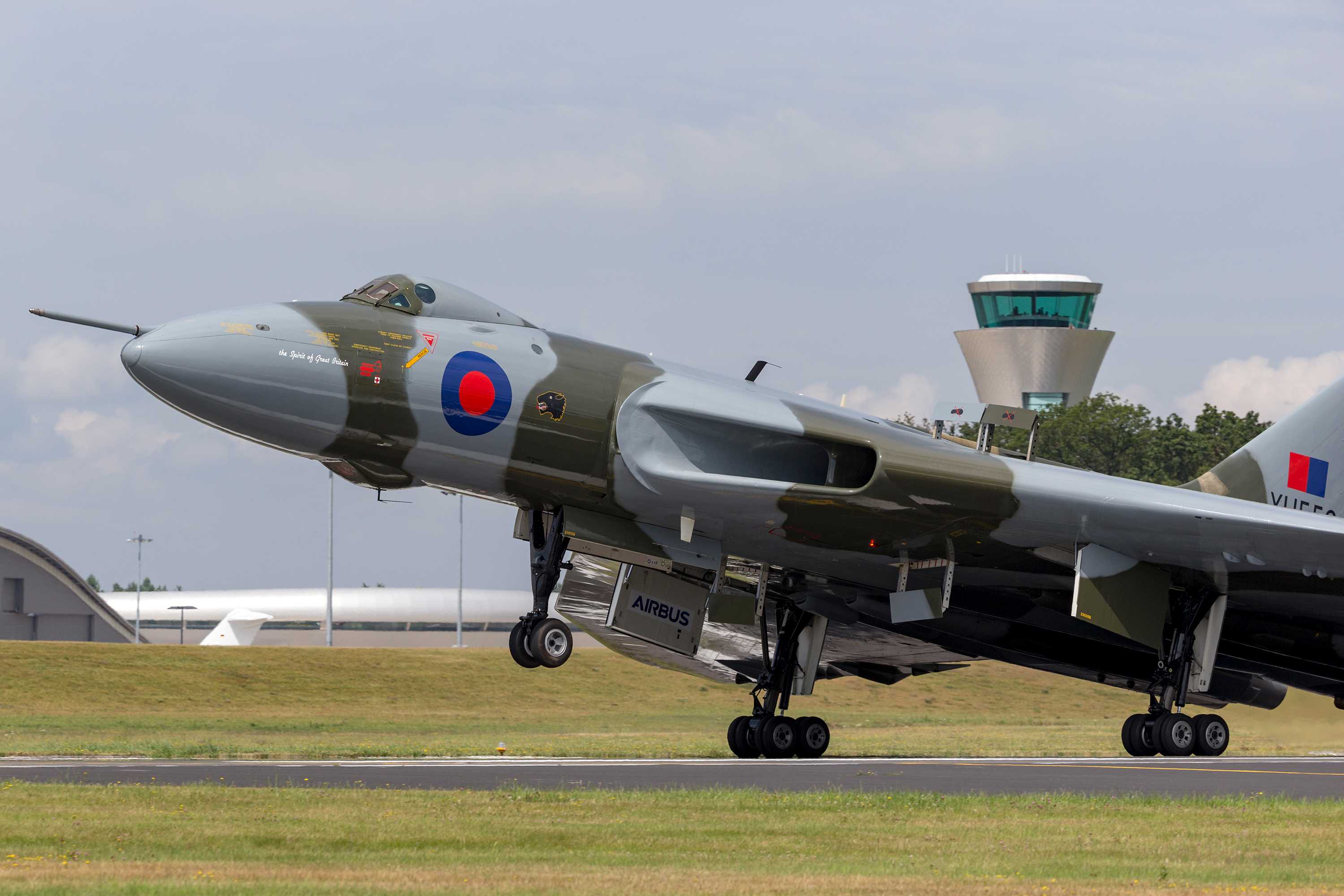
Each elevon was operated by its own electrohydraulic Powered Flying Control Unit (PFCU) to prevent a total failure of the flight control system. So, electronic signals were sent to the aircraft’s flight controls instead of having the pilots muscle it out, thereby making the aircraft easier to control at speed.
Olympus Turbojets
The four Rolls-Royce Olympus 202 engines packed 17,000 pounds of thrust each, delivering sufficient thrust to reach 45,000 feet. According to Vulcan pilot Bill Ramsey,
“In operation, we flew up to 45,000ft and fighters would come up to have a go at us – Mirages, Phantoms, Voodoos, Starfighters, Lightnings – and none of them could get up and fight a Vulcan at that altitude! We would sit there at low speed and 2g out-turning them. The high wing loading fast-jets didn’t stand a chance – we were never defeated by a solo fighter at 45,000ft!”
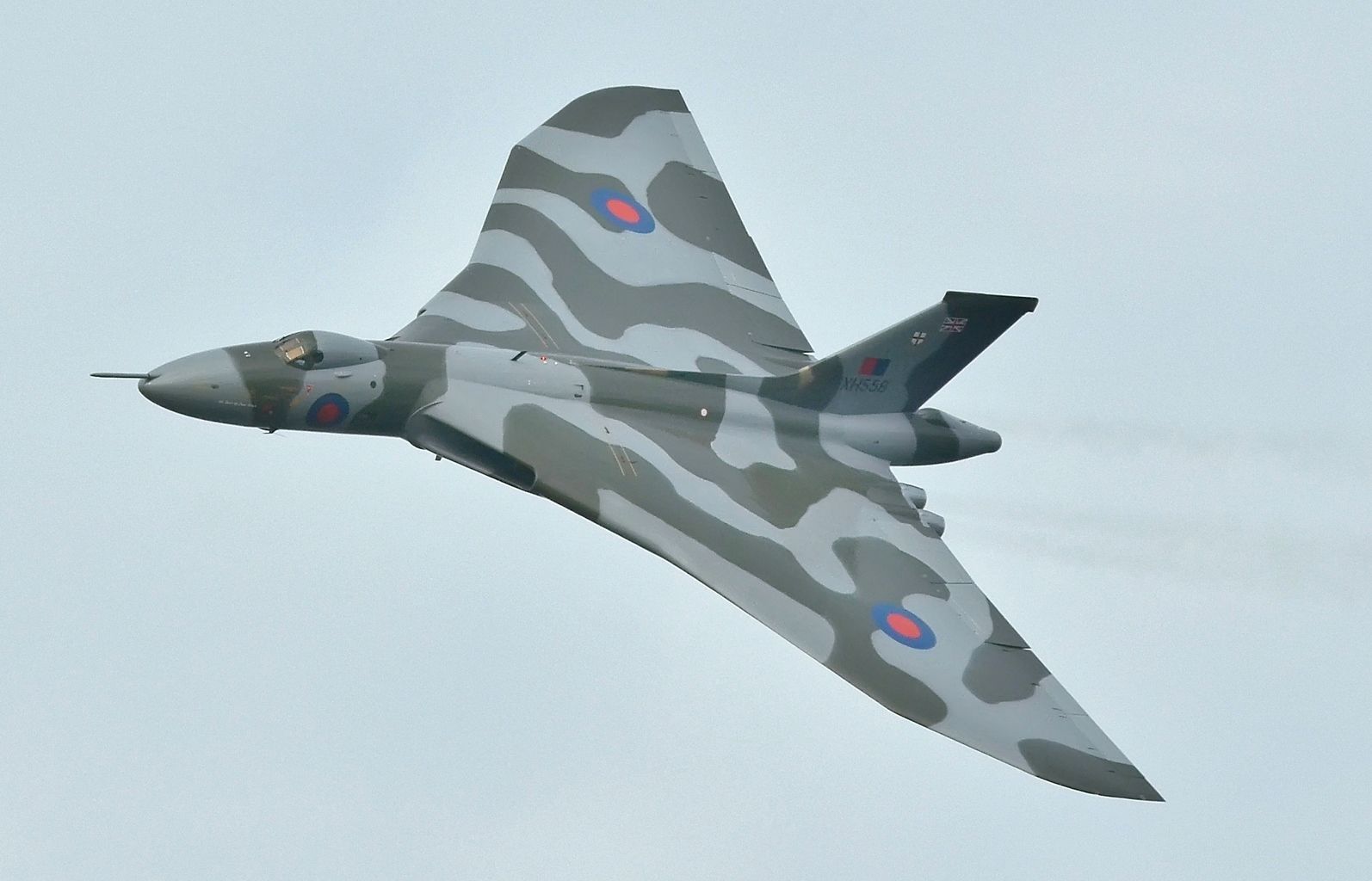 Photo: Alastair Barbour | Wikimedia Commons
Even without afterburners, the Avro Vulcan could hold its own in a dogfight, and its ability to haul fuel and fly efficiently kept the Vulcan relevant until 1984.
Help develop Concorde
One should also note that the Avro Vulcan helped develop Concorde supersonic transport in several significant ways. According to an April 10th, 2023, Key Aero report, Concorde development was able to sling a Bristol Siddeley/SNECMA Olympus 593 via the bomb bay to test the engine.
Concorde’s Olympus 593 also has some heritage with the Olympus 202 engines of the Vulcan, as does arguably the wing design, except Concorde has a high wing loading meant for less drag at supersonic speeds.
Operational history
The Vulcan formally entered service with the RAF in 1956 and spent almost three decades in active service before its retirement in 1984. Throughout the vast majority of its service life, the Vulcan was only really effective as part of the UK’s nuclear deterrent forces—however, it did see full-combat usage at one point in history.
Its long-range bombing capabilities were evident during the Falklands War in 1982, which was the Vulcan’s only combat operation throughout its service history. The aircraft was part of ‘Operation Black Buck,’ a series of British raids to damage the runway at Stanley Airport. These daring raids utilized the Vulcan’s strengths, taking off from Ascension Island around 3,400 miles away from their target.
| Engine | 4 x Bristol-Siddeley Olympus 201/301 |
| Max Speed | 644 mph (1037 km/h) |
| Range | 4,603 mi (4,000 NM / 7,408 km) |
| Capacity | 5 crew |
| Max weight | 250,000 lbs / 113,398 kg |
| Range | 4,603 mi (4,000 NM / 7,408 km) |
Bottom line
The Avro Vulcan was a leading-edge bomber that helped bring about a new wing configuration, electro-hydraulic flight controls, and good turbojets that also helped spawn Concorde. Overall, the Avro Vulcan was the pinnacle of 1950s British aviation advancement, which helped with 1960s Anglo-French aviation – not to mention creating a big winged bomber that could go Mach 0.96 and 2,607 miles (4,195 kilometers) to an altitude of 55,000 feet.