



Edward Hulton knew he was chucking money down the drain in keeping Short Sunderland G-BJHS flying, but he wasn’t about to throw away his dream. Thirty years after it left for the States, the archives of its former captain, Ken Emmott, offer some wonderful memories
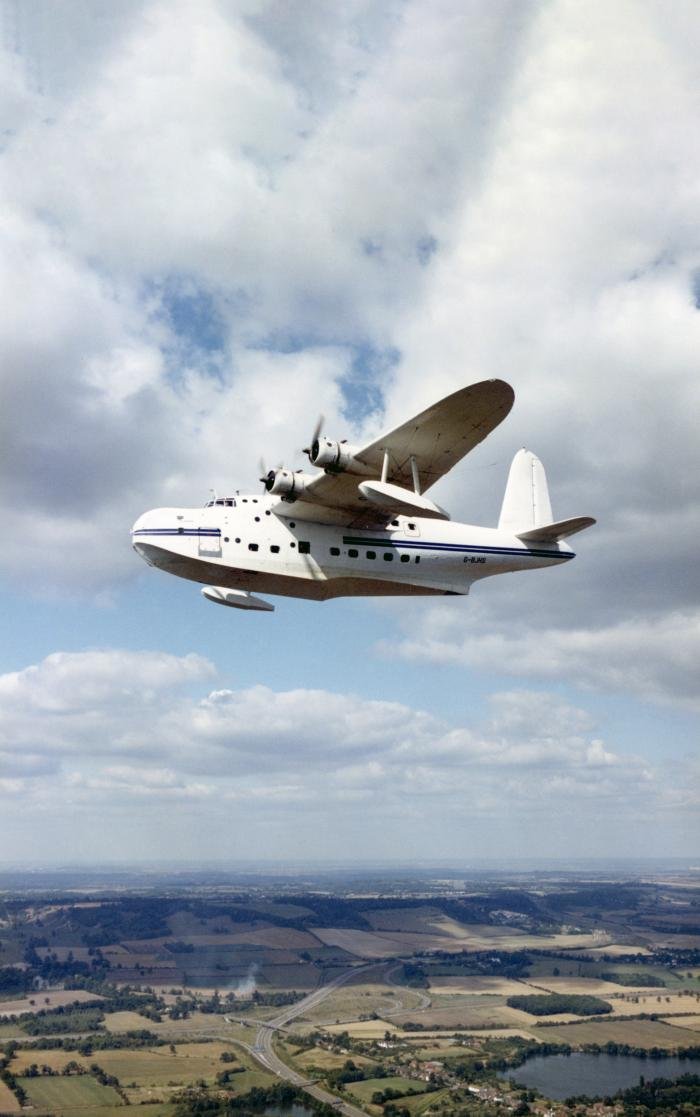
Surely it couldn’t be right. “Sunderland display and depart”, said the entry on the flying programme for 1990’s RAF Coningsby open day. Must be a misprint. No way would it turn up here. But, come the appointed time, the authoritative voice of commentator Roger Hoefling spelled it out. “Thus”, he intoned, “the Short Sunderland V”. And there it was, one of the most majestic sights imaginable in the skies, juxtaposed incongruously against the backdrop of hardened aircraft shelters and Tornado F3s as it swept low along the main runway. In those glorious days of neither needing, nor being able, to know everything due to appear at an airshow, this was just about the ultimate surprise.
The entry in the late Ken Emmott’s logbook for that date, 16 June 1990, shows one of the busier days in the air display career of Sunderland G-BJHS. Airborne with co-pilot ‘Mac’ McKinney and engineer Geoff Masterton, he took the flying boat from its Calshot base via a flyby at Southampton to the Biggin Hill Air Fair, and one of its rare full demonstrations. Flyovers of Duxford and Cambridge ensued en route to that memorable, lengthy showing at Coningsby, after which there was still the chance to fit in appearances at the RNAY Fleetlands open day, and overhead British Aerospace’s Hamble plant. It would be easy to wish there had been more such occasions, affording the chance to see G-BJHS in the skies, but then the times it did happen would have been that much less special.
Edward Hulton — heir to the Hulton picture library empire — worked wonders to keep his pride and joy flying. He did so in the face of considerable, and seemingly never-ending, challenges. Given the circumstances, it’s remarkable G-BJHS was kept running as long as it was. By now stored at Isla Grande, Puerto Rico, the machine was acquired by its new British owner during 1979. Period reports say he paid £50,000. As shown in last month’s Personal Album pages, he had it worked on there for a ferry flight to the UK. Bryan Monkton, a colourful Royal Australian Air Force veteran who had famously formed Trans Oceanic Airways with five ex-RAAF Sunderlands, was the captain. Still with the US registration N158J, the aeroplane duly alighted at Calshot on 21 May 1981. This was only the beginning.
There being a need to carry out further restoration, the Sunderland took off again three days later, bound for Marseille-Marignane. While there it was transferred to the UK register as G-BJHS. Much local expertise was on hand courtesy ex-Aéronautique Navale personnel who knew the type well. Wartime Sunderland pilot Ron Gillies — who, like Monkton, had worked for the aircraft’s previous owner Antilles Air Boats — took the controls for the return to Britain on 6 August 1982, which concluded with a landing on the Thames. Tower Bridge was opened to enable it to taxi to a mooring adjacent to the Tower of London, and there it stayed until 19 October, a tourist attraction in its own right with public visits to the interior made possible via a small boat. Then it was back to Calshot, and an uncertain future.

Moored at Tower Bridge in September 1982, about half-way through its stay there. DENIS J. CALVERT
Kept on dry land, the flying boat received more fettling, but for a long while it didn’t go anywhere. Having been beached for the whole of 1983, most of 1984 went by in a similar vein. That was until 17 November, when a 90-minute test flight was conducted by Reg Young and Ken Emmott. Even then, there were few pilots with the correct concoction of heavy multi-engine and seaplane experience, Young making the trip over from Canada where he flew Martin Mars fire-bombers. Emmott, however, came from closer to home. The Surrey resident, a Coastal Command Catalina and Liberator pilot during hostilities, started his BOAC career on its Hythe and Plymouth-class Sunderland variants, and went on to the Short Solent, DH Comet 4, Boeing 707 and 747. Recently retired after stints with Dan-Air and Zambia Airways, he could spare the time, and duly popped over to Jack Brown’s Seaplane Base in Florida for a quick water flying refresher on a Twin Bee.

The plight of G-BJHS attracted attention beyond the specialist press. Seldom did an historic aviation story find its way into Nigel Dempster’s Daily Mail gossip column, but the travails of the Sunderland’s wealthy owner were just too much to resist. According to Dempster, Edward Hulton’s wife Jill Robertson wasn’t too happy with the flying boat consuming so much of her husband’s attention. “I don’t think she’s very pleased about all this”, Hulton was quoted as saying, “but we’ve reached a point of no return”. Even so, he added, “It’s given me a lot more pleasure and interest than I could have imagined…” Apparently he planned to operate it on charters in Australia.
Winter quarters had been arranged at Chatham, a more protective environment than the Calshot slipway. Hampshire County Council had served notice to quit the site pending its redevelopment, but despite a last-minute offer to extend the lease, there was reportedly no wish to repeat the previous year’s corrosion issues caused by frost and subsequent condensation. On 20 November 1984, Young and Emmott completed a two-hour 35-minute flight, its eventual destination the historic dockyard in Kent. Dempster’s piece had dubbed the Sunderland “a flying white elephant” — now it sported just such an emblem on its tail.
To read Ken Emmott’s logbooks is to trace much of the aircraft’s history in Hulton’s hands, as from then until its departure from Britain 30 years ago, no-one else had the honour of captaining it. Under the leadership of Australian chief engineer Peter Smith, the opportunity was taken to carry out additional refurbishment with a view to the CAA granting a full certificate of airworthiness. This ensured 1985 was not wholly fallow, although its sole flight, on 29 October, ended with the number one engine shut down due to falling oil pressure. Emmott had been at the helm, with visiting New Zealander Gary Wrathall alongside. It turned out, said one report, to have been down to the failure of a main conrod bearing. With repairs effected, hopefully 1986 would bring better fortune.
It certainly brought a new co-pilot, seasoned warbird exponent Mike Searle being asked by Hulton to join the team. He had been flying the Catalina for Plane Sailing, so came suitably qualified. Two-and-a-half hours of water trials on 8 July, including high-speed runs along the River Medway, indicated the Pratt & Whitney Twin Wasp powerplants were now in good shape. G-BJHS missed a planned debut airshow appearance at Middle Wallop a few days afterwards, but hopes were high of getting out and about before the season was over. They were dashed on 18 July, sinking oil pressure on number four leading to another three-engine landing. The underlying cause was the same, put down to water in the oil.

Finding suitable reconditioned Twin Wasps wasn’t an issue. The damage wrought in the ‘great storm’ of 16 October 1987 — in an awful irony, 50 years to the day since the Sunderland prototype’s maiden flight — was. Sitting outdoors in readiness for engine runs, the hurricane dislodged G-BJHS from its beaching gear. The outer portion of the starboard wing was bent noticeably upwards after hitting the ground, while the floats and sternpost received particular damage. Prospects really didn’t look bright. The previous year, another of Nigel Dempster’s diary pieces had quoted Pete Smith as saying of Hulton, “Things have got to a stage where he is probably going to sell”. Surely this would be the final straw?
Not so. Again, Smith — who kept a tame one-eyed pigeon called Nelson — and colleagues set to. It was just as well that, as Mike Searle told the author in 2020, the Australian engineer “lived for that aeroplane. In fact, he lived on that aeroplane”. Such dedication, combined with encyclopaedic Sunderland knowledge, was worth its weight in gold. The paid workers and volunteers toiled for long days and nights in the Chatham hangar to put it right. Hulton asked the Imperial War Museum’s deputy director of Duxford, David Lee, if he could swap the repaired wingtip and its float for those the IWM had recently restored for ML796. In an excellent gesture on the part of a national museum, a deal was agreed.
Rectification took until the summer of 1989, and then there was a sudden rush. Hulton had arranged with the then fledgling Irish airline Ryanair — nothing more than a few BAC One-Elevens, Embraer Bandeirantes and HS748s in those days — to sponsor the Sunderland. The intention was to operate it with the carrier’s titles from the old flying boat base at Foynes in County Limerick, where the Flying Boat Museum was being established with the support of Guinness Peat Aviation, as well as Lough Derg on the River Shannon. Some accounts say Ryanair had ambitions to gain full public transport certification for G-BJHS and offer tours to the Nile, in the pre-war Imperial Airways mould. A far cry from selling ’em cheap and piling ’em high aboard 737s.
A test flight on 6 July brought further disappointment, with an oil leak on number three engine. It recurred during high-speed water runs a couple of days later. But once an oil seal had been fixed, Emmott and Searle were able to make an initial C of A test flight on the 20th, lasting some five-and-a-half hours and treating Manston, Lydd and Headcorn to flybys. They were up again on the 31st for just short of four hours, taking in Bournemouth, Gatwick, Cowes and Calshot. Among the documentation Emmott kept was the mock bill he received from Gatwick Airport’s maintenance division following his especially spirited pass: £20,000 “To repair of runways, namely filling in the grooves left by low flying Sunderland”, £1,500 “For treatment to shock to unspecified number of spectators”, and lastly £50, “Laundry bill for above…”

The captain’s logbook entries illustrate succinctly what went on next. He, Searle and engineer Geoff Masterton flew from Chatham to Lough Derg on 3 August, giving nine impromptu passes this time at locations from Farnham to Waterford. The 7th saw G-BJHS making a quick trip to Foynes — but the following day the Irish sojourn was cut short, the Sunderland returning from Lough Derg to Calshot. What had happened?

Speaking to this magazine at the time, Ken Emmott put it diplomatically: “Mr Hulton and Ryanair could not agree on the terms of the contract… The deal fell through”. Mike Searle remembers, “The Irish minister of transport was there — we flew him, Ryanair dignitaries and everyone else. There was a big party that night. In the middle of the party, Ken kept taking ’phone calls from Edward Hulton. He told him, ‘Bring the aeroplane home’… He had changed his mind. That was the end of that.”

But not, thankfully, of the Sunderland’s operations. Moving back to Calshot was less than ideal, Chatham, despite earlier high hopes, having fallen through as a base. Yet G-BJHS was running well, and finally had a C of A, though the carriage of paying passengers would have required significant further expense. Having conducted a flight with 24 people on board that included a display practice — you wouldn’t get away with that nowadays — at last it made an airshow, the Great Warbirds Air Display at West Malling, on 28 August. Star status was guaranteed. A formation was flown with the Catalina for Arthur Gibson’s camera, while London City and Heathrow Airports were greeted with flypasts. The start in Southampton on 2 September of the Whitbread round-the-world yacht race brought another opportunity to get airborne, taking Eric ‘Winkle’ Brown along for the ride.

It was the aeroplane’s most concerted period of activity since Hulton acquired it, and June 1990 brought more. G-BJHS flew five times that month, including the display day on the 16th with which we started this story. Another memorable trip saw the first Sunderland arrival at Lake Windermere for decades, the aircraft staying there from 28 June-17 July. “When we landed on Windermere”, says Mike Searle, “the water police came on board first and presented us with a speeding ticket amid much merriment”. That, however, was its season over. Given the cost involved, this was never a machine likely to be found pounding around shows weekend in, weekend out. Equally, little revenue was coming in.

Something had to give, and Hulton entered the Sunderland into a Sotheby’s auction on 24 September 1991. It had made a couple of recent flights, Emmott reporting its condition as “tip-top”. But in a time of recession, achieving the £450,000-500,000 catalogue estimate was always going to be a tall order. Sure enough, bidding ceased at £320,000 and G-BJHS was left unsold. A local sortie on 23 October would, it turned out, be the aircraft’s last flight under Hulton’s ownership.
American collector Kermit Weeks was, of course, its saviour. His February 1993 acquisition of the flying boat meant it would leave British shores, but find a permanent home. Personal Plane Services prepared G-BJHS for a trans-Atlantic ferry flight, and on 7 July 1993 it took to the air again, twice, Weeks joining Emmott on the flight deck. Five test and training sorties were undertaken from Calshot between then and the 16th, the last concentrating on the all-important fuel system checks. With that, all was set. The objective was Oshkosh, and pride of place at the EAA AirVenture event.
Departure had been due on 19 July, but a domestic issue for one of the crew put it back until the 20th. “The send-off from Calshot was tremendous”, wrote Ken Emmott, “with families, friends, well-wishers, old associates, and many people with tears in their eyes at the loss from the UK of such a famous aircraft. With a certain amount of difficulty, we managed to extricate ourselves from the many TV, radio, newspaper and magazine reporters, and we departed, probably for the last time, from Southampton Water. Naturally a flypast was the next thing, to say thank you to all those interested people lining the shore and jetty at Calshot.”

So many were the flypast requests, indeed, that they “were beginning to interfere with the progress of the flight”. After Pembroke Dock, no more were agreed to. Emmott recalled, “The flight to Lough Derg took four hours, buoy to buoy. Brian Cullen, of Derg Marine, had everything organised for our arrival with a flotilla of launches to escort us to our moorings, and at this point I began to become astonished at the drive and determination of our American crew member friends […] in their resourcefulness for getting the boat refuelled. Two bowser-loads of fuel had to be brought from Shannon Airport — two journeys for the driver — and it was late in the evening before this was completed, albeit at a very high price!
“Departure the next morning was normal, and uneventful. Brian Cullen took off just before us, with his wife on board, to witness our take-off and flight out. We made one pass over the base before setting course. It had been our intention to go out over Galway Bay, to get away from the hills as early as possible, but the boat was performing so well — about 50 seconds to take off, at a max newly approved permitted all-up weight of 59,000lb — and with the weather being clear over the northern part of Eire, we decided to continue on the direct track to Reykjavík.
“Unfortunately at this stage the HF/RT failed us. We were able to receive, but not to transmit, and were soon out of VHF contact. However, we were lucky to be intercepted by a Nimrod of No 120 Squadron, obviously out on Atlantic patrol, and he was so useful in transmitting our position reports to Shanwick and in getting weatherfor us.”
The crew stopped engines on Reykjavík’s expanses of water and talked to a former Catalina captain, receiving his expertise on moorings and refuelling. “Once again”, wrote Emmott, “we were fortunate in that the wind direction was such that, with what was now becoming the expertise of the Americans on the water, we were able to manoeuvre the boat nose-into a refuelling jetty, and take on board all the fuel we required — full tanks, of course! A ground radio engineer was summoned to give us some help with the HF, and all appeared to be well before we left. Pete Smith stayed on board, sleeping on board as he did throughout the whole flight to Oshkosh, while the rest of us settled into a hotel.
“From Reykjavík our next problem was the weather at Gander and Goose Bay. I really wanted both landing areas to be open for our flight, but in the end we had to settle for less. Even when Gander cleared, the weather en route across the Atlantic was poor, with low cloud and drizzle, and as the Sunderland was not equipped with wing de-icing, we were obliged to wait for an improvement. This all took no less than five days; our commitment was to be at Oshkosh in time for the first day of opening, so time was becoming important.
“On 26 July the weather generally had improved somewhat, and we left for our 10-hour flight to Goose Bay, Gander being closed for weather again. As usual, most of the flight was carried out at anything between 500ft and 1,500ft, dependent on weather. Our route was direct to a point 20 miles south of the tip of Greenland, and on making our first landfall there I must say it was quite a different experience for me, having flown the Atlantic so many times in Comets, 707s and 747s, but always at 35,000ft or so. To see Greenland at such close quarters was memorable. Even in July the sea around the coasts was full of icebergs — white tops with brilliant blue under the water…
“Departure from Goose Bay the next day was normal, but the flight across the barren territory of Labrador at 1,500ft was exceptionally bumpy, and some of the crew members were feeling queasy within a very short time. The flight to Toronto took 10 hours, and a course was set for the St Lawrence, the intention being to reconnoitre some of the seaplane bases spread along that river. This was carried out, and we noted some very interesting sites, but the weather began to deteriorate to the familiar low cloud and drizzle as we approached Quebec. Radar assistance from Quebec was excellent, and we managed to avoid the worst of the weather in that area. The aircraft was not cleared IFR, although we had an operating transponder which was useful to radar controllers, but without adequate airframe de-icing protection, and with no-one on board with a valid instrument rating — mine had lapsed some time previously, my having no further use for it, and Kermit had never had one — we were committed to VFR.
“After Quebec, the weather improved for a while, but approaching Montreal, navigation visually — by now we were down to about 400ft above the St Lawrence — became impossible, and we climbed to our safety altitude of 2,300ft and asked for radar assistance from Montreal. This was similarly excellent, and within some 20 minutes or so of dodging clouds, we were in the clear again and safely on our way in good visibility to Toronto.
“For me, the next part of the flight was even more memorable. I had previously contacted my son, Kevin, who lives with his wife and two children in Ontario, with full details of our flight, and he told me a local flying association had offered to fly a Malibu from Oshawa, their base, to Toronto Island Airport to pick up Kevin and his whole family to meet us over Oshawa Airport, and escort us into Toronto! En route I called Ottawa control, who very kindly passed our ETA in Oshawa to Oshawa tower. In the event, when we were some 50 miles east of Oshawa, I was surprised to see the Malibu flying alongside us, along with about half a dozen other sightseeing and photographic aeroplanes, and within seconds I was talking to my son on the RT…
“My thoughts at this time strayed back to 1942 when I was commissioned in the RAF, through the RCAF, at the Toronto exhibition grounds (then home to the manning pool), having just come up from completing my flying training on Catalinas with the US Navy at Pensacola, Florida. If someone at that time had told me that 51 years later I would be flying a Sunderland into Toronto, with my son and family flying alongside in a private aeroplane, they would have received the usual RAF-style response!
“Two days were spent in Toronto, resting and preparing for the flight to Oshkosh, our final destination. We planned to arrive to open the first day’s flying display and it all worked out that way. Our arrival early-afternoon on 29 July was the opening flight of the seven-day show.
“Landings and moorings were made on Lake Winnebago, again an ideal spot for flying boat operations. Here Kermit came into his own, showing tremendous initiative in organising a pontoon boat to carry tours of some 14 passengers from jetty to flying boat throughout the next seven days. Kermit himself drove the pontoon boat for most of the time! At $7 per head, the income made a tremendous contribution to the enormous cost of getting the Sunderland over to the States.”
With Emmott laid low by a cold, Weeks took the captain’s seat for the daily Oshkosh displays. The flying boat veteran was very impressed by the Sunderland’s new owner, recalling his “ability, generosity, and wonderful approach […] in what could have been a difficult situation for him and for all of us, with Kermit having just acquired the aircraft, flying with me as captain, after all my years on the aircraft. Relations were smooth throughout, Kermit took to the boat very quickly, and I have had no hesitation in stating that he is thoroughly checked out on the aircraft. Facilities were generously provided throughout the trip, all paid for by Kermit, and part of his concern at all times was to ensure that, as well as being a safe delivery flight of the boat to the United States, we should all enjoy ourselves at the same time.”
So ended Ken Emmott’s association with G-BJHS. He noted it was “an epic flight, probably the last Atlantic crossing by a large flying boat for many years to come”. In fact, it was almost the end of his career as a pilot. Very fittingly indeed, his final few trips were as co-pilot to Paul Warren-Wilson in the Plane Sailing Catalina, which he’d started flying during Sunderland ‘down-time’. The return from Loch Lomond to Duxford on 14 October 1993, following a session of water landing practice, rounded things off. And the Sunderland? Re-registered N814ML, it hasn’t flown often since heading Stateside. Having spent a year at Lake Winnebago while a seaplane ramp was built at Weeks’s Fantasy of Flight attraction at Polk City, Florida, it enjoyed a rare outing in 1996, transporting the Olympic torch from Sarasota to Miami on 4 July. When Fantasy of Flight is open, the aircraft can be viewed in its hangar.
There is, with apologies for the cliché, somehow a particularly British flavour to the spirit that kept a Sunderland flying in private hands. A BBC documentary, Edward’s Flying Boat, characterises it well. In it, Hulton’s then-new wife Caroline says, “I just think he’s so much more intelligent than spending his time tinkering with an old toy”. Often described as an eccentric, Hulton himself can be seen bemoaning the sums he was pouring into his pet project for no return. Even now, the reaction of anyone who saw it flying will be, ‘Thank goodness he did.’
